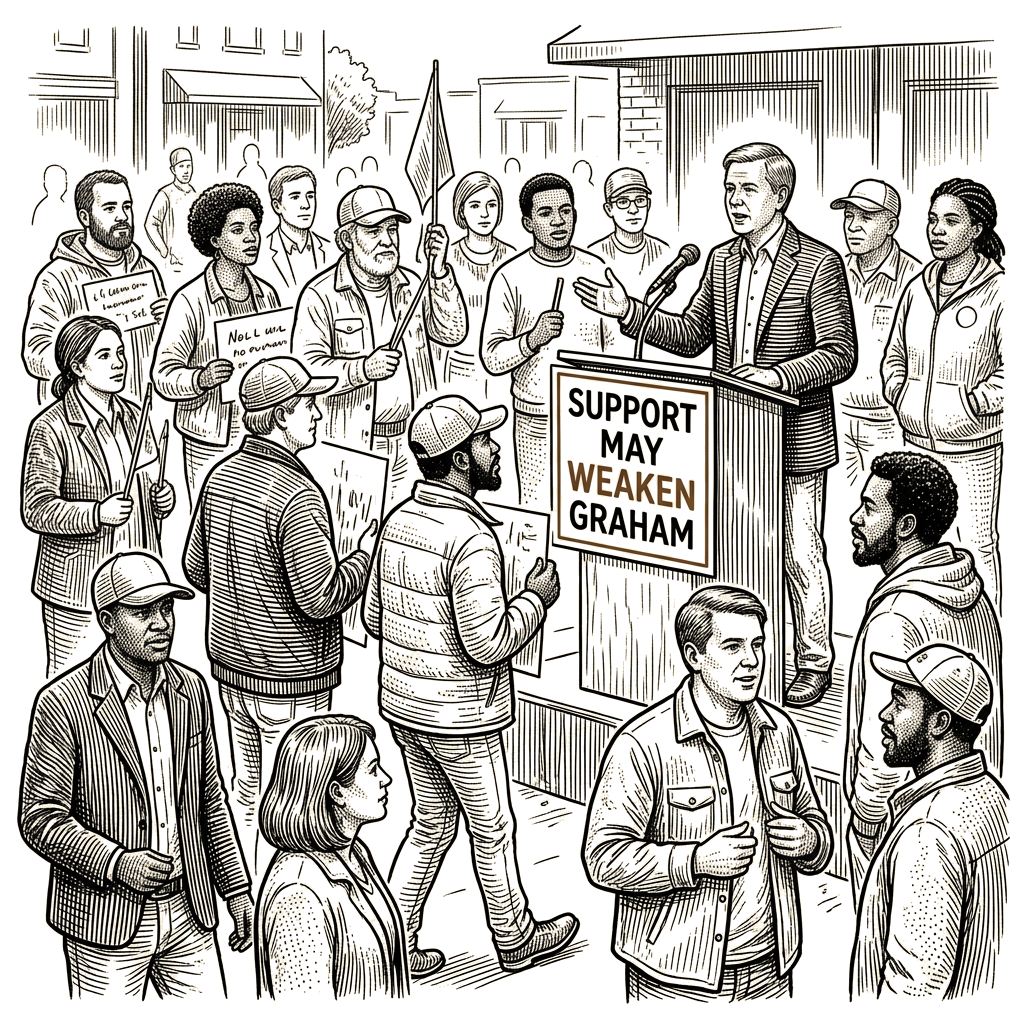
Graham and Andrews exchange barbs over qualifications and policy
The South Carolina U.S. Senate contest between Republican Darline Graham and Democrat Annie Andrews is entering its final stretch with Associated Press reporting that President Donald Trump’s backing may be eroding Graham’s support from both sides. AP said independent voters unhappy with Trump’s second term and Ralph Norman supporters on the right unhappy that the president interfered in what should be a decision left to the state’s voters were both uneasy about Graham’s inexperience and the prospect of a Graham family dynasty. An October New York Times/Siena poll appeared to show a close race, and the candidates have disputed which of them is better qualified for the seat.
In their sole debate last month, Graham and Andrews traded barbs over the economy, the war with Iran and artificial intelligence, but the exchange mostly focused on who was less qualified for the South Carolina Senate seat. Andrews came up short in a 2022 challenge to U.S. Rep. Nancy Mace but has remained visible since, though she has never held office or run statewide.
Graham rejected Andrews’ accusation that she was seeking to ride her brother’s political coattails. She said she had legally kept her maiden name to maintain a connection with both parents, who died when she was young, and added, “Thank you for bringing up a horrible, tragic memory for me.”
At a primary debate, Graham was asked whether the U.S. has a national security interest in Taiwan and the South China Sea, a longstanding contention of both Democratic and Republican administrations. She struggled to answer before admitting, “National security is not my thing.”
AP reported that six months ago the contest was expected to be a straightforward campaign for incumbent Lindsey Graham and the dominant Republican Party. Lindsey Graham’s sudden death in July and Darline Graham’s elevation from a placeholder role to seeking her own six-year term altered the candidate field; AP described her as a political neophyte. Supporters of Democrat Annie Andrews can now envision a Senate flip in one of the nation’s most reliable GOP strongholds, an outcome that seemed impossible amid double-digit Republican wins this century.
Darline Graham has acknowledged that she is a reluctant candidate and was abruptly thrust into the political spotlight when her brother died seeking a fifth term. Republican Gov. Henry McMaster appointed her to finish his term in a move AP described as widely hailed because of the siblings’ close relationship. Lindsey Graham helped raise his younger sister after their parents’ early deaths.
Graham’s decision to seek a full six-year term was more surprising. The snap primary was organized just a month after Lindsey Graham’s death and drew some of the top names in South Carolina politics.
AP reported that President Donald Trump wanted Darline Graham in the Senate and immediately and forcefully backed her. The president had feuded with her brother at times but considered Lindsey Graham an ally during his second White House term, particularly on the war with Iran. As Darline Graham and U.S. Rep. Ralph Norman, an occasional Trump critic, competed in a primary runoff, Trump campaigned for her in South Carolina and returned twice in the final weeks before the election.
Republican-affiliated groups across the country reshuffled last-minute campaign spending, while the Senate Republicans’ primary super PAC sent reinforcements to deep-red South Carolina to shore up Graham. Republicans said they remained confident that they would retain the seat.
Andrews had already been campaigning for more than a year and had won her primary outright when Lindsey Graham died, forcing her to rework a general-election plan centered on ousting the incumbent. In recent weeks, Andrews has run an independent campaign and has rarely appeared alongside prominent Democrats from South Carolina or elsewhere. She has focused on economic problems and has said Graham will be like her brother, “a part of the same Washington cabal that enriches only itself and cares little about the people back home.”
Andrews has also benefited from South Carolina’s leadoff status on Democrats’ 2028 presidential nominating calendar. Former Transportation Secretary Pete Buttigieg and Arizona Sen. Mark Kelly have visited the state, boosting Andrews’ visibility and their own.
The October New York Times/Siena poll appeared to show a close race. But polls also showed an apparently close contest in 2020, when Lindsey Graham, Democrat Jaime Harrison and outside groups supporting their campaigns spent hundreds of millions of dollars in South Carolina’s most expensive election. Graham won that reelection by a 10-percentage-point margin.
The winner would be the first woman elected to represent South Carolina in the U.S. Senate. Supporters of Andrews have predicted that she could be the first Democrat since 1998 to win a statewide race for the Senate or the governor’s office. Fritz Hollings was the last Democrat elected to a South Carolina Senate seat, winning his final term in 1998.
Republicans have held both Senate seats since Hollings’ 1998 victory, and Jim Clyburn is the state’s only Democrat in the U.S. House. Straight-ticket voting allows voters to choose all GOP candidates on their ballots. The open governor’s race has not appeared as close as the Senate contest, and Libertarian and Constitution Party candidates are also on the general-election ballot.
Collins reported from Columbia, South Carolina.