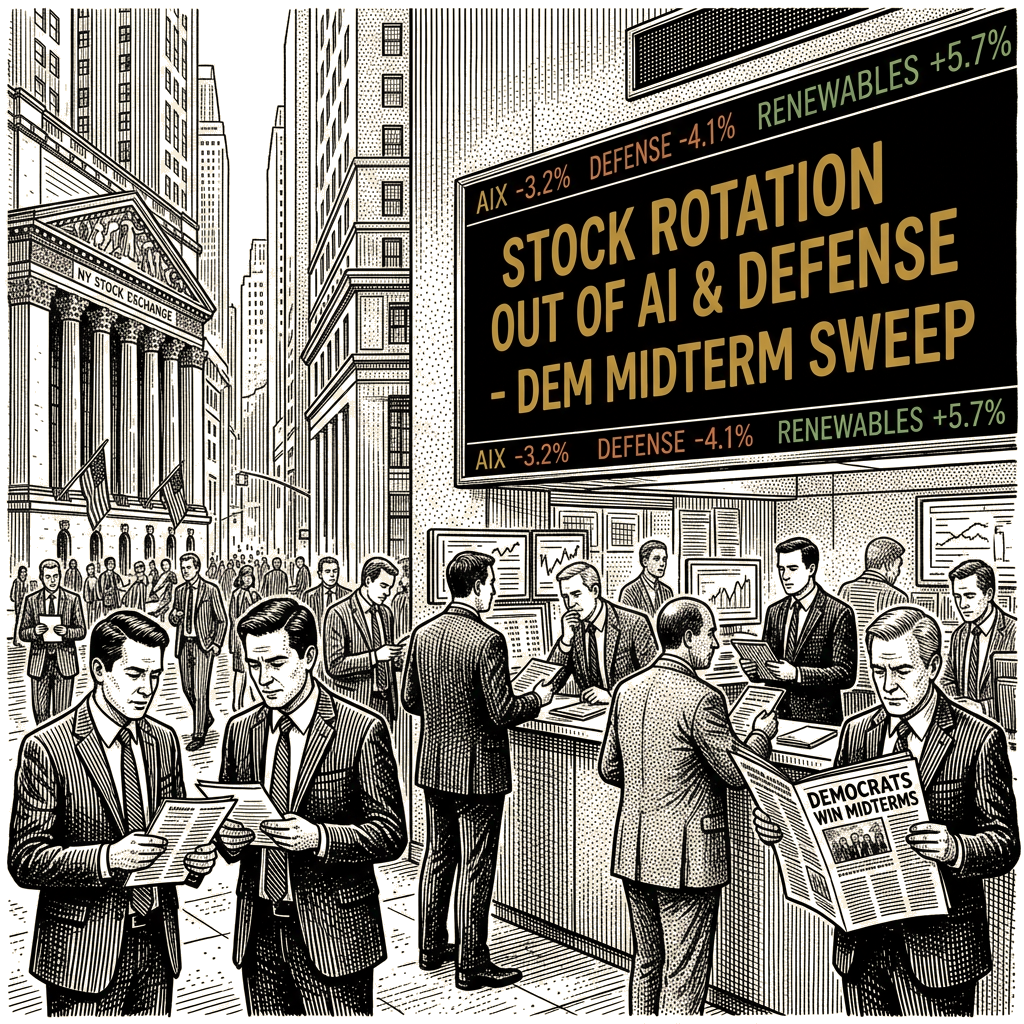
Hospitals, homebuilders and consumer staples gained as investors anticipated policy relief
Democrats’ sweeping victory in the midterm elections changed how investors priced a broad set of industries this week, according to an Associated Press report by Damian Troise. AI-linked shares saw the largest declines, defense and oil companies lost ground, and hospitals, homebuilders, alcohol companies and consumer staples gained. The S&P 500 large-cap equity index stood at 7,353.73 as of Nov. 7, according to Federal Reserve Economic Data (FRED).
Policy expectations separated technology and energy stocks
The construction of data centers to power AI had produced profits across a wide group of companies, including chip makers, power providers, cooling-system producers and cloud-computing companies. Some related stocks rose by double or more as investors increased their stakes in the buildout, but concerns grew that AI shares had become too expensive, AP reported. After Democrats swept the midterms, Nvidia, Lam Research and other AI-linked companies swung sharply this week as Democratic victories in statehouses across the country raised concern about slower construction, particularly in Texas. Hyperscalers that finance the buildout, including Amazon, fared better.
Defense companies had been volatile throughout the year, rising and falling with shifts in the U.S. war with Iran. Hopes for an end to the fighting increased after the Democratic sweep. Such an end could mean lower business volume for several large defense companies, although the conflict also depleted weapons stockpiles and could create U.S. government demand for resupplies. Northrop Grumman, Lockheed Martin, RTX and General Dynamics fell between 4% and 12% after Tuesday.
Oil exploration and refining companies had been among the biggest beneficiaries of the war, which had stifled global supplies since February and raised crude-oil and gasoline prices. Several large energy companies lost ground after the midterms because investors expected an end to the fighting to lower oil prices and reduce profits, according to AP. Exxon Mobil and Phillips 66 were still showing solid year-to-date gains.
Policy expectations also separated renewable-energy companies from companies supplying power to data centers. Wind, solar and other renewable-energy businesses could benefit from a more industry-friendly Congress. Democrats will have overwhelming influence over funding once they take control of Congress in January, raising hopes for a wide range of green-energy companies. Companies involved in powering data centers did not fare as well after data-center skeptics were elected to Congress or governorships.
Funding and tariff expectations lifted hospital and consumer shares
Hospital operators gained on hopes that funding for several government programs could be restored or boosted, including Medicaid and subsidies for the Affordable Care Act. Medicaid spending had been reduced under Trump, while enhanced tax credits for the ACA had been allowed to expire without renewal, resulting in a national decline in insurance enrollment. AP reported that more funding would eventually boost health-care providers, including hospitals. After Tuesday, HCA Healthcare rose 6.9%, Tenet Healthcare gained 6.2% and Universal Health Services added 10.4%.
The housing sector, including builders, continued to face pressure from historically high home prices and mortgage rates. The shift in congressional power scheduled for January could mean greater attention to affordability, a key Democratic theme, while lower tariffs and energy costs could reduce supply-chain costs. Lower costs could also ease pressure on consumers and help home-improvement retailers. D.R. Horton gained 4.9%, PulteGroup rose 4.4% and Home Depot added 2.9%.
The median sales price of U.S. homes sold stood at $393,300 as of Nov. 7, according to FRED. Mortgage rates remained a complicating factor: The Federal Reserve was expected to raise its benchmark interest rate again to cool inflation, which likely meant rates on many types of loans, including mortgages, would remain high.
Beer, wine and liquor companies could gain relief from tariffs that had hurt sales in the United States and globally as investors anticipated a Democratic Congress acting to end the global tariff conflict that had raised prices. S&P 500 member Constellation Brands, which holds U.S. import rights for Corona and Modelo beers, and S&P 500 member Brown-Forman, which makes Jack Daniel’s and other liquors, both posted gains.
Makers and sellers of everyday consumer staples gained as investors moved out of riskier sectors and anticipated policies that could help cool inflation. Eliminating or reducing tariffs could lower business costs, while ending the U.S.-Iran war could increase global oil supplies and reduce oil prices and shipping costs for everything from food to clothing. Costco Wholesale added 3.4%, Procter & Gamble rose 2.1% and Dollar General rose 2.5%.
Political risks weighed on Musk and Trump Media holdings
Elon Musk spent more than $445 million in an attempt to help Republicans maintain control of Congress, but the spending did not prevent the Democratic midterm victory. Shares of Musk’s two publicly traded companies fell on concerns that a Democratic Congress would investigate Musk’s work as Trump’s cost-cutting chief in 2025. SpaceX, which houses Musk’s xAI business, fell 5% after the midterms, while Tesla, which plans a fleet of mostly autonomous vehicles, fell 10.1%.
Trump Media & Technology Group, the president’s social media company, lost 33% of its market value in the three days after the election. Trump’s stake was worth nearly $5 billion in March 2025 and less than $600 million at the time of the AP report. The company was hoping to improve its fortunes by merging with nuclear-fusion company TAE Technologies, but completion of the deal was pending.
The market moves reflected expectations about future policy rather than actions already completed. Democrats were not scheduled to take control of Congress until January, and completion of the Trump Media-TAE Technologies merger remained pending.