Texas Democrats won statewide offices while targeting Musk’s spending and tax breaks
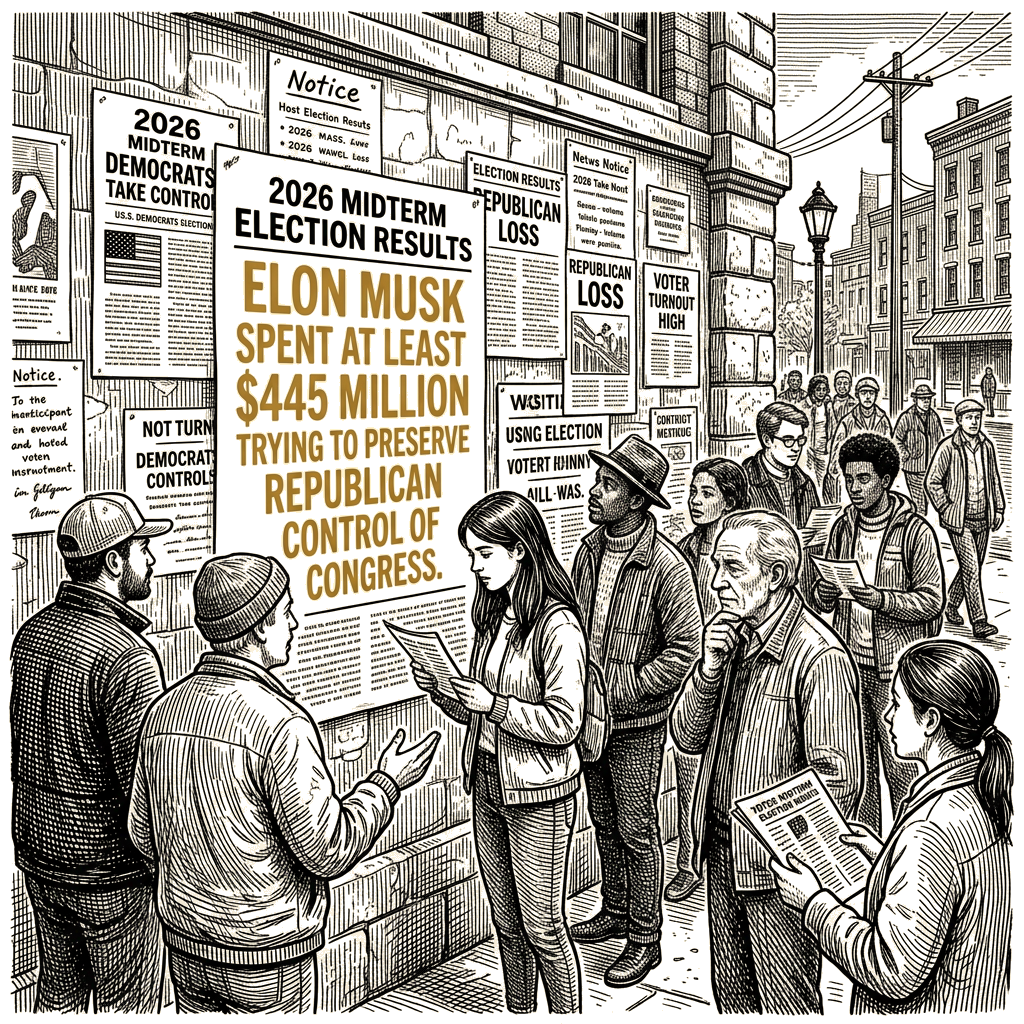
Elon Musk put at least $445 million into an effort to help Republicans keep control of Congress, an amount the Associated Press noted is roughly equivalent to someone on a $100,000 annual salary saving every penny for 4,400 years. To the world’s first trillionaire, the AP reported, it is a pittance — but the billions of dollars’ worth of business his companies do with the federal government is not. On Tuesday night, the Republican Party that had embraced Musk lost again and again, ceding control of Congress to a Democratic Party that, per the AP, is leery of the world’s richest person and keen to put his companies and his work at the Department of Government Efficiency under a microscope.
Nobody may have suffered bigger losses on Tuesday than President Donald Trump, the AP reported, but few others had more on the line than Musk, who gambled big and came up holding the midterm’s worst return on investment. Democrats in Congress were already queuing to get their shot at Musk, with possible subpoenas and investigations. As what the AP described as the bloodiest election for Republicans in recent history wore on, Musk joked on X, the social media site he owns: “Guess my election-interfering space lasers didn’t work this time,” he wrote with a shrug emoji.
In Texas, where Musk has based himself and several of his companies, the results added a string of defeats for Republicans he backed. Musk spent at least $5 million trying to reelect Republican Gov. Greg Abbott, who lost. Democrats also secured control of the Texas House and the U.S. Senate, partly by defeating Texas Republican Attorney General Ken Paxton, who effectively benefited from $158 million of Musk’s spending but lost his Senate race against Democrat James Talarico. It was the first statewide win for Democrats in Texas in more than 30 years, and the candidates won in part by hammering Musk, the tax breaks and grants his companies receive, and his relationships with elected Republicans. “This era of open corruption is going to come to an end,” said Rep. Gene Wu, chairman of the state legislature’s newly empowered Democratic Caucus. Musk did not respond to messages seeking comment.
Musk’s reputation did not help him with many Texas voters. Slightly more than half of Texas voters said they had an unfavorable opinion of Musk, according to the AP Voter Poll of more than 5,000 voters in the state. Musk is overwhelmingly viewed positively by MAGA Republicans, according to the poll, but those numbers dip among non-MAGA GOP voters and plummet among independent and Democratic voters — the voters Talarico and Hinojosa were targeting.
The two Democrats often framed politics not through partisanship but as billionaires versus everyday Texans, and Musk’s emergence as a major Republican benefactor played into that message. “Paxton is funded by one dude. Elon Musk wants our land. He wants our water. He wants our tax dollars. He wants his very own personal United States senator,” Talarico told the crowd at his final rally of the election, just after Hinojosa delivered a similar excoriation from the same Austin stage. “We know that Elon Musk got a $1.7 billion property tax break here in Texas, property taxes that the rest of us have to pay full price on,” Hinojosa said.
Even as Musk’s money helped blanket Texas in negative ads largely aimed at Talarico, the Democrats’ message targeted an electorate under economic strain. The AP reported that the state’s median household income of $85,000 a year is under a pressure test as the prices of gas, groceries, rents and mortgages keep climbing. Outgoing Rep. Chip Roy, R-Texas, said there was a point at which the sheer amount of Musk’s donations became unhelpful to the GOP’s effort. “You’re reaching the upper bound of the benefit of any of these dollars,” Roy said in an interview. “People are so turned off by all of the ads, and all you’re doing is running the same ad every single time.”
The reaction reached Musk’s two publicly traded companies, which saw their share prices drop considerably on Wednesday even as the tech-heavy Nasdaq composite index climbed. Tesla shares declined Wednesday afternoon, wiping out about $40 billion from the electric carmaker’s market capitalization and leaving the company valued at $1.54 trillion. SpaceX also lost about $40 billion in market value, which stood at $1.83 trillion. The Nasdaq Composite Index stood at 25,736.51 as of Nov. 5, 2026, according to FRED, the Federal Reserve Economic Data service. Musk lost about $45 billion of his net worth on Wednesday, Forbes reported, leaving it at $865.6 billion, though the estimate could rebound. Investors are signaling some jitters about the election’s impact on Musk’s businesses: worries that he may face congressional investigations “contributed to the early plunge for his benchmark firms,” said Joe Mazzola, head trading and derivatives strategist at Charles Schwab.
Musk’s genius is also his danger, said Michael Morris, a professor of leadership at Columbia Business School. “I can understand that the same strategic mind that makes him so good at some of the business ventures and the hedging, it makes him think that he can also take control of politics, but it’s a different animal,” Morris said. “He obviously has way more money than he will ever need, and his companies are doing well,” Morris continued. “I do think it is kind of a game to him.”
Democrats have not forgotten Musk’s time in Washington last year heading the Department of Government Efficiency, which the AP said blitzed through agencies culling federal workers, nor a recent episode in which SpaceX’s Starlink internet service in Ukraine was throttled amid the war with Russia. “Elon Musk waved a chain saw on stage and laughed while he fired public servants and gutted the services Americans rely on,” Rep. James Walkinshaw, a Virginia Democrat, wrote in an X post just before the election. “He must answer for it under oath.”
Back home in Texas, with an incoming Democratic governor, Musk’s dealings with the state, including tax breaks, could face similar scrutiny. In August, Musk’s companies received a $30 million grant through a state program to build a semiconductor plant estimated to create 3,000 jobs, one of several cash infusions his companies have received through state programs, according to the AP. He has also successfully pushed the state legislature to pass laws favorable to his businesses.
Musk has also railed against what he has called the “woke mind virus,” which, according to the AP, appears to be a partisan motivation for him, and he fired off a slew of X posts leading up to the election against Talarico, aimed almost entirely at past stances the Democrat has taken on transgender rights and other progressive causes. That was Paxton’s central attack against Talarico as well, though it fell far short. “You know you couldn’t pull the wool over their eyes anymore with these culture wars, and they are frustrated with the costs,” said Rep. Christina Morales, a state Democrat from Houston now in the majority in the state’s House. “We’re not saying you don’t belong here,” Morales said, but “Texans can’t be bought.”
The election did not settle whether Congress will investigate Musk or whether Texas will scrutinize his business dealings, but it changed the political actors asking the questions. Democrats now control Congress and the Texas House, a Democratic governor is set to oversee the state’s dealings with Musk’s companies, and Musk’s immediate market losses, the possibility of subpoenas and investigations, and potential state scrutiny all remained unresolved.
AP’s Ortutay reported from Oakland, California.