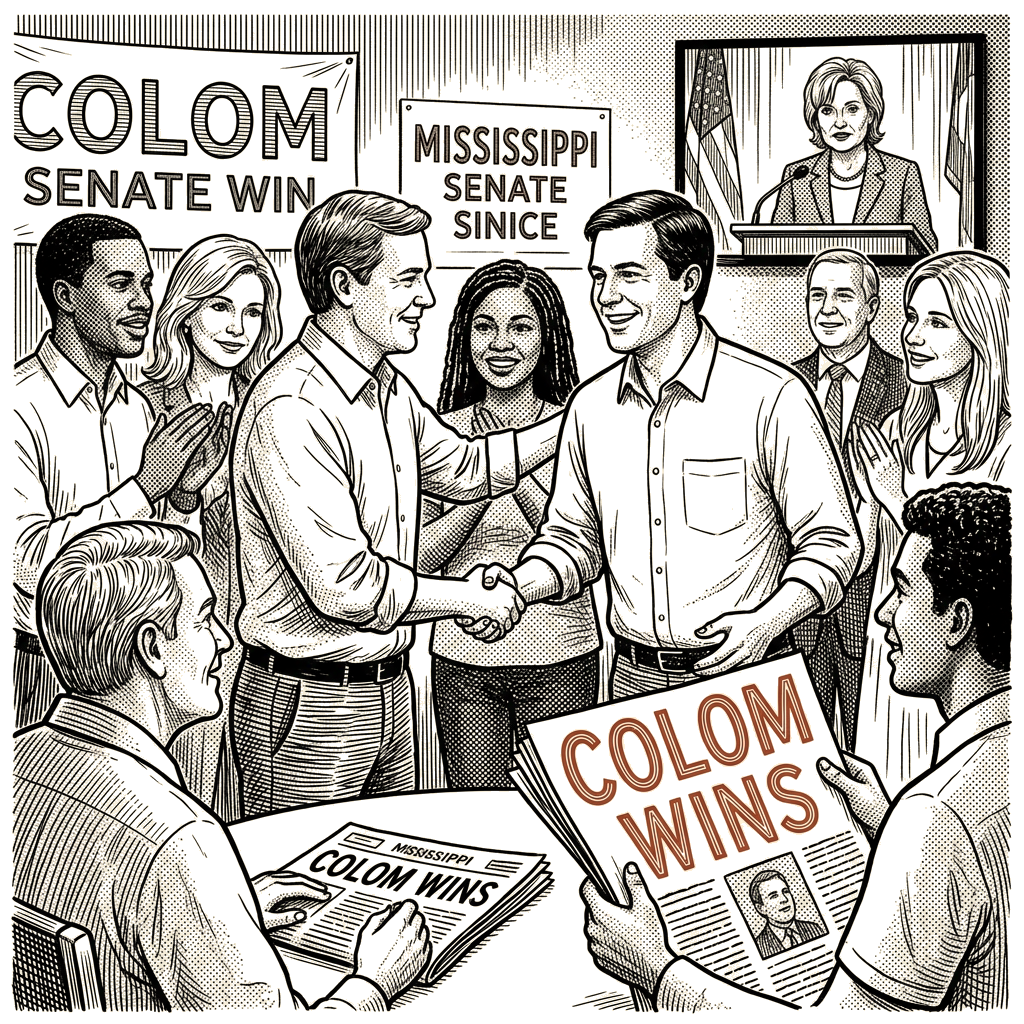
Reporter attributes Colom’s victory to affordability and voting-rights concerns
Republican Cindy Hyde-Smith conceded Mississippi’s U.S. Senate race Wednesday night in a video posted to her social media, closing out a contest that was finally called a week after election night. “While this is not the outcome we worked for or hoped for, I respect the decision of Mississippi voters,” Hyde-Smith said. “I want to congratulate Scott Colom and wish him well as he takes on the tremendous responsibility of representing our great state.”
The state Republican Party also congratulated Colom on his win and his campaign, Elise Catrion Gregg of the Gulf States Newsroom and Mississippi Public Broadcasting told NPR. A challenge from state Republicans had seemed highly likely while votes were still being counted, Gregg said, “but now not so much.” With the concessions, she said, the race may be headed for “a quiet wrap.”
Colom spent the evening at a victory rally at Tougaloo College, a historically Black institution in Jackson, where Gregg reported for NPR. The senator-elect offered thank-yous to his wife, his two young daughters, his campaign team and the voters. Gregg said Colom had been confident for months that he would win and took time to recognize that — while acknowledging he had not done it on his own.
“It’s not something that I did, y’all. It’s something that we did,” Colom told the cheering crowd. “All I did was have the courage to imagine a night like this. I had the courage to believe in Mississippi.”
The crowd, filled with signs and banners cheering Colom on, chanted “We want Scott.” Gregg, who attended both the rally and Colom’s watch party a week earlier on election night, said that if energy was high on election night, “it was through the roof yesterday.” People she spoke with seemed proud, she said, with “a lot of joy, a lot of excitement and no small amount of relief.”
Plenty of Tougaloo students were in the crowd, including Nukia Tullis, a Mississippi native, who called the result “just a thrilling experience, personally” and said it “just goes to show that anything is possible.” “You’re never too small. And your dreams are never too big for you to accomplish, and to just keep going, because this is truly amazing,” Tullis said.
The race itself was a tight one. Colom, who ran on healthcare access and affordability, defeated Hyde-Smith by just shy of 5,000 votes, becoming the first Democrat to win a Senate race in Mississippi in nearly four decades and the first African American senator from the state since Reconstruction — the first Black man to represent Mississippi in the Senate in nearly 150 years, according to NPR.
In Gregg’s assessment, the outcome turned on pocketbook pressures. Affordability issues and the impacts of policies like the Iran war have become financially untenable for voters across the board, she said. Republican Cindy Hyde-Smith ran on her record and her support of President Trump, and that is “simply no longer a winning strategy,” Gregg said.
Voting rights also shaped the contest, in her account. Voters were clear about their opposition to any restrictions on their right to vote, she said. Mississippi has not redistricted yet, but there is clear dissatisfaction with the “Louisiana-versus-Callais decision, which significantly gutted the Voting Rights Act.” Mississippians also faced voter inactivations after the secretary of state switched systems to check voter rolls — a change Gregg said could have made voting feel urgent for people in the state.
The race may also signal that change is coming nationally, Gregg said, and that the South, a region she described as often overlooked, is investable for Democrats. “And they’ll need to keep up in the region,” she said.