No automatic recount exists as both campaigns prepare for a legal fight
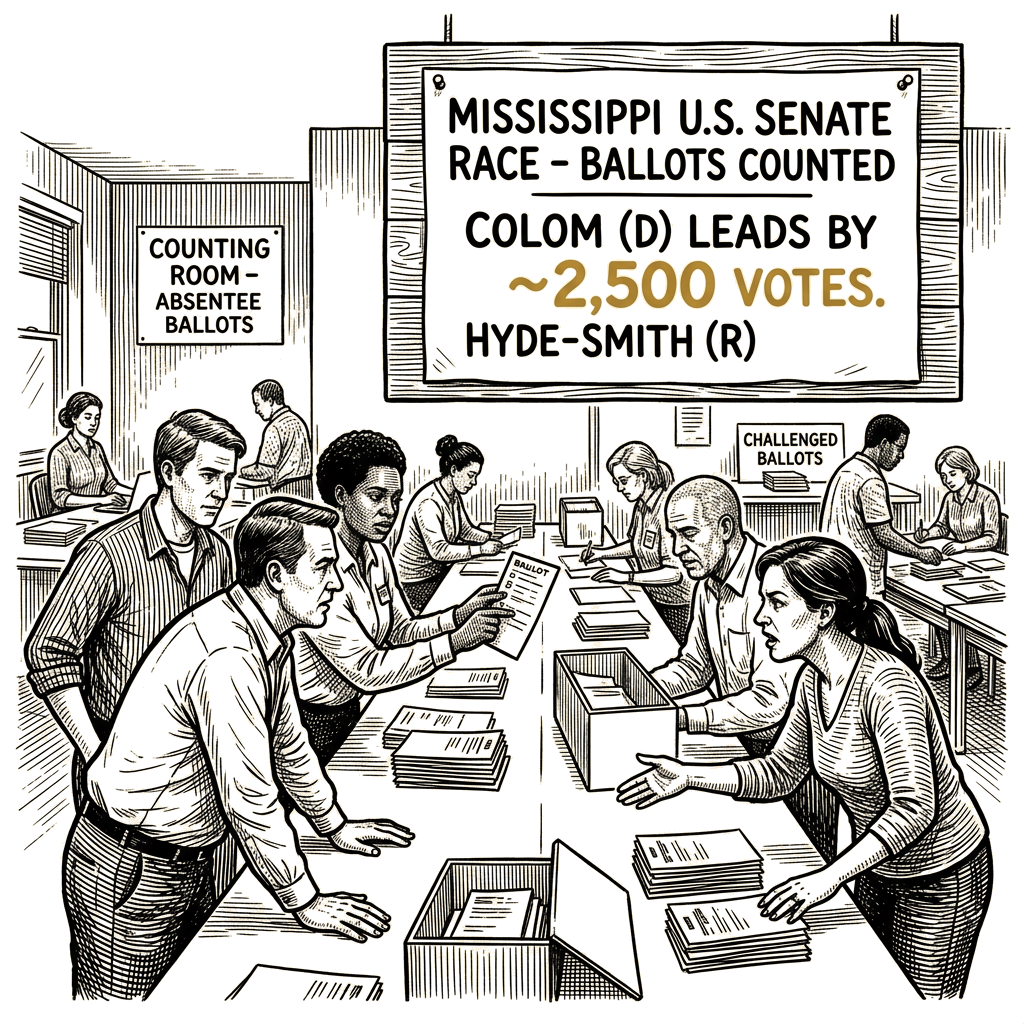
Democrat Scott Colom holds a narrow lead over Republican Senator Cindy Hyde-Smith in Mississippi’s uncalled US Senate race, with both campaigns disputing the counting of the remaining ballots that could decide the outcome. Lawyers for each side are preparing for a possible legal battle over the final result.
The stakes are considerable. The result could mark the end of almost 40 years of Republican control over Mississippi’s Senate seats and will determine the size of the Democrats’ majority in the chamber. Hyde-Smith has held the seat since 2018. A Colom victory would make him the first Black US senator elected in the state since 1875, and the first Democrat elected to the Senate from Mississippi since 1982.
With 97% of the votes counted as of Friday, Colom was about 2,500 votes ahead of Hyde-Smith.
Mississippi Secretary of State Michael Watson said on Wednesday that 3,600 “absentee-by-mail ballots” were still to be counted. The state can accept those votes so long as they were postmarked by election day and are received by 10 November. Watson said an “unknown” number of provisional ballots, also known as affidavit ballots, remain to be counted as well. Those ballots are typically cast when a voter lacked the required identification to vote, and the deadline for voters to resolve any ID issues, usually by providing acceptable photo identification, is also 10 November.
Mississippi Republican Party Chair Michael Hurst said on Thursday that the party estimated there could be “approximately 20,000 outstanding ballots left to be counted.” Hyde-Smith’s campaign said the same day that “thousands of votes remain to be counted from dozens of Republican counties” and that it is “confident” the count will secure her re-election.
Colom said the election saw “historic voter turnout” and that he is “confident that when votes are counted, we will flip this seat.”
Both campaigns are readying for a fight over the count. Colom said his campaign has “an army of lawyers” ready to act, while the state Republican Party said it has sent more than 50 volunteers, attorneys and observers across the state.
Lawyers from both campaigns have sent letters to Mississippi election officials about the counting of outstanding provisional ballots. Hyde-Smith’s campaign lawyers have requested that all 82 counties in the state keep all provisional ballots separate from regular or absentee ballots. Their letter also asked election officials to preserve various records associated with the provisional ballots — including information on how the votes were processed — as “potential evidence” in a possible legal dispute.
Colom’s campaign lawyers responded that the move has “no legal authority whatsoever.” The Colom campaign said the request from Hyde-Smith’s team could allow “a particular ballot to be traced to a particular voter,” in violation of ballot secrecy laws.
Ronald Rychlak, a law professor at the University of Mississippi, said “Mississippi law does give any candidate a right to examine ballot boxes and their contents within 12 days after the relevant canvass and examination,” and that the state’s affidavit-ballot statute “also requires eligibility review and records concerning whether affidavit ballots were counted.” “Neither law, however, establishes a blanket requirement to segregate all affidavit ballots after they have been accepted,” he said.
On the secrecy concern, Rychlak said, “That’s where he does have a more reasonable argument,” noting that ballots in the US are private by law and that where no clear procedure is in place, “there could be a possibility a voter’s privacy might be breached.”
Recounts rarely succeed. Just three of 37 completed statewide recounts across the US since 2000 have reversed a result. In many states, automatic recounts are triggered when a vote is very close, and in others there is an official process for campaigns to request one in a tight race. Two states, Illinois and Tennessee, allow recounts if a candidate mounts a formal legal challenge.
Mississippi does not have a set procedure allowing a result to be automatically recounted, even if it is tight or contested. Specific disputes are effectively left up to judges in the state to resolve.
Rychlak said Mississippi’s lack of a formal recount procedure “does not leave either campaign without a possible avenue to challenge the result.” Ballot-box examination, he said, “is an available post-election mechanism, and that can lead to discoveries that may result in a recount.”
A challenge could also be raised at the federal level, with the US Senate potentially holding authority to determine who is entitled to the seat. Article I of the US Constitution contains a provision giving each chamber of Congress the power to be the “judge of the elections, returns and qualifications of its own members.”