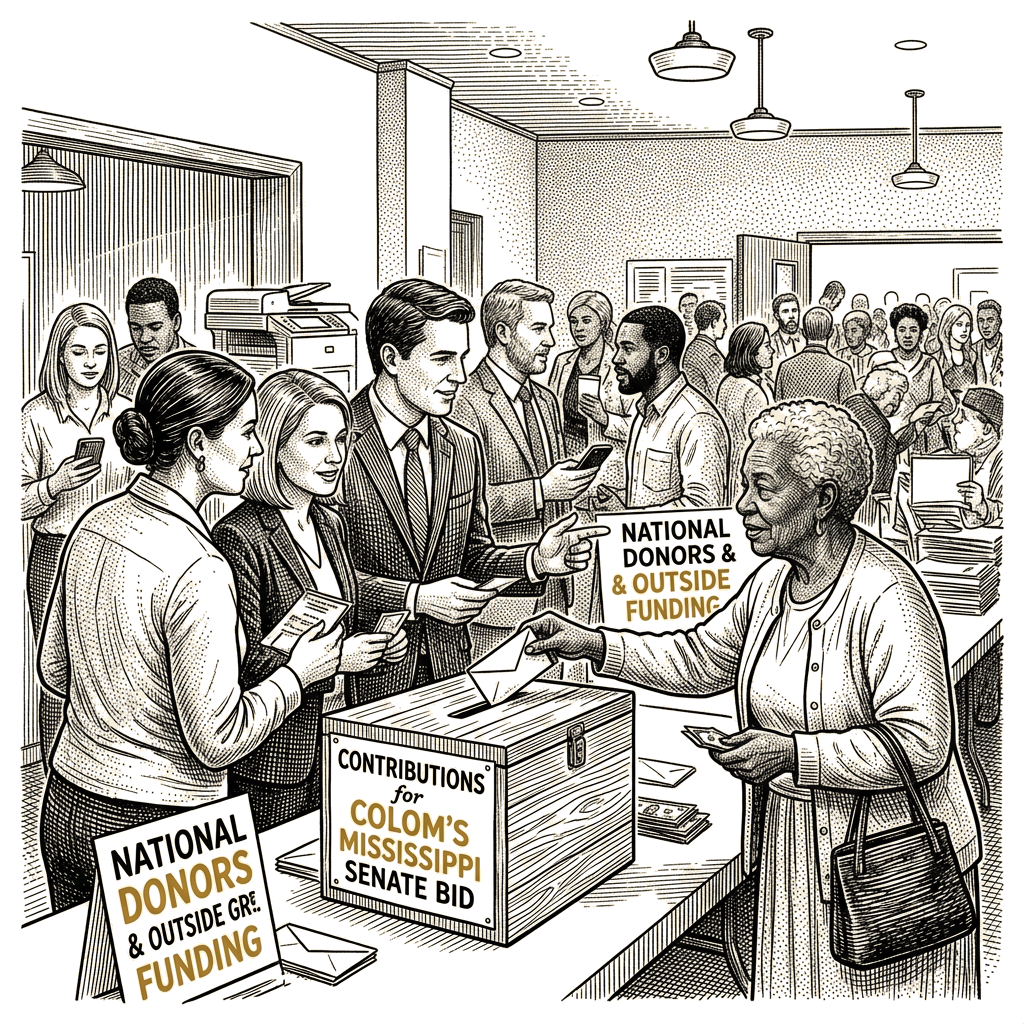
Soros-backed PAC channels $1 million to Mississippi super PAC
District attorney Scott Colom, a Democrat running for U.S. Senate in Mississippi, has spent recent weeks meeting voters at familiar Jackson venues — at a Waffle House, where a server recognized him and asked, “Are you running for office?” — and earlier this month at a Tougaloo College food-truck event, where he handed out tacos with his wife. National Democratic donors and outside groups have begun directing money into the state to support his long-shot challenge to Republican incumbent Cindy Hyde-Smith.
It has been almost 40 years since Mississippi sent a Democrat to the Senate, and hardly anyone expects that to change this year. But in a sign of just how bullish some Democrats are feeling, some party officials and donors are starting to size up the potential of once-unthinkable seats in the Deep South. Inspired by success in places like Georgia, they see Colom’s long-shot bid as a down payment for future victory in a state with a large Black population.
Senate Minority Leader Chuck Schumer has told donors at fundraisers and dinners in recent months to consider putting money into Mississippi, according to people with whom the senator has spoken. Several national Democratic organizations are quietly helping with advertising or door-knocking in Mississippi, while a political group associated with Schumer has not yet spent money in the state, though a spokeswoman said the group is “watching the race closely.”
A PAC funded by George Soros and his son Alex Soros has diverted $1 million into a second, little-known super PAC that identifies itself as “Mississippi-based” and has spent money in favor of Colom, according to campaign-finance records. A Soros-backed PAC spent close to $1 million on Colom’s first district-attorney race in 2015, a fact that Republicans have cited to label him as “bankrolled” by Soros. Major individual donors have also sent money to Colom’s campaign, including businessman Fred Eychaner, philanthropist Karla Jurvetson, and Rory Gates, the son of Bill Gates.
Despite the attention, the structural odds remain steep. The Cook Political Report rates the race solid Republican, and President Donald Trump won Mississippi by 23 percentage points in 2024. Democrats are operating at a huge cash disadvantage nationally going into November’s midterms, with super PACs funded by Trump and Elon Musk preparing to spend hundreds of millions of dollars that Democrats cannot match. Proponents of spending in states like Mississippi argue anger over gas prices and the war in Iran have created conditions in which Democrats could build support from voters in unexpected places.
Television advertising in the state reflects the limited scale of the contest. Around $4 million in advertising has been spent or booked in Mississippi, according to the tracking service AdImpact — a tiny fraction of the more than $8 billion being spent on midterm ads nationwide. Mississippi is so reliably red that residents said they rarely see political advertising on television, a pattern now broken by ads supporting both Hyde-Smith and Colom. At the Waffle House, Colom tapped another server on the shoulder. “Aside from me, have you ever seen a political TV commercial?” he asked.
Colom’s campaign biography is built on his prosecutorial record. He first won election as district attorney in 2015 in an eastern Mississippi district best known for an Air Force base and Mississippi State University. Colom stresses his record of securing convictions in more than 15 murder trials and notes he has been repeatedly re-elected.
Hyde-Smith, by contrast, worked in state politics for two decades before her 2018 appointment to the Senate and retains an extensive network across the state. Longtime state political figure Brad White, who helped Hyde-Smith set up her Washington office after her appointment and now serves as executive director of the Mississippi Department of Transportation, said she still fields calls from farmers on the same cellphone number she used before entering the Senate.
White framed the Republican edge as the product of sustained campaigning rather than demographic certainty. “When Republican candidates don’t take anybody for granted in a campaign and let the people of Mississippi know who they are, we’ve been successful,” he said.
Democrats point to two statistical anchors as evidence that the state is more competitive than it appears. Close to 40% of Mississippi residents are Black, and Black voters in the state overwhelmingly support Democratic candidates. In 2023, a Democrat came within three percentage points of winning the governor’s race. “It’s not the red state anybody says it is,” said Pete Perry, who for decades led the Hinds County Republican Party.
Democrats can get 45% or more of the vote in the state, but turnout is often poor. During the last midterm elections, less than a third of registered voters cast ballots in Hinds County, the state’s most populous county, according to county records. At a folding table in a hallway outside Colom’s Tougaloo event, employees from the Mississippi chapter of the NAACP sat with stacks of voter registration forms as part of a yearslong turnout effort. Brittany Reed, who spent her day helping people confirm their voter registration, said she frequently encounters residents who do not vote because they doubt their participation could change anything.
Colom has tried to thread a needle between the state’s socially conservative Baptist voters and the Democratic base. At Tougaloo, he said he is “personally pro-life” but would want his daughters to have the right to choose whether to have an abortion. Hyde-Smith’s campaign has focused its attacks on a 2021 letter Colom signed with other state prosecutors condemning bills banning gender care for transgender youth.
Perry credited Colom as a stronger candidate than some past Democratic nominees but said he did not expect a victory. “I don’t know that he’s put out a message that is going to take that person who is disenchanted from Trump and make them go vote for Scott Colom,” Perry said.
Pamela Shifman, president of the Democracy Alliance, a group that advises major Democratic donors, framed the spending as a long-horizon investment rather than a 2026 expectation. “We’re not going to pretend it suddenly became an easy state to win. It’s that the political potential has been chronically undervalued,” Shifman said.
At the Tougaloo event, Colom returned to the turnout argument. “We’ve got to get out of this mindset that Mississippi is not competitive. You can just look at the math,” he told a crowd of roughly 50 students and retirees.