Vance, DeSantis and Trump give different explanations for Republican losses
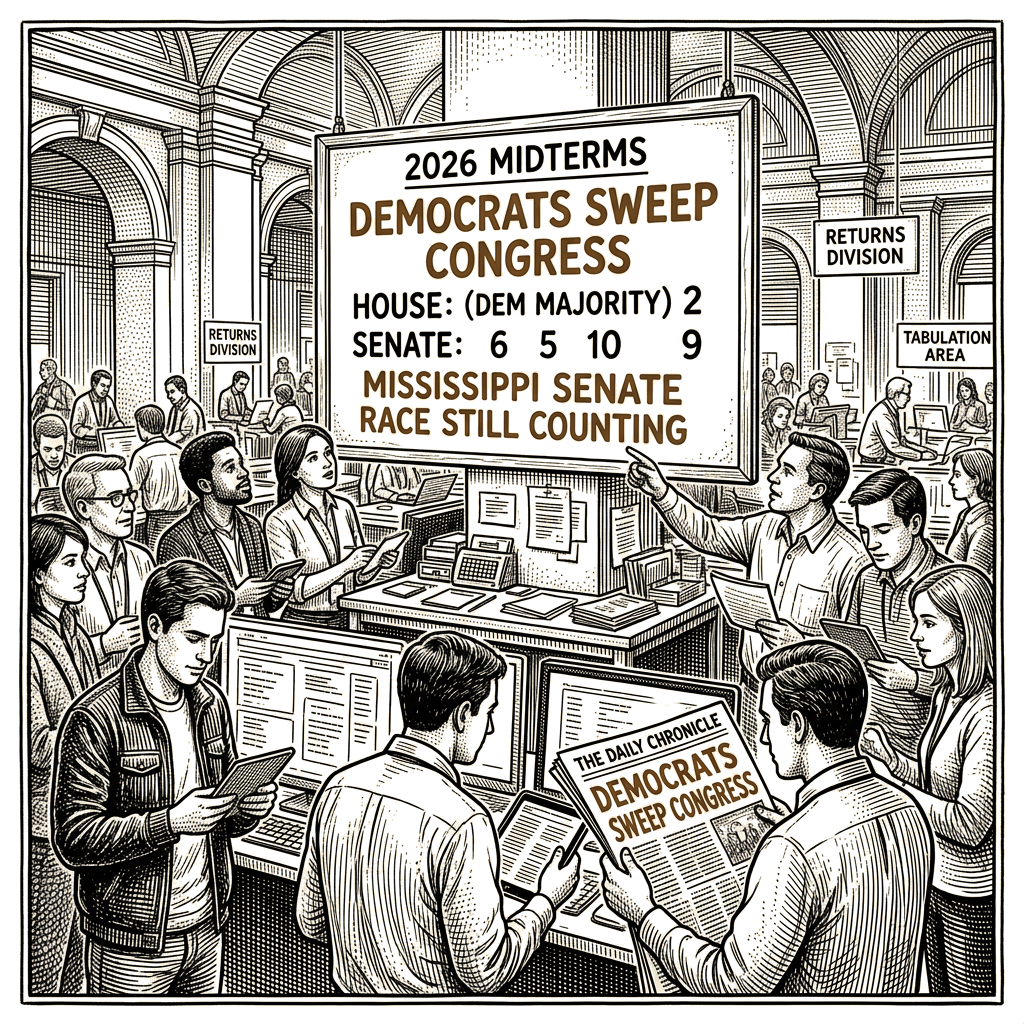
Democrats secured a historic sweep of Congress in the 2026 midterms, but two Senate seats remained in play nearly 24 hours later. Counting was still under way in Mississippi, where Democrat Scott Colom leads Republican incumbent Cindy Hyde-Smith by 1,138 votes with almost 96% of the vote counted, and in Alaska, where the count was expected to continue into Thursday.
The Mississippi count was moving in Colom’s direction, though slowly. The Guardian’s live coverage reported that votes for Colom had been outpacing votes for Hyde-Smith in the last few hours, though new batches of votes had not been reported for several hours. Democrats were close to pulling off another upset in a state where the party has not won a Senate seat since 1982.
The stakes in the race extend beyond the parties’ seat totals. Donald Trump carried Mississippi by 22 points in 2024, and it has been since 1875 that the state elected a Black person to the Senate. Colom, a seventh-generation Mississippian, is the candidate who would end that gap if his lead holds.
Colom’s background places him at the intersection of both parties in Mississippi politics. His father was a Republican who campaigned for Ronald Reagan and was friends with Thad Cochran, a longtime state politician. In 2015, Colom unseated a nearly 30-year incumbent when he was elected the first Black district attorney for the 16th circuit, a position in which he maintained a 94% success rate for convictions.
The closeness of the count also raises a procedural question the state’s statutes do not resolve. A race this close would automatically trigger a recount in some states, but Mississippi has no law on the books for initiating a recount.
The other unsettled Senate contest is in Alaska, where the count was expected to continue into Thursday. With two races unresolved and no final outcome in either state, the size of the Republican losses was still being measured.
Republican leaders have moved quickly to account for the result, and their explanations do not converge. Trump claimed that Republicans fared poorly because he was not on the ballot, after repeatedly urging voters to pretend he was on the ballot.
JD Vance pointed instead to Trump’s ongoing war in Iran as the “obvious” culprit for the loss. The Guardian’s coverage said Pete Hegseth’s role leading the unpopular war could lead him to take the fall despite Trump’s public backing, and noted that Republicans including Trump’s foe Thomas Massie have criticized the defense secretary.
Ron DeSantis, Florida’s governor, said the “close to an extinction-level event for Republicans” was caused in part by his party failing to target its ad spending on issues that would motivate voters.
Exit polls from the Associated Press indicated what voters said mattered most: the cost of living and government corruption were their two top issues.
Two counts remain open as the week turns toward Thursday — the margin in Mississippi, where no new batches have arrived for several hours, and the outcome in Alaska. If Colom’s lead holds, Democrats would take a seat the party has not held since 1982 and would put the first Black person in the Senate from Mississippi since 1875. Republican explanations for the losses also remain unsettled, with the party’s own leaders pointing to the president’s absence from the ballot, the war in Iran and the party’s ad strategy.