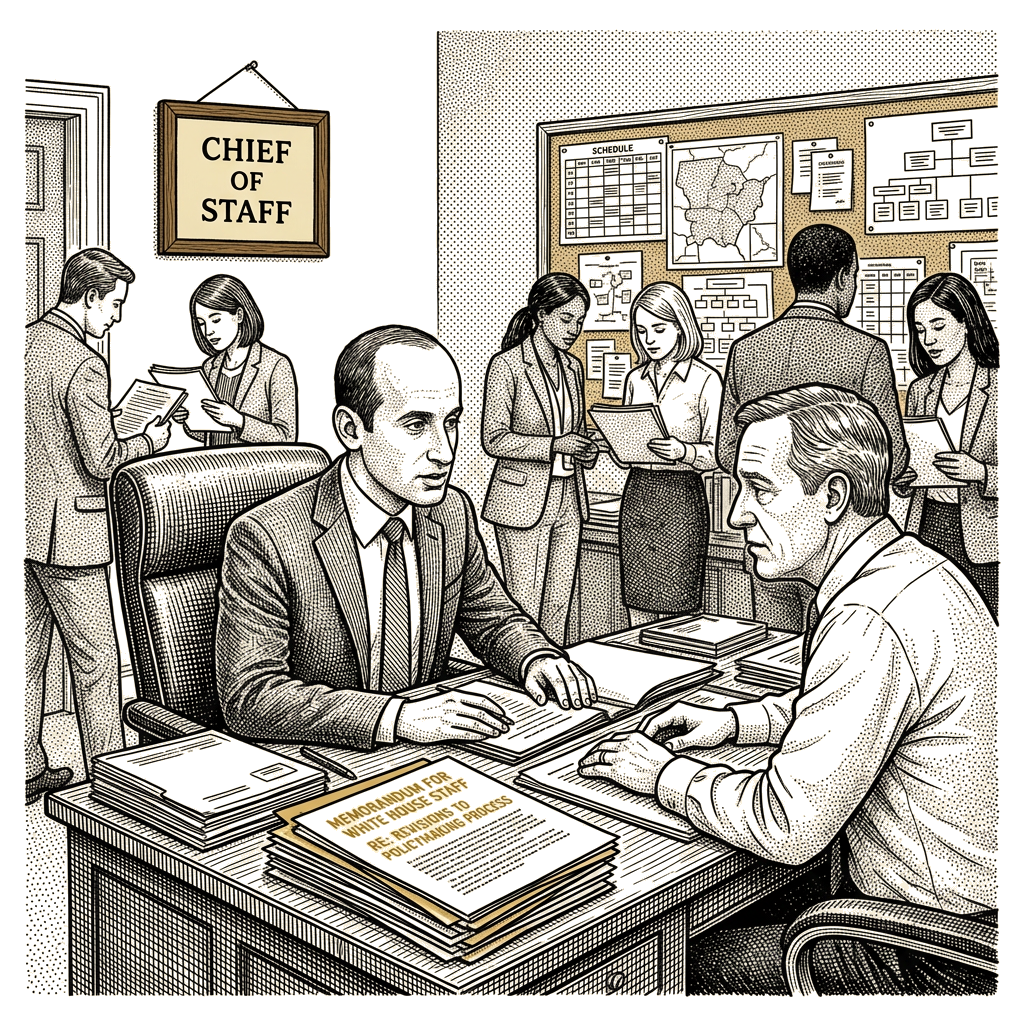
Miller tells associates he will not filter access to the president
WASHINGTON — One week into his tenure as White House chief of staff, Stephen Miller is charting a different path from his predecessors, some of whom sought to put strictures on a president who has long chafed at efforts to manage him. Since starting the role Nov. 6, Miller has organized a marathon series of meetings with cabinet secretaries and senior advisers, begun gearing up for a confrontation with Democrats on Capitol Hill, and had to navigate a widening international espionage scandal that has pitted two of Trump’s cabinet secretaries against each other.
Miller, 41, has told associates that he doesn’t plan to limit access to the president or filter the ideas pitched to him, according to people familiar with the matter. The Oval Office — which aides over the years have privately compared to Grand Central Terminal — will remain a bustling hub of activity, with advisers cycling in and out, and Miller has said he wants to expose Trump to as many people, ideas and disagreements as possible to help inform his decision-making.
People close to Miller say he plans to help steer the White House back to the MAGA movement’s ideological roots, reviving the hard-line, populist agenda that defined Trump’s first rise to power and putting it at the center of the administration’s remaining years. A longtime political adviser and one of the chief architects of Trump’s hard-line immigration policies, Miller has been by Trump’s side since he launched his bid for the White House more than a decade ago. Now, as Trump enters the final stretch of his presidency, Miller will lead the West Wing through what is likely to be a consequential and combative final chapter of the administration.
The approach has drawn skepticism and outrage from Democrats and some Republicans, who worry that Miller’s elevation signals that Trump has not learned from the GOP’s midterm losses. Hakeem Jeffries, who is set to become speaker of the House next year, has said he would refuse to work with Miller, adding that the new chief of staff “should be eradicated like a malignant tumor.” Retiring Republican Sen. Thom Tillis called Miller “the worst of all possible choices.”
White House spokeswoman Taylor Rogers said Miller had been “one of the most effective implementers of federal policy and bureaucratic reform in Washington, D.C.,” adding, “In his role as chief of staff, he will continue working to implement President Trump’s populist agenda on behalf of the nation’s working people.”
Miller began overhauling the West Wing with two memos issued to staff this week. In the first, reviewed by The Wall Street Journal, he named Caleb Orr, one of Marco Rubio’s top advisers at the State Department, deputy chief of staff for policy, and instituted new decentralized processes meant to empower individual cabinet secretaries. Separately, Miller invited longtime ally May Mailman, a former deputy assistant to the president and senior policy strategist, to return to the White House temporarily to help revamp operations across the administration.
A second memo, sent a few days later, forbade staff from meeting with lobbyists on White House grounds to discuss policy issues without explicit permission. The memo does not completely limit all interactions with lobbyists. While Miller isn’t interested in acting as a gatekeeper for the president, he has told associates that he wants to limit the influence of corporate lobbyists on White House staff. The memo follows allegations from some of Trump’s allies that people close to former White House chief of staff Susie Wiles cultivated cozy relationships with lobbyists and bent the administration agenda to the priorities of special interests. The memo raised alarms across K Street, according to two longtime Republican lobbyists who said their firms are already developing strategies to comply with the stricter rules.
In a sign of Miller’s approach to the next two years, the desk in his spartan West Wing office is adorned with a red hat bearing the word “VETO.” This week Miller ramped up the administration’s combative posture toward Democrats. The White House warned the incoming chairman of the House Oversight Committee that some verbal threats from Democrats against executive branch officials “may cross the line into blatant criminality,” as Democrats prepare to launch dozens of investigations into the administration.
Miller is among a small group of Trump aides seen as fiercely loyal and protective of the president, a group that includes Dan Scavino, Trump’s former golf caddie turned adviser. Miller was the best man at Scavino’s Mar-a-Lago wedding this spring. “We need to stand with the man who has stood with us with every fiber of his being,” Miller told a crowd of conservatives at Mar-a-Lago the day his promotion was announced. “I pledge you, Mr. President, my absolute loyalty, my unwavering commitment and my total devotion to your success and the success of this country.” Trump, who invited his new chief of staff to make the impromptu remarks, later shared a video of the speech to his millions of Truth Social followers.
Over the past week Miller has held one-on-ones with cabinet secretaries and agency and department heads, taking stock of what is working and what should change in the administration’s final two years, administration officials said. He handed to a deputy the daily 10 a.m. interagency call on immigration that he had attended religiously before his promotion. A person close to Miller said the new chief of staff, who served in both Trump administrations, has spent years studying the inner workings of White House operations and the wider government and has long been known to get into the weeds of policy debates, contacting lower-level staff at agencies to encourage them to move more quickly.
One former Trump administration official said Miller has been taking stock of executive actions that died on the vine during Wiles’s tenure, particularly those related to Make America Healthy Again initiatives and issues that affect young men. Other priorities people close to him cite include healthcare, urban crime and affordability. The turnover in the chief of staff’s office has also produced anxiety among aides worried about personnel changes, administration officials said; the White House moved quickly to deny reports that Kevin Hassett, director of the National Economic Council, would step down in the coming months.
Miller previously served as a congressional aide to former Alabama Sen. Jeff Sessions and comes to the job with deep relationships on Capitol Hill. He quickly reached out to Republican congressional leaders, speaking directly with South Dakota Sen. John Thune, who will serve as minority leader, and Ohio Sen. Bernie Moreno, who will lead Senate Republicans’ campaign arm, according to two sources familiar with his conversations.
Russ Vought, director of the White House Office of Management and Budget, described Miller as both “a master of the intricacies of government” and “acutely aware that our most precious resource as an administration is time.” Sen. Eric Schmitt (R., Mo.) said: “He understands the president well. Stephen doesn’t need to be the main character, and views himself in a supporting role of this president and that’s why they’ve always had a good relationship.”