The April Callais decision drew thousands to a Mississippi Fights Back rally
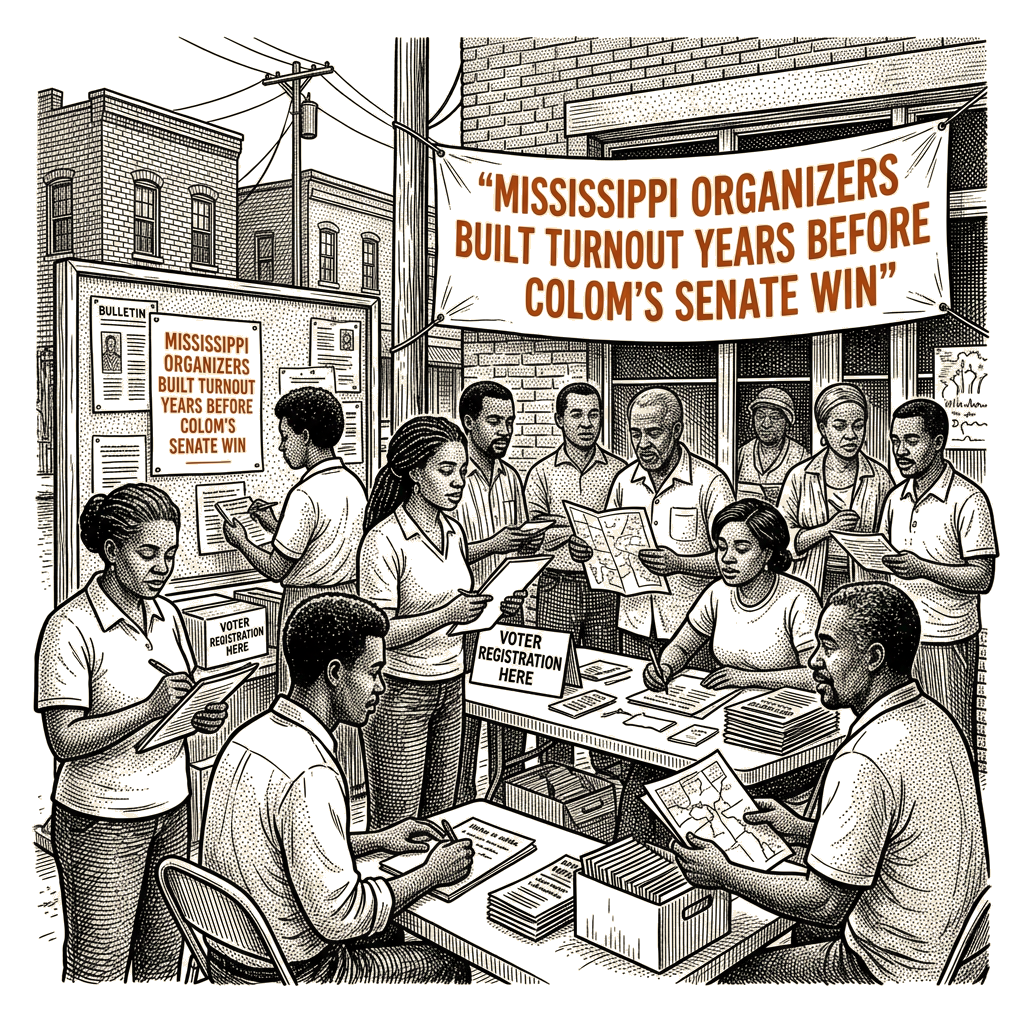
Long before national political leaders and media were paying attention, and long before the Louisiana v Callais supreme court decision — which The Guardian described as gutting the Voting Rights Act — Mississippi organizers were working to grow political participation and improve quality of life in a state that often ranks low on its residents’ health and wellbeing, The Guardian reported. Activists’ momentum contributed to Democrat Scott Colom’s historic upset in the midterm elections. Colom greeted supporters during the conclusion of a victory rally at Tougaloo College on 11 November.
A loose coalition of about a dozen, mostly Black-led nonprofits or initiatives rallied residents after Callais, the April decision that set off a flurry of redistricting efforts across southern states. The Guardian reported that Callais was not the sole impetus for organizing efforts across Mississippi, but it turned out thousands in the 20 May “Mississippi Fights Back” rally. Callais became the most recent opportunity to channel people’s frustrations and hopes into action, and to harness previous campaigns that go back years and even decades.
Rukia Lumumba, executive director of the People’s Advocacy Institute, described a division of labor that ran alongside the state’s redistricting fight. “We knew who was registering people in which counties. We knew who was going to be responsible for getting out the vote and how, whether it was canvassing, phone banking, text banking,” Lumumba said. “We knew who was going to be responsible for the legal strategy. We were doing all of that while also fighting against redistricting in our state. The redistricting fight allowed us time to really educate our community around the importance of getting out to vote this electoral cycle.”
Turnout in Mississippi had consistently fallen below the national average for the last two decades due to extreme voting restrictions, the Guardian reported. This year’s midterm broke that pattern: almost 1 million Mississippians voted, numbers that rival turnout during presidential elections. The Guardian’s photographs show Lumumba leading a protest about conditions at state prisons outside the Mississippi state capitol on 10 January 2020.
MS Votes, one of the members of the coalition, has become synonymous with voting rights in the state since its 2016 founding. The organization held voter registration drives on college campuses and in rural communities, worked to ensure that people in prisons and jails whose crimes did not have a felony disenfranchising effect knew they could vote absentee, and held community forums and political education events.
The Guardian reported that 2020 was a turning point. When people took to the streets to protest the police killing of George Floyd — more than 4,000 in Jackson alone — MS Votes expanded to Hattiesburg and continued work throughout the Gulf coast and Delta regions. That year it helped organize one of the largest protests in state history, which helped bring down Mississippi’s state flag and its Confederate battle emblem. In 2023, in partnership with the Mississippi Center for Justice, ACLU of Mississippi and the Mississippi Southern Poverty Law Center, MS Votes launched a voter information hotline.
Those actions fed into the creation of the coalition that coordinated this year’s outreach to Black voters and those who were unregistered. While the coalition responded to this year’s voting-rights fights, the organizations have worked together for, in some cases, at least a decade, and they often share volunteers, staff and resources.
Arekia S Bennett-Scott, MS Votes’ executive director, said the coalition grew from a desire for an anchor organization. “We wanted an organization that can serve as our anchor. My interpretation of that was a political home, like BYP100 and Malcolm X Grassroots Movement were for me,” Bennett-Scott said. The lightbulb went off for everybody else, she said: “We could actually do some progressive things” with greater collaboration.
Coalition members had already partnered on other fights: to counter the state’s attempt to take over the majority-Black Jackson public school district, to help residents weather the winter storm of 2021 that worsened Jackson’s ongoing water crises, and to fight to close the Parchman Penitentiary. The People’s Advocacy Institute held the first participatory budgeting process in Mississippi in 2019, which gave Jacksonians an opportunity to be involved with planning the city’s fiscal year. Lumumba is also the co-coordinator of the Electoral Justice Project for the Movement for Black Lives.
“Since Katrina, we’ve been talking about how we save ourselves,” Lumumba said. “We understand how we can be the folks that pull people into safety and help each other. We do it all year-round. We take care of each other, and we understand we’re not going to wait on the country.”
After Trump’s second inauguration, Kathleen O’Beirne met with several people who believed that “inaction wasn’t an option”. There were numerous issues, she said: the department of government efficiency cuts, the disbanding of USAID and “the unmitigated attacks on Black and brown immigrant communities across the country”. The group said: “Alright, we gotta do something.” The interracial group called themselves the “Do Somethings”, and encouraged each other to do whatever they could to make a difference.
From there, O’Beirne created MS United, which works independently and with organizations across the state to make it easier for Mississippians “to take specific actions that, when all combined together with the actions of hundreds or thousands of other Mississippians, might actually move the needle”. MS United has worked with larger organizations, like the Mississippi NAACP, Mississippi Black Women’s Roundtable, Mississippi Southern Poverty Law Center and the League of Women Voters of Mississippi, but also smaller ones such as local Indivisible chapters and Hands Off My Mississippi.
To win, Colom needed a surge in Black voter turnout and about a quarter of white voters. MS United put out an election guide. In the state that has not had a Democratic senator since the 1980s, its volunteers reached out to people who typically voted Republican by writing personal messages that they mailed or texted, and encouraged the people they contacted to reach out to others.
O’Beirne said that “white Mississippians have been misled for a long time into believing that the harder we make life for other Mississippians, the better life will be for us.” She added: “I often share Lyndon B Johnson’s quote that says, ‘If you can convince the lowest white man he’s better than the greatest Black man, he won’t notice you’re picking his pocket. Hell, give him somebody to look down on, and he’ll empty his pockets for you.’”
“I think this election cycle was a perfect illustration of that … if our lawmakers are just focused on making life harder for a small population, if all your time and energy is spent lobbying against people having health care or advocating for new laws that impact [transgender athletes] in sports … You’re focusing on doing all this stuff that does not make life better for any Americans and, in fact, if you look at diesel prices and gas prices and the prices of just about anything that we consume, it’s made life worse for us,” O’Beirne said.
Many activists and organizers in Mississippi view themselves as existing in the lineage of the Mississippians who came before them. “People tend to forget our history,” Lumumba said. “It was in 1964 that Fannie Lou Hamer spoke before the US Congress, talking about how sick and tired she was, but also talking about the potential in Mississippi and the potential of Black voters. She led to the formation of the Mississippi Freedom Democratic Party. If you don’t allow us to have full representation in your party, we create our own space to rule, to govern, to obtain the right and the privilege of the power that we know we deserve.” Hamer, a Mississippi Freedom Democratic Party delegate, had spoken for her delegates at a credential meeting before the formal meeting of the Democratic National Convention on 22 August 1964.
“We’re continuing that legacy,” Lumumba said. “We have some great ancestral mentors to help us get there: Fannie Lou Hamer, the likes of Hollis Watkins, the likes of even my father, Chokwe Lumumba, Frankye ‘Malika’ Adams-Johnson, who believed in more than just the power of the ballot, but believed in the power of self-determination and this theory around co-governance. We’re not just looking to cast a ballot. We’re looking to be active participants in the governing of our cities, of our counties, of our states.”
“Mississippi has a civic engagement infrastructure. It’s built by Mississippi. It’s run by Mississippi,” Cassandra Welchlin, executive director and co-convener of the Mississippi Black Women’s Roundtable, added. “That is important for us to say. We’ve been doing it consistently, educating, doing civic engagement work, so that people can exercise their right to vote.”
After the election, almost two dozen organizations — some of the same ones in the get-out-the-vote operation, including the Mississippi Poor People’s Campaign, JXNOlogy, Fair Fight, Mississippi for a Just World and others — ensured every legally cast ballot was counted. While counties were inundated with a historic number of affidavit ballots, the organizations informed people about how to “cure” their ballots or correct minor issues that might otherwise disqualify a ballot. They phone-banked, contacting people across the state about their ballots, trained volunteers in being nonpartisan ballot count monitors, and provided regular updates to the public about what was happening.
Colom won despite his campaign’s naysayers, long odds and late support from the Democratic party. His argument that Mississippi matters meant that he campaigned in the state before he started receiving significant outside resources and before national attention, the Guardian reported. Mississippi has not had a Democratic senator since the 1980s.
“I have been preaching that people should pay attention to Mississippi since I was a young organizer at Jackson State,” Bennett-Scott said. “I’ve been telling people that they need to be investing early. We don’t need to wait until the day after an election, the week before the election, hours before affidavits need to be secured, before we invest in a place like Mississippi.”
Days after Colom’s win, Bennett-Scott and her team are already planning for the next election and legislative session. One of the first orders of business is pushing to change Mississippi’s antiquated voting process: the state is one of only three without early voting, it imposes a lifetime voting ban on people with certain convictions, and its secretary of state used unverified Experian data that inaccurately marked almost a quarter of a million as inactive voters.
There’s more than enough to keep organizers busy, Bennett-Scott said. “The movement never stopped because the cameras went away, and the movement won’t stop when the cameras leave.”