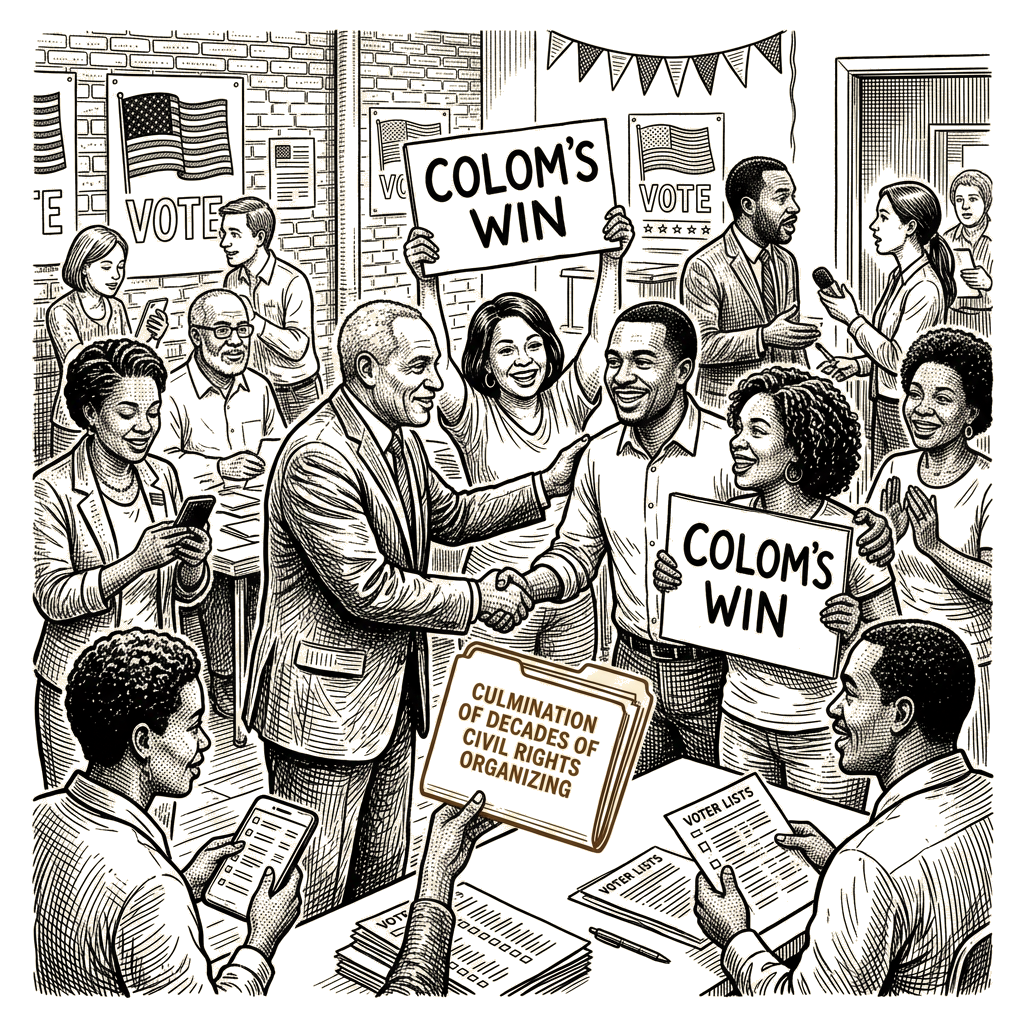
Espy handed Colom his donor and voter lists, hoping his losses paved the road
Mike Espy served as an adviser to Colom this year, handing over his donor and voter lists in the hope that his own two Senate losses “paved the road” for the senator-elect, he said in an interview. “There is a time and place for everything,” Espy said. “This is Scott Colom’s time, and his place is in the U.S. Senate. I’m so pleased with the way he ran his campaign, and I was happy to support him.”
Colom’s Wednesday night victory will make him the first Black person to represent Mississippi in the U.S. Senate since post-Civil War Reconstruction — a milestone that Espy and many other Black Mississippians who were among the first to win elected office in the state called both a personal celebration and the culmination of decades of civil rights organizing.
Espy blazed trails in Mississippi politics in Congress, then again in a presidential cabinet, and came close again in the U.S. Senate. He was the first Black person to represent Mississippi in the U.S. House since Reconstruction and the first Black person to become U.S. agriculture secretary, and he unsuccessfully ran against Republican Cindy Hyde-Smith twice, in a special election in 2018 and a regular election in 2020. He conceded to Hyde-Smith on Nov. 3, 2020, at the Mississippi Civil Rights Museum in Jackson.
Espy and Colom share similar stories of how they were initially shut out of power by incumbent politicians but persevered to use that to their advantage. Colom was blocked from getting a federal judgeship by Hyde-Smith. Espy was denied support from longtime Mississippi U.S. Rep. Jamie Whitten to gain congressional clout. Yet both went on to secure other high-ranking positions.
The shut-outs fit a pattern that has played out through Mississippi’s political history: incumbent politicians try to close the door on others seeking to gain power, and scrappy challengers, time and time again, jammed their foot in that door and, occasionally, yanked it open.
In 1992, Espy had served three terms on the House Budget Committee, steering money toward many parts of rural Mississippi, but internal rules of the Democratic caucus prevented him from serving another term. Still eager to divert money and projects to his impoverished district in the Mississippi Delta, Espy sought Whitten’s backing for a spot on the powerful House Appropriations Committee.
Whitten was retiring from Congress and departing as chairman of the committee. If the northeastern Mississippi congressman had backed his fellow Mississippi Democrat, it would have given Espy a much-needed boost and likely secured him a spot on Appropriations. But Whitten, who was initially elected as a segregationist in 1941 and had later suffered a stroke, ultimately declined to support Espy.
“After that, I began looking for a position in the government where I could have power and influence to provide for rural America,” Espy said. Espy then asked newly elected President Bill Clinton to appoint him as agriculture secretary — a proposal from a 39-year-old, three-term congressman — and pitched it to the former Arkansas governor by scribbling on an envelope 10 reasons the president-elect should nominate him for the post.
Asked about the historic nature of his win, Colom has said he only wants to ensure he won’t “be the last” Black person elected to the Senate from Mississippi. “I don’t want anybody to say that I did anything to hurt the next person that has the talent, the work ethic, the ability to be able to reach for their dreams,” Colom said recently. “That’s my focus.” Colom is focused on the next person ready to go through the door.
Flonzie Brown Wright, the first Black woman elected to public office in Mississippi, said Colom’s win also brings to mind those who never got the chance to walk through the door. She said the victory reminds her of how she felt in 1965, when the federal Voting Rights Act passed. “The same emotions, the same anticipation,” Wright said. “It’s a strange dichotomy because we were jubilant but sad in another sense, because there were so many we lost who couldn’t vote.”
Wright spoke with media after a press conference announcing a statewide voter registration day named in her honor on Friday, Aug. 28, 2026, in Jackson.
Wright often thinks about the generations who didn’t live to see this. “Many of our ancestors brought us as far as they could bring us, but they couldn’t cast a vote,” she said. “We got here not because somebody thought it was a nice idea to treat Blacks as equal,” Wright said. “We got here because we struggled, we toiled, we kept moving, we took the defeats, we cried. But we wiped those tears off and kept on marching.”
Wright’s own march began in the 1960s, when she became an election commissioner in Madison County on Nov. 5, 1968. She served one term before moving to Jackson. She later testified before a congressional subcommittee in support of the Voting Rights Act. She views the U.S. Supreme Court’s recent Louisiana v. Callais decision as a major setback, saying it gutted key parts of the act. But, Wright said, every journey of 1,000 miles begins with a single step. Every journey has setbacks, but she sees Colom’s win as one more step toward the end of that journey. “The 1,000 miles was our goal,” Wright said. “But not everyone could walk the 1,000 miles. Some walked 50, and some walked 20. They walked as much as they could and kept stepping. They kept stepping, so we kept stepping.”
When Colom goes to Washington soon to be sworn into office, he will become the first Black senator from Mississippi in nearly 150 years — climbing the Capitol steps carrying all those miles with him.