A congressional waiver is required after Cao left active duty in 2021
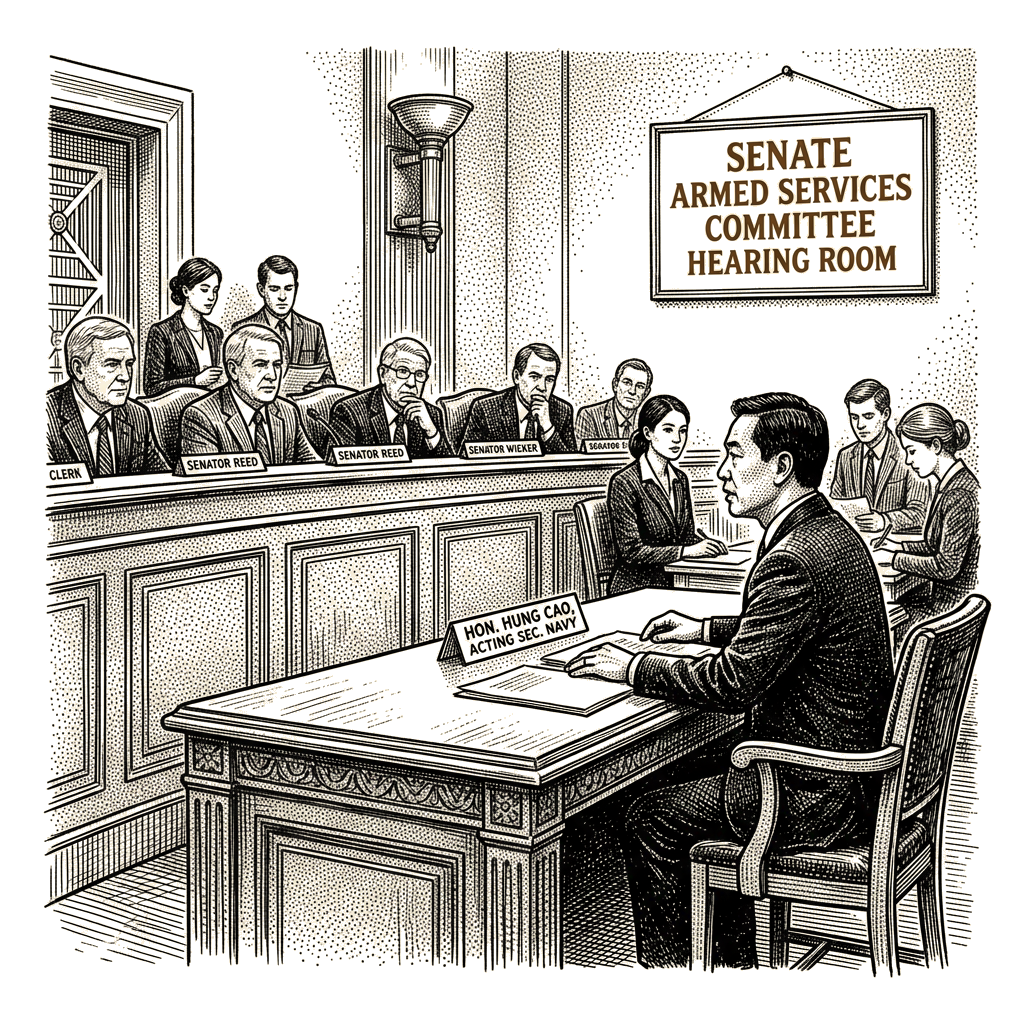
Acting Navy Secretary Hung Cao is scheduled to testify before the Senate Armed Services Committee on Tuesday in the first step of his bid to become the permanent Navy secretary. He is seeking the Navy’s permanent top civilian job during what AP described as a particularly volatile time in Washington. AP said the hearing opens a process that could become a fierce debate over the Iran war, military transparency and the well-being of American sailors.
Cao faces an additional hurdle: Congress must grant a rare waiver from a law that prohibits military officers from serving as a service secretary until they have been retired for at least seven years. Cao left active duty in 2021, and AP reported that he needs the waiver to take the post.
For now, Republicans still control Congress, but Democrats are likely to subject Cao to intense scrutiny over aspects of the Iran war. AP identified major damage to the 5th Fleet headquarters in Bahrain and the recent firings of Navy officials as issues likely to draw questions.
The hearing comes after a third U.S. aircraft carrier arrived in the Middle East, with Trump keeping his options open for what AP described as the intermittent and unpopular war. It also follows a failed House impeachment attempt against Defense Secretary Pete Hegseth that was launched in part over his handling of the conflict.
Republicans lost the House and Senate in the midterm elections, which AP said were widely seen as a repudiation of the war, and Democrats are set to take control of Congress in January. Until then, the Senate committee considering Cao’s nomination will remain under the current Republican majority.
Lawmakers have also raised concerns about sailors’ mental health after reports of crew stress and supply shortages aboard the USS Abraham Lincoln. The carrier completed a record-breaking deployment supporting the Iran war before returning to its homeport of San Diego in October, and Cao is likely to face questions about the sailors’ welfare.
Democratic lawmakers say the Navy failed to inform Congress that it had fired the entire leadership team of a nuclear-powered attack submarine after an underwater collision. The Navy also fired the commander of a destroyer deployed to the Middle East.
Trump nominated Cao for the permanent post in September. He has served as acting Navy secretary since April, following John Phelan’s departure, which came with little public explanation, and previously served as Navy undersecretary. AP described Cao as a Trump loyalist and combat veteran.
Cao ran an unsuccessful Republican bid in 2024 to unseat Virginia Democratic Sen. Tim Kaine, who serves on the committee considering his nomination. During that debate, Cao said, “When you’re using a drag queen to recruit for the Navy, that’s not the people we want,” and continued: “What we need is alpha males and alpha females who are going to rip out their own guts, eat them and ask for seconds. Those are the young men and women that are going to win wars.”
Cao fled Vietnam with his family as a child in the 1970s before attending the U.S. Naval Academy. According to his Senate campaign biography, he was commissioned as a special operations officer and served with SEAL teams and special forces in Iraq, Afghanistan and Somalia.
A similar law governing the defense secretary has been on the books since the end of World War II and was designed to ensure truly civilian control of the military. Congress has granted only three exceptions for that post, twice in the past decade. In 1950, lawmakers waived the prohibition for George Marshall, a former five-star Army general. Since then, Congress has issued waivers for retired Marine Gen. James Mattis during the first Trump administration and retired Army Gen. Lloyd Austin under President Joe Biden.
In each case, Republican and Democratic lawmakers expressed aversion to granting a waiver and setting a precedent for future exceptions, citing concern about further erosion of the already precarious concept of civilian control of the military. The Republican Study Committee, an influential bloc of Republican lawmakers, said in 2021 that it opposed Austin’s waiver “based on the lessons learned after the House made the unprecedented move of granting a waiver four years ago” to Mattis.
Rhode Island Sen. Jack Reed, the ranking Democrat on the Senate Armed Services Committee, supported Austin’s waiver but called it “a once in a generation exception” in a 2021 statement. AP said that language strongly indicated Reed would not support a similar waiver in the future.
Republican Sen. Tom Cotton of Arkansas told reporters during Austin’s confirmation hearing that he regretted voting for Mattis’ waiver and felt the 1950 exception for Marshall was a mistake. He told Defense News in 2021 that “under no foreseeable circumstances can I imagine supporting such a waiver again.” Cao’s hearing is only the first step; Congress still must consider the nomination and the requested waiver.