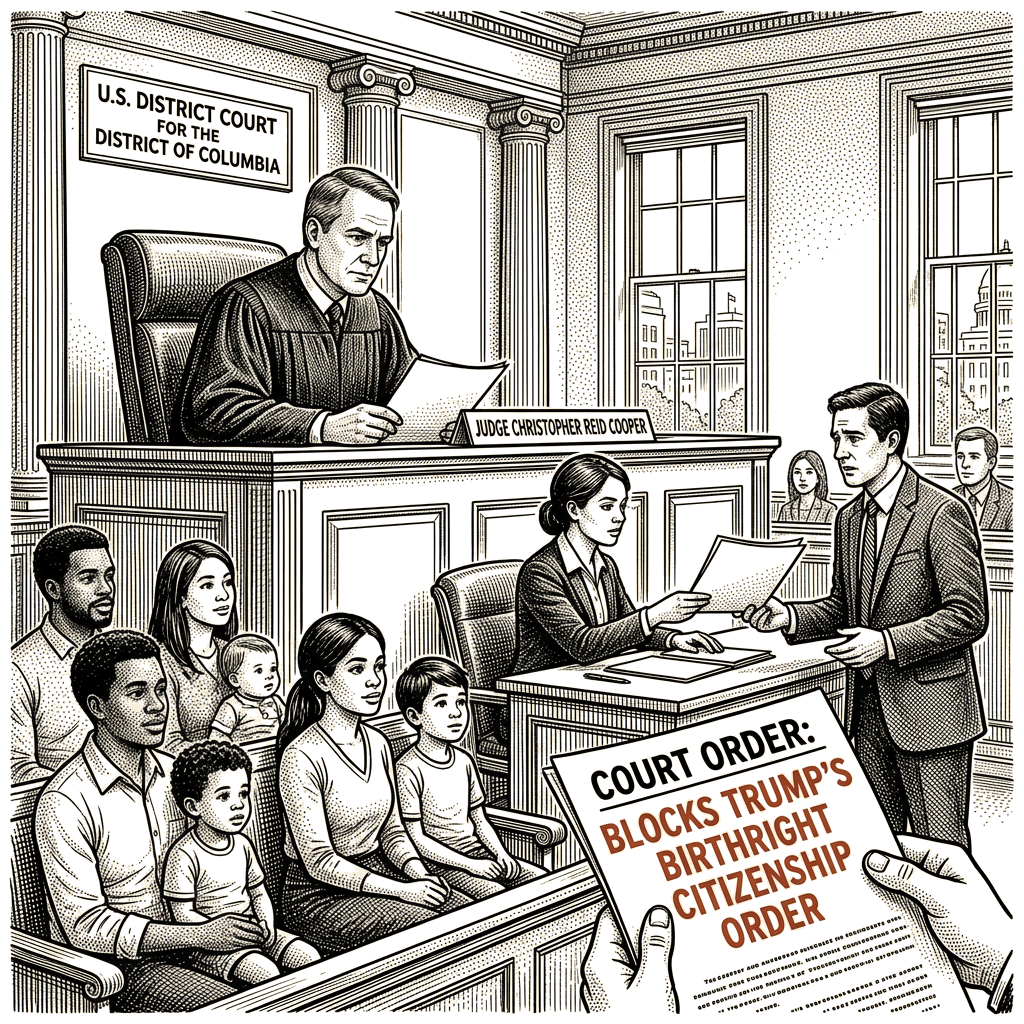
The injunction covers a defined group during continuing litigation
A federal judge in the District of Columbia on Wednesday blocked the Trump administration from implementing its second attempt to redefine the constitutional right to birthright citizenship. Judge Christopher Reid Cooper issued a classwide injunction that will remain in effect while litigation continues.
The injunction blocks action affecting a defined group of people, as opposed to a nationwide injunction. It prevents federal agencies from acting on Executive Order 14418 while the case proceeds, leaving the underlying constitutional dispute unresolved.
In a memorandum opinion, Cooper noted that the Supreme Court earlier this year rejected President Donald Trump’s first executive order in Barbara v. Trump. That order would have denied citizenship to babies born in the United States to parents who entered the country unlawfully or on a temporary basis.
Cooper’s memorandum opinion described the sequence this way: “Yet Barbara’s ink had scarcely dried when the President issued a second executive order—Executive Order 14418, at issue here—directing federal agencies to withhold recognition of citizenship from additional categories of U.S.-born children with noncitizen parents,” he wrote.
He also wrote: “As the Supreme Court has made clear, however, the President cannot carve out new exceptions to birthright citizenship for children born within the United States and subject to its laws.”
Executive Order 14418 targets children born in the United States to parents deemed part of a designated terrorist organization. It also covers children whose parents purposefully came to the United States to gain citizenship, which critics call “birth tourism.”
The order also aimed to deny citizenship to children born to foreign diplomatic staff and children born in U.S. territories where Congress has not passed a law granting citizenship. There is already a small carve-out for birthright citizenship involving children born to foreign diplomats.
The American Civil Liberties Union, which led the first challenge to the administration’s birthright citizenship order and is leading the second challenge, welcomed Cooper’s ruling.
“Enough is enough,” Cody Wofsy, deputy director of the ACLU’s Immigrants’ Rights Project, said in a statement. “The Supreme Court has twice rejected efforts to gut birthright citizenship, in 1898 and again earlier this year. Third time is not the charm, and the President needs to accept that birthright citizenship is the law of the land.”
Earlier in the month, Cooper seemed skeptical of the legality of the administration’s second attempt.
The Department of Justice did not respond to States Newsroom’s request for comment.
Cooper’s order keeps the second executive order from taking effect during the continuing litigation. The dispute over whether the administration may withhold citizenship from the specified categories of U.S.-born children remains before the court.