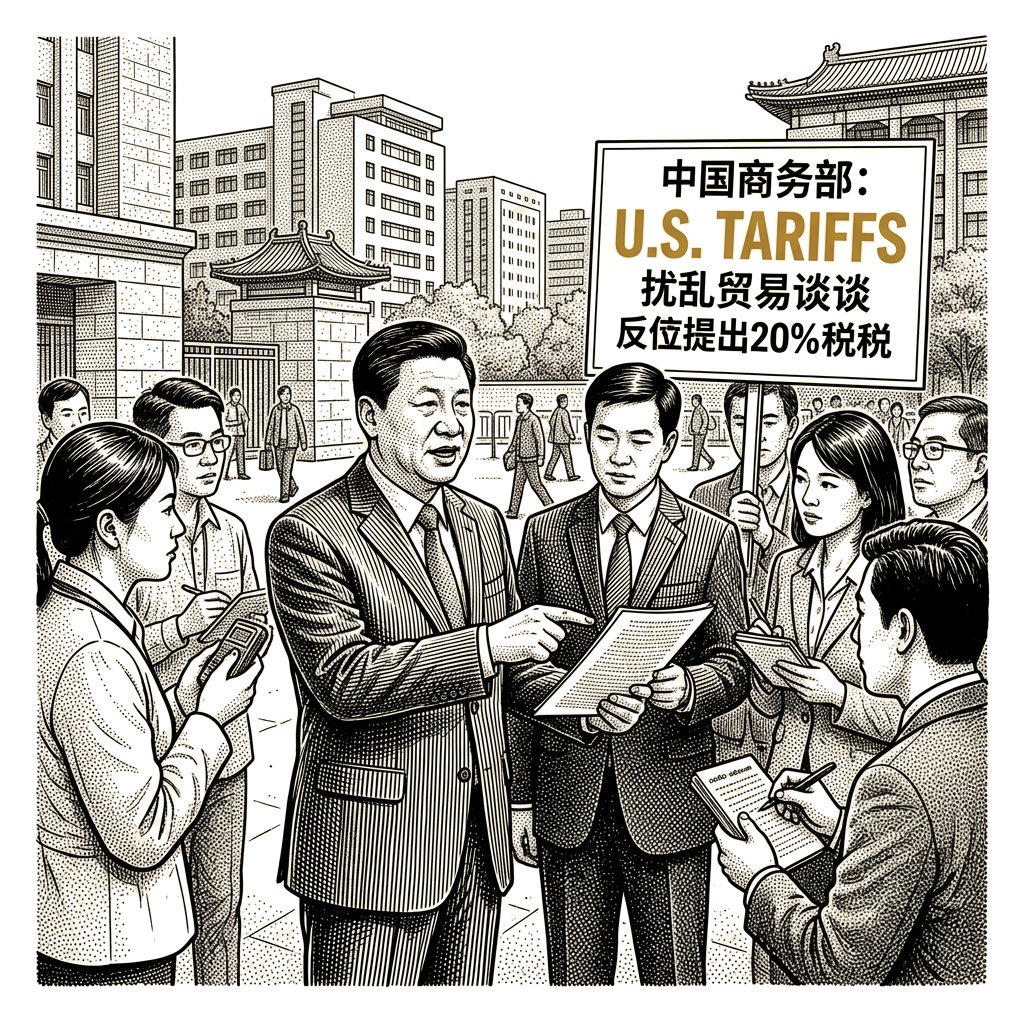
Trade office says China duties could reach 40% if negotiations collapse
China warned in Beijing on Thursday that it could retaliate against a proposed 20% U.S. tariff on most Chinese exports and said the duties could disrupt ongoing trade talks. U.S. Trade Representative Jamieson Greer had announced the proposal Wednesday after a monthslong investigation into industrial subsidies. The U.S. trade office said tariffs on China could rise to 40% if negotiations between Washington and Beijing collapse.
Greer said the investigation of China, the European Union and large Asian exporters found that industrial subsidies had created excess capacity, leading to a flood of cheaper goods in global markets that was hurting U.S. companies. The proposed remedy would apply a 20% tariff to most Chinese exports. Wendy Cutler, a former U.S. trade negotiator now at the Asia Society Policy Institute, said the announcement came three weeks before President Trump and Chinese leader Xi Jinping were due to meet in Miami for a fourth time this year, leaving room for negotiation.
Beijing responded sharply. China’s Commerce Ministry spokesman He Yadong called the trade investigation a protectionist measure that undermined the global economic order and warned that the U.S. moves would disrupt global supply chains and drive up inflation. He and Chinese Foreign Ministry spokesman Guo Jiakun, speaking at a separate briefing, rejected the notion of an overcapacity problem, calling it a “false proposition.”
The administration appeared to have calibrated the proposal to avoid derailing the existing trade truce. The duties would not stack on top of separate, recently unveiled tariffs targeting forced labor. A U.S. official said Beijing had anticipated the new tariffs and that they would not disrupt the existing agreement, which is set to expire in January, as the two sides negotiate an extension.
Under the current agreement, Washington has held off on higher tariffs on Chinese goods, while Beijing lifted export controls on critical minerals and rare earths. Washington says the flow of critical minerals has not returned to previous levels, and the U.S. is pressing Beijing to fulfill promises to buy more American farm products. The truce followed last year’s tit-for-tat tariff battle, which began after Trump imposed double-digit percentage tariffs on Chinese goods and Beijing responded by choking off supplies of critical minerals and rare earths used by American manufacturers, including defense companies.
The U.S. trade office said the proposed China rate could rise to 40% if negotiations collapse. The levies would not apply to roughly $30 billion in consumer goods that the United States and China have identified for lower tariffs under the Board of Trade initiative, which covers less-sensitive industries.
Mark Williams, chief Asia economist at Capital Economics, noted China’s frequent appearance in the trade office’s discussions of trade with Vietnam and the European Union. Washington has accused some partners, including Vietnam, of serving as a backdoor for Chinese products exported to the United States. Vietnam’s surplus with the U.S. has risen in recent years as Chinese companies set up operations there to avoid American duties.
“Clearly, the U.S. is using these tariffs as leverage to secure expected shipments of critical minerals and rare earths, and further purchases of U.S. agricultural goods,” Cutler said. She predicted that Beijing would likely settle for a new tariff rate as long as it did not exceed 20%.
Economists said the announcement would likely have a minimal impact on China’s surging exports. China’s trade surplus with the rest of the world reached $1 trillion as of October, and economists expected the full-year surplus to exceed the record $1.19 trillion China recorded last year, the largest single-year trade surplus in recorded history.
Hutong Research partner Guo Shan said, “Last year, tariffs did not really hurt China’s exports.” She said the competitive pricing of Chinese products would make it fairly easy to pass the cost of tariffs to consumers.
U.S. tariffs on Chinese imports have reduced the U.S. goods-trade deficit with China sharply in recent years. Chinese exporters have diverted products to other markets, causing tensions with some trade partners.
Williams wrote that the proposal signaled that significant parts of the U.S. government remained hawkish on China and would give the United States ammunition if the trade war restarted. He separately assessed the economic effect: “The economic impact should be limited: the tariff increases were widely expected, are relatively small, and would return us roughly to where we were earlier in the year.”
The duties remain proposals. The current truce is set to expire in January, and the two sides are negotiating an extension ahead of the Miami meeting. Washington is seeking increased shipments of critical minerals and rare earths and greater purchases of U.S. agricultural goods. Beijing has warned of retaliation, while the U.S. trade office has said the China rate could reach 40% if negotiations collapse.
MSI previously reported the administration’s proposal for an additional 20% tariff on Chinese goods. This development adds Beijing’s warning that retaliation could disrupt the trade talks, while the questions over critical minerals, rare earths and agricultural purchases remain unresolved.