Proposals cover 14 trading partners before a 25 January hearing
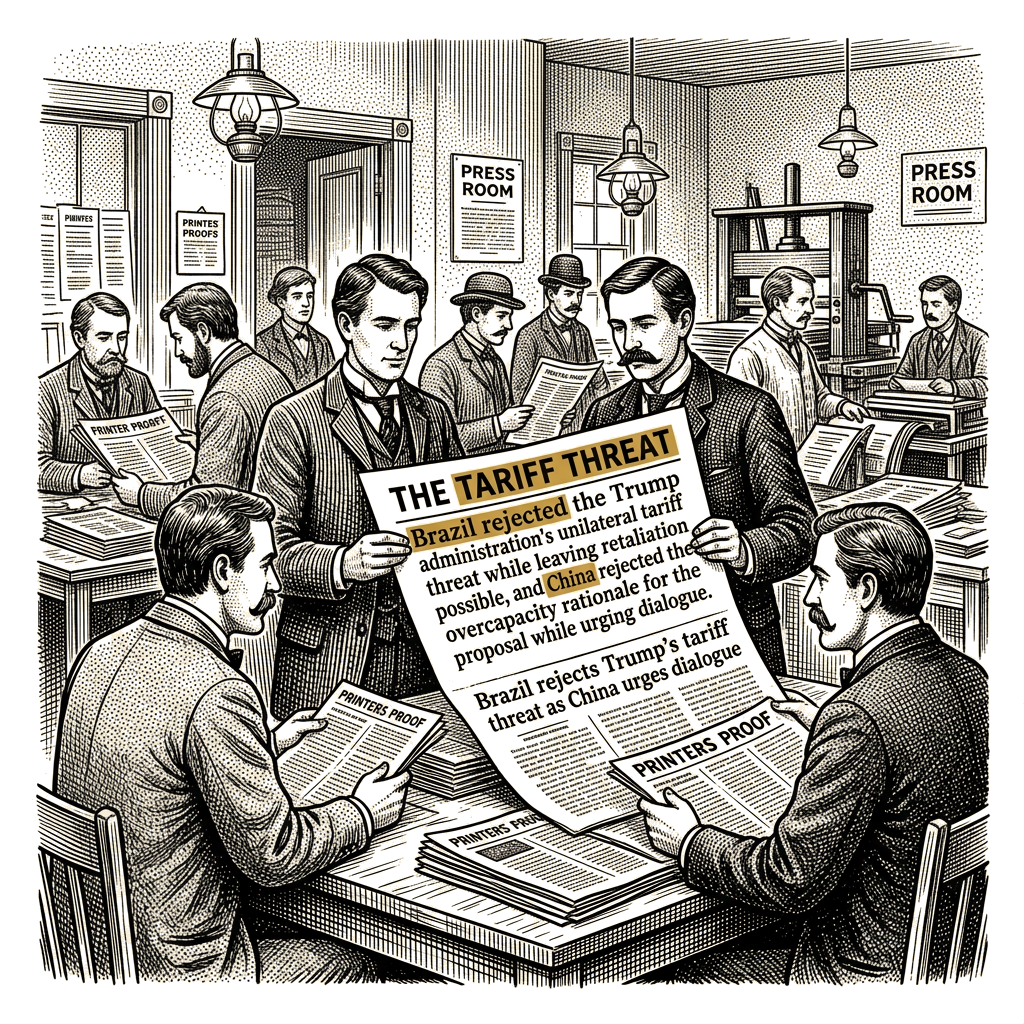
The Trump administration’s proposed tariffs on 14 major trading partners drew objections from Brazil and China, which chose different responses. Brazil’s government said Wednesday that the United States’ unilateral decision was unacceptable after trade talks stalled. China’s foreign ministry called for dialogue, while a Chinese embassy spokesperson rejected the overcapacity allegation behind the levies. Brazil left retaliation possible, while China stopped short of threatening it.
Brazil’s government said on Wednesday: “Brazil will not yield to this type of threat”, adding in its statement that the “unilateral decision constitutes an unacceptable action within the framework of the ongoing bilateral negotiating process”. It voiced particular indignation at US proposals for higher import taxes for raw and refined sugar and a new 10% tariff on aircraft, a change that would hit Embraer, Brazil’s largest aircraft maker. It added that Brazil would continue to negotiate “without ruling out the possibility of adopting retaliatory measures in response to the illegal and unjust imposition of tariffs on Brazilian products”.
The Trump administration claimed on Wednesday that the new tariffs would be consistent with trade deals the US reached last year with dozens of countries. The administration said the proposal relied on a law that allowed the president to target countries the US had found to engage in unreasonable or discriminatory trade practices. Jamieson Greer, the US trade representative, told CNBC that many US trading partners had adopted “market distorting practices that tilt the trade balance in their favour while eroding America’s manufacturing base.”
The administration will seek feedback from affected industries and hold a hearing on 25 January, suggesting final duties will not take effect until February or March.
China was potentially facing one of the biggest increases. The US said China would face the highest capped rate of 20%, which in some cases would be stacked on other import taxes for a total rate of 45%. The US and China reached a trade truce last year that is set to expire on 10 January 2027.
A spokesperson for China’s embassy in Washington rejected allegations that China was a source of excess capacity but stopped short of threatening retaliation. “The so-called issue of ‘industrial overcapacity’ does not really exist and should not be used as a pretext for political manipulation,” the spokesperson said, urging both sides to deliver jointly on agreements secured between Donald Trump and Chinese leader Xi Jinping. Earlier, China’s foreign ministry restated its opposition while calling for the US to resolve the issue through dialogue. Spokesperson Guo Jiakun said: “A tariff war or a trade war serves no party’s interests.”
Greer told CNBC that the administration was proposing a “broad exemption” for $30bn worth of Chinese goods in line with the deal. “We’ve talked to our trading partners about this – they know what we’re proposing,” Greer told CNBC. “I think a lot of this is baked in.”
Some US analysts criticised the duties as too weak to change China’s trade practices. Derek Scissors, a senior fellow at the American Enterprise Institute, said China “is a bigger source of excess production than the rest of the world combined.” He said Wednesday’s proposal “barely raises existing tariffs on China and will make no difference to the country’s trade behaviour.”
Vietnam’s trade ministry said it was working with the US to complete its trade deal as soon as possible and would coordinate with relevant US agencies. It added that it was preparing and submitting rebuttal comments on the preliminary findings and on inaccurate submissions and allegations made by interested parties.
The Indian government denied it had any structural excess capacity in any sector and said it remained committed to an early conclusion of a trade deal with the US. Greer said the tariff on Indian imports would be capped at 17% if a deal was struck.
Taiwan was singled out for new tariffs, but Taipei said Thursday it was confident it would keep its existing 15% tariff rate. Taipei and Washington signed trade deals in January and February of this year that secured preferential treatment for semiconductors and other tech products, which account for over 70% of Taiwan’s exports to the US.
Other affected countries and regions include Bangladesh, Cambodia, the European Union, Indonesia, Japan, South Korea, Malaysia, Singapore, Switzerland and Thailand. Japan’s top government spokesman, Minoru Kihara, said it was “regrettable that a proposed measure targeting Japan has been announced”.
Trump’s proposed tariffs may remain in place despite the Democrats’ electoral sweep in the US midterms. Some Democrats will likely support some of the tariffs, particularly on China, and Trump can veto legislation seeking to overturn the import taxes. Ron Wyden, a Democratic senator from Oregon who will take over the finance committee next year, said he would “use every tool at my disposal to end Trump’s tariffs chaos.” He said, “This is another blatant attempt by Donald Trump to reconstruct his illegal global tariffs,” adding, “Global overcapacity is a serious problem, but Trump’s unilateral price-hiking tariffs are not the solution.”