Asylum denial rates reached 94% in June amid court overhaul
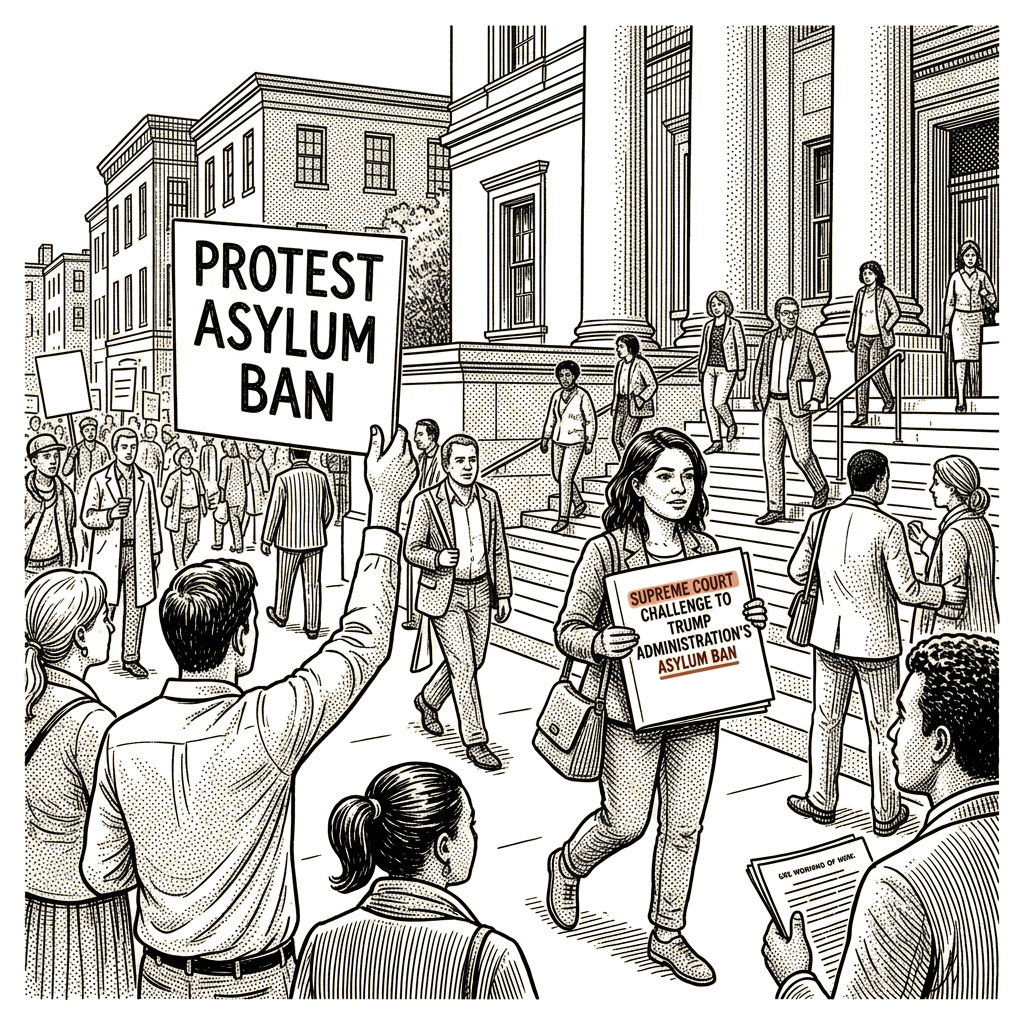
The U.S. Supreme Court will soon consider whether the Trump administration may unilaterally suspend access to asylum protections at the U.S.-Mexico border by circumventing Congress and existing federal immigration law. The challenge concerns a presidential ban that took effect within hours of President Donald Trump’s return to office. Two lower federal courts have rejected the administration’s position, but the ban remains largely in place while the case continues through the courts.
For nearly two years, the administration has prohibited asylum claims at the U.S.-Mexico border, canceled thousands of pending asylum applications and overhauled the immigration court system through mass firings. Critics say the combination has effectively shut down a once-vital pathway for people fleeing persecution or danger. The Supreme Court case is the latest challenge to the administration’s broader immigration changes; critics say those changes have robbed asylum seekers of basic due process rights and transformed the immigration court system into a deportation arm of Immigration and Customs Enforcement.
In legal filings, the Trump administration has insisted that the proclamation is necessary protection against an “invasion” along the southern border and has cited what President Trump and conservative critics have long described as abuse of the system by “fake” asylum seekers. Since the ban took effect, crossings have plummeted. U.S. Customs and Border Protection data show that Border Patrol apprehensions fell to their lowest level in agency history this year. The agency recorded fewer than 99,000 Southwest border apprehensions in fiscal year 2026, a 95% decline compared with more than 1.8 million per year under President Biden.
Simon Hankinson, a senior research fellow with the Border Security and Immigration Center at the Heritage Foundation, a conservative think tank closely aligned with Trump, told NPR: “The difference between an average month under Trump and an average month under Biden is just staggering.” Hankinson said a Supreme Court ruling against the ban would be disastrous.
Hankinson contended that most people arriving at the southern border do not qualify for asylum. Even if they did, he said, they had passed through Mexico, which he described as a safe third country where they could claim asylum, especially if they came from Venezuela or Afghanistan. He said the population overwhelmingly would not qualify under U.S. law for asylum and that people were in the United States because they wanted a job.
Immigrant-rights advocates argue that the administration’s policies have gutted access to asylum. Lee Gelernt, lead counsel and deputy director of the American Civil Liberties Union’s Immigrants’ Rights Project, one of the groups behind the challenge to the asylum ban, said: “The president does not have the right to unilaterally override the protections Congress has afforded those fleeing danger.” Gelernt added: “The courts are right to reject this unprecedented power grab that would put countless lives in danger. We look forward to making our case before the Supreme Court.”
If the majority-conservative Supreme Court rules for immigrant-rights groups, advocates say, the decisions could break what they describe as the administration’s choke hold on asylum approvals, which are at their lowest level in decades. TRAC, a research project at Syracuse University that tracks data about immigration judges, reported that the national asylum denial rate reached 94% in June, up from about 50% in 2024, the last full year of the Biden administration.
In December, the Supreme Court will separately review the administration’s strategy of deporting immigrants to third countries that have agreed to adjudicate asylum claims. Some of those countries face human rights abuse allegations and cannot guarantee that someone seeking asylum will not be returned to their home nation. The administration also faces a third legal battle that could end its attempt to indefinitely detain thousands of people in deportation proceedings.
To curb asylum applications and reduce a backlog of cases at U.S. Citizenship and Immigration Services, the administration urged Immigration and Customs Enforcement attorneys to terminate asylum claims by convincing immigration judges that an application was incomplete or that a claimant could not substantiate it. The administration could also argue, as it did in ZG’s case, that the person could apply for asylum in a third country. The Department of Homeland Security has canceled thousands of pending cases as the strategy takes effect.
That policy backdrop has particular consequences for Madhavi Narayanan, a Los Angeles-based immigration attorney with Human Rights First. Advocates say a Supreme Court ruling could be lifesaving for several of her clients. Narayanan is currently representing immigrants who, before Trump’s second term, would have had what she calls “slam dunk” asylum petitions.
One is ZG, a 30-something Ethiopian man who arrived in the United States through Mexico in February 2025 after enduring extensive torture in Ethiopia. Narayanan requested that NPR use only ZG because he fears retribution from the Ethiopian government. He turned himself in at the southern border, was detained and immediately filed an asylum petition.
Narayanan said ZG belongs to an Indigenous group in Ethiopia that is involved in an ongoing armed conflict. Human rights organizations have reported that the group is at risk of committing further atrocities against civilians. Narayanan, who has been working on the case for nine months, said she produced documents and letters supporting his claims of torture. “Any other time, it would have been a really straightforward case,” she said, adding that human rights reports show people in ZG’s position face a high risk of violence and death if they return to Ethiopia.
Instead of an immigration hearing, ZG received a deportation order this month to Uganda, a country he had never visited and one that does not recognize the military violence in Ethiopia as a war. Narayanan said the changes had all but eliminated due process rights, including evidentiary hearings, and cleared the way for summary removals. New guidelines also limit judges’ autonomy, she said. Recounting the judge’s statement, Narayanan said: “OK, I hear everything that you said, but I read this case and I’m not allowed to consider this.”
According to the Executive Office for Immigration Review, nearly 60 policy memorandums have been issued so far during the second Trump administration, compared with 30 immigration-court-related memorandums during Biden’s four-year term. The administration also removed more than 100 experienced immigration judges. Jennifer Peyton, a former assistant chief immigration judge in Chicago, was fired by email in July 2025 after more than nine years on the bench. She said immigration courts across the country have become unrecognizable. “Everything is different now,” she said.
During Trump’s first year back in office, nearly 40% of immigration judges were fired or resigned. Nearly all were replaced with judges whom the administration calls “deportation judges”; critics say they are ideologically aligned with the president’s immigration agenda and eager to approve asylum denials and expedited removal orders. That shift, along with Trump’s previous appointees, has overhauled the immigration bench. More than half of immigration judges now are Trump appointees.
Very few of the new immigration judges have experience working on behalf of migrants. About two-thirds come from a homeland security or military legal background, according to an essay in The Yale Law Journal by Geoffrey Heeren, an immigration law and policy professor at the University of Idaho. Heeren wrote that “only about eleven of the new [immigration judges] have clear prior immigrant-defense experience, and of those, only one does not also have DHS or military legal experience.”
Peyton previously served on the Justice Department’s immigration-judge hiring-and-training team and now represents asylum seekers before some of the same judges she helped train. She said she feels more comfortable before judges who received that training but is often dismayed by unfamiliar hires. “There is no doubt in my mind, when I have the misfortune to appear before them, that they don’t know the immigration law so much and they don’t care that they lack the training that we so rigorously put them through when I was on that team,” Peyton said. She added: “The vast majority have not been taught the process of evaluating a case, but rather the shortcuts to make sure that these procedural roadblocks come up, to make sure that the noncitizens are stripped of their due process.”
MSI previously reported on the administration’s five-part immigration strategy, including changes to asylum access and the immigration court system. The Supreme Court’s review of the asylum ban advances that broader legal fight by placing one of the administration’s immigration restrictions before the high court.