Quebec face-covering ban cannot apply to elected officials
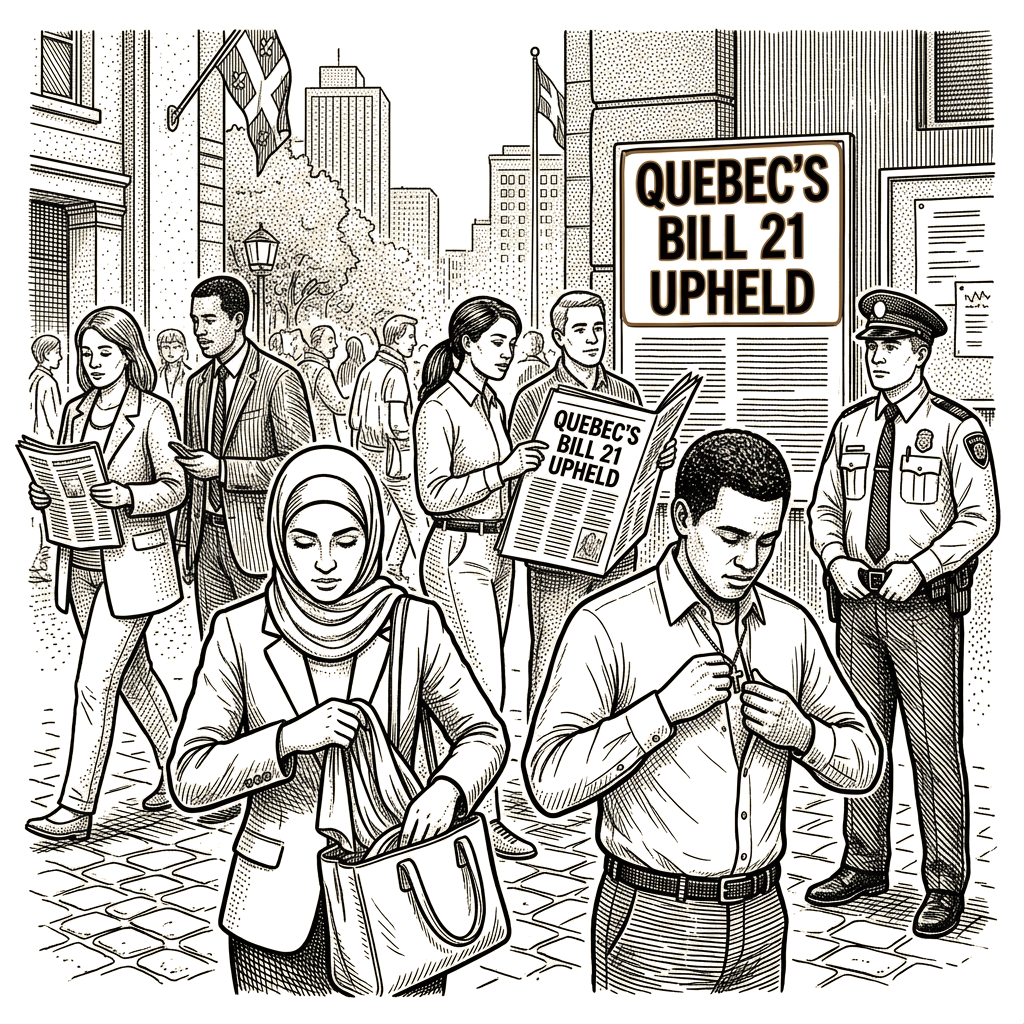
The Supreme Court on Friday largely upheld Quebec’s Bill 21, the 2019 law barring public-sector workers from wearing religious symbols. The law covers symbols including the hijab and cross, and most of its restrictions remained in force after the ruling.
Bill 21 faced legal challenges from a range of groups, including female Muslim, Sikh and Catholic teachers. The teachers argued that the law violated their fundamental rights.
Quebec passed the law under the notwithstanding clause, a provision of Canada’s constitution that permits governments to override certain rights, including freedom of religion. The clause’s use was central to the court’s ruling.
The court ruled that Quebec’s use of the clause is valid and that Bill 21’s prohibition on public-sector workers wearing religious symbols can stand. The ruling upheld the law’s central restriction rather than invalidating the overall measure.
The exception concerns a section barring elected officials in Quebec’s legislature from wearing a face covering. The court found that the provision violates a section of the Canadian Charter protecting the democratic rights of all citizens. Those rights are not covered by the notwithstanding clause.
The court said barring elected officials from wearing a face covering would infringe an individual’s right to run for public office. As a result, Quebec cannot enforce that face-covering restriction against elected officials.
The court’s majority also addressed the scope of judicial review after a government invokes the notwithstanding clause. It ruled that a Canadian court can declare whether a law is consistent with Charter rights even when the clause has been used. That authority remains available despite a government’s reliance on the clause.
The majority would not use that authority to decide whether Bill 21 was consistent with the Canadian Charter in this case. Instead, it accepted Quebec’s invocation of the clause for most of the law while separately holding that the face-covering provision fell outside the clause’s reach.
BBC News described the decision as one of the most closely watched in Canadian history and said its impact would be felt both in Quebec and across the country. The ruling centered on the limits of Quebec’s constitutional mechanism and the democratic rights of elected officials.
The result leaves the religious-symbol ban applicable to public-sector workers while preventing Quebec from enforcing its face-covering restriction for elected officials. It also leaves a Canadian court able to assess Charter consistency, although the majority did not undertake that assessment in this case.