Federal government asks court to limit section 33’s override powers
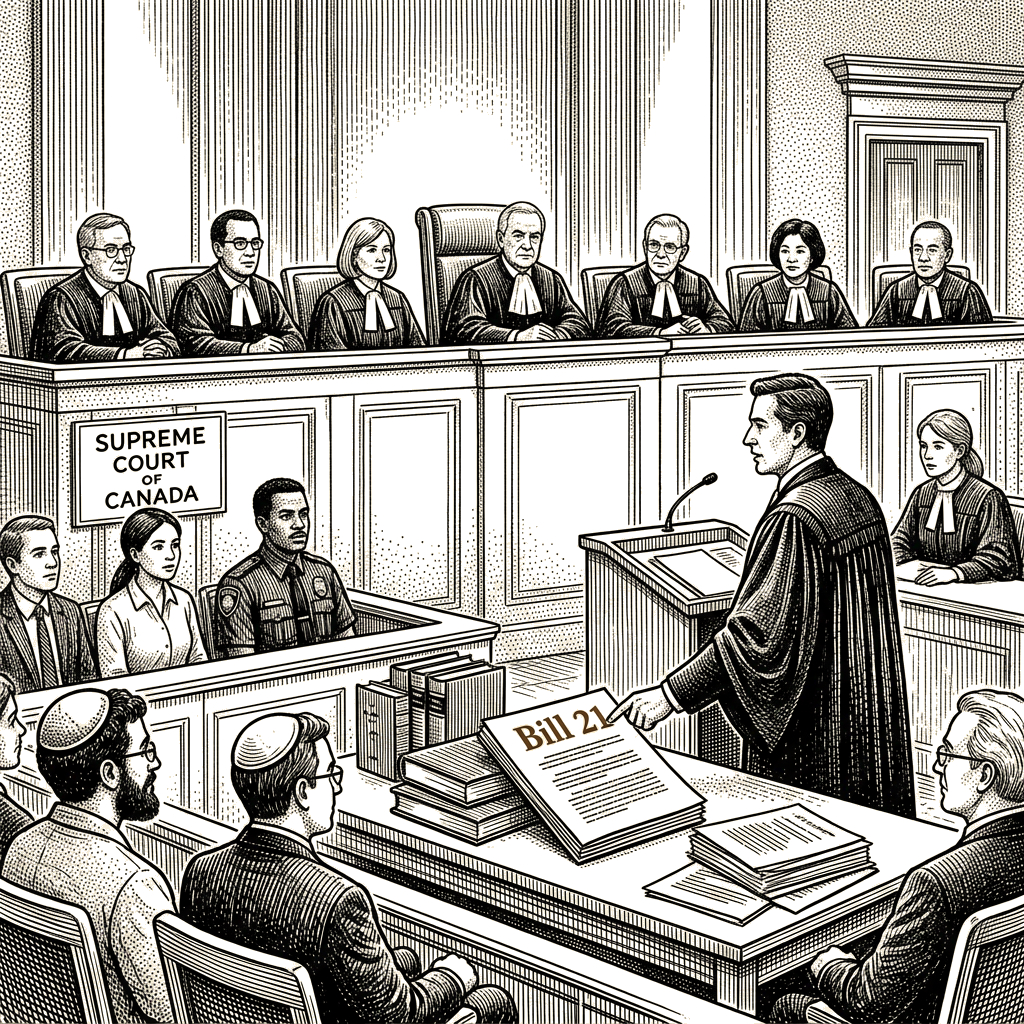
Canada’s Supreme Court is set to rule Friday on a constitutional challenge to Quebec’s Bill 21, which bars civil servants including judges, police officers and teachers from wearing religious symbols at work. The court must consider both whether the law is valid and whether Quebec properly invoked section 33 of the Canadian constitution, the notwithstanding clause that allows governments to override certain Charter rights. More than 50 interveners, including the federal government, took part in four days of hearings in March.
Bill 21 was passed in 2019 by the Coalition Avenir Quebec, then the provincial government, as part of Quebec’s state secularism, or laïcité. The report noted that Quebec’s secularism is central to the province’s identity, as it is in France. Supporters compare religious neutrality in state institutions to separation of church and state and say the law is a reasonable step toward enshrining that separation. Critics say the law is discriminatory, has made integration more difficult for religious minorities and unfairly targets Muslim women. The legislation does not single out any religion. In an attempt to insulate the legislation from legal battles, the Coalition Avenir Quebec pre-emptively included section 33 in the bill.
The Canadian Civil Liberties Association called Quebec’s arguments in court “spine-chilling.” In a March op-ed in the French-language newspaper Le Devoir, the association asked: “Could a government invoke [the clause] to ban abortion? To criminalise political speech critical of the government? To legalise torture?” It added: “According to the Quebec government’s logic, even in such cases, the courts would not only be powerless but also bound to silence.”
Section 33 allows provincial or federal governments to override certain Charter rights involving religion, expression and association, as well as legal and equality rights. The provision is subject to renewal and, in theory, can be extended indefinitely; democratic and language rights are excluded. It was introduced in the early 1980s as Canada sought to repatriate its constitution from the United Kingdom and adopt a Charter of Rights and Freedoms similar to the US Bill of Rights. The agreement was intended to bring all provinces on board, including those concerned that a rights charter would give courts more power than elected legislatures. The report described section 33 as a unique Canadian invention, brought in as a “safety valve.”
Quebec has invoked section 33 several times over the past few decades, and other provinces have also increasingly employed it. Ontario invoked it to cut the size of Toronto’s city council; Alberta used it to order striking teachers back to work; and Saskatchewan required parental consent before students under 16 could change their names or pronouns at school. Critics say these uses go beyond the general understanding that the clause is a last resort.
The CCLA and Ichrak Nourel Hak, a Muslim teacher in Quebec who wears a hijab, were among those seeking leave to appeal. In a March statement, they said Bill 21 was infringing on the dignity, rights and freedoms of people who work in or aspire to work in the public service. They also said the law had a disproportionate impact on specific religious minority groups, including Muslim, Sikh and Jewish communities.
In court, a lawyer for the CCLA, the National Council of Canadian Muslims and Hak argued that unrestricted use of section 33 could allow a simple legislative majority to effectively amend the constitution through the backdoor. Quebec’s government argues that whether Bill 21 restricts individual freedoms is not the issue because section 33 shields it. Quebec argued that “Section 33 constitutes, in a way, one of the cornerstones of the Canadian Charter.” The province says the law protects religious neutrality and a shared civic identity. The province argues that preemptive use of the clause is allowed and consistent with Supreme Court precedent.
The court has been asked whether Bill 21 itself is constitutionally valid, whether Quebec used section 33 properly and whether limits apply to the override clause. Many participants, including the federal government, have asked for limits. Federal Justice Minister Sean Fraser said in September that the decision would shape how both federal and provincial governments could use section 33 for years to come, calling Canada’s rights charter a “pillar of our democracy and a reflection of our shared values.” Federal court filings argue that section 33 cannot function as an unlimited authorization and should not be used to distort or annihilate Charter rights or reduce them beyond recognition. The government did not take a position on Bill 21’s merits.
That federal argument received rapid pushback from the provinces, many of whom are also interveners in the case. Quebec accused Ottawa of staging an “attack on the parliamentary sovereignty of the legislative assemblies of all of Canada.” The leaders of Saskatchewan, Alberta, Ontario, Quebec and Nova Scotia said Ottawa should withdraw its legal arguments, which they said “threaten national unity by seeking to undermine the sovereignty of provincial legislatures.” In a joint statement, they said: “Indeed, the federal government’s position amounts to a direct attack on the foundational constitutional principles of federalism and democracy.” Alberta separately argued in its filings that section 33 was a “hard-fought and hard-won compromise” brought in with the intent to “preserve parliamentary sovereignty.”
Errol Mendes, a University of Ottawa law professor and an intervener for the International Commission of Jurists Canada in the Quebec case, said he and others had warned that the clause was overly broad and could be misused. He said their predictions were coming true as governments used it more frequently. The March hearing was the first time the Supreme Court had considered a challenge to the provision since 1988.
Legal experts said the outcome would have an impact on much more than religious expression in the country. The case has been described as potentially the most important constitutional case in a generation and could test national unity and the balance between courts and elected officials. The BBC report said polls suggest that a majority of people in Quebec support Bill 21. The decision will therefore bear not only on rules governing religious symbols but also on how provincial governments may invoke a constitutional override.