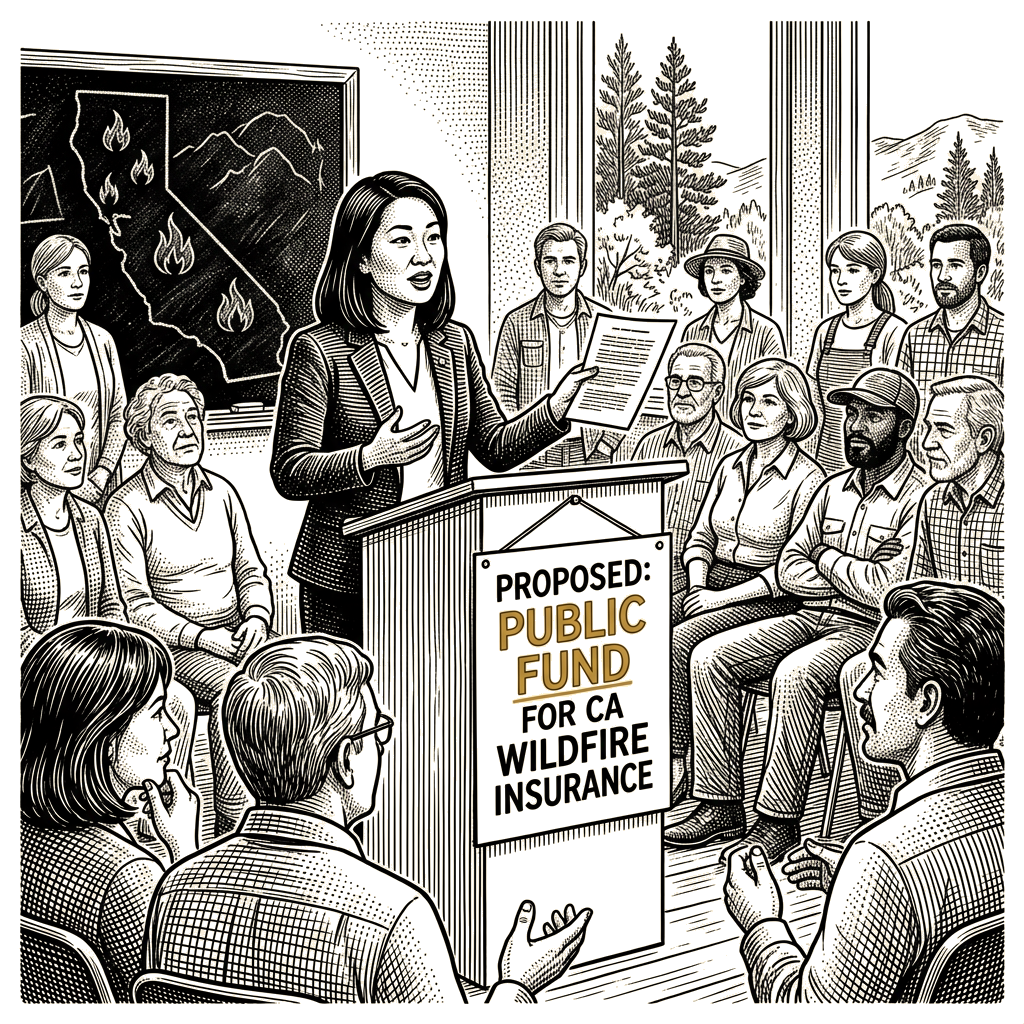
State wildfire coverage would draw $3 billion to $6 billion a year
Jane Kim, elected California’s insurance commissioner in November after campaigning to overhaul the state’s troubled homeowner insurance market, has proposed a publicly run wildfire insurance plan that she says would guarantee every home can obtain coverage. Major insurers are pulling back from the state at the same time that survivors of the January 2025 Los Angeles-area fires — which destroyed nearly 17,000 structures in and around Los Angeles and caused nearly $4 billion in losses — are struggling to have claims paid.
Kim, a former San Francisco County supervisor backed by Vermont Sen. Bernie Sanders, used her victory speech to argue that insurers had raised premiums, canceled coverage and fought claims for too long. “We are going to take on this trillion dollar industry because they have been profiting for way too long by raising our premiums, canceling our coverage and fighting our claims, and we are going to make it again a system that protects us,” Kim said.
The market Kim wants to overhaul has contracted. State Farm and Allstate are among the major insurers no longer writing new policies in California, and enrollment in the state’s insurance plan of last resort has skyrocketed. Survivors covered on both state and private plans have struggled to get claims paid; a state investigation found State Farm mishandled hundreds of claims by underpaying, denying smoke damage claims and responding slowly. Helping homeowners rebuild, and protecting homes from burning in the first place, has become an increasingly important political issue in California.
Under Kim’s plan, private insurers would keep selling homeowners coverage, but the portion of premiums collected for wildfire insurance would flow into a publicly managed fund of $3 billion to $6 billion. Part of that money would help homeowners retrofit their homes against fire risk, including replacing roofs with fire-resistant materials.
“Everyone agrees that this is the only way to make insurance more affordable and more available in the long run,” Kim said of her plan to spend more money on prevention. Kim also said U.S. insurers currently invest billions in the fossil fuels industry, which she said is worsening the climate disasters they have to pay out for. “We would invest it all back in fireproofing our communities because what we actually want is less claims to pay out in the future,” Kim said.
Consumers would see little change in how they buy insurance. California residents pay about $18 billion in homeowners insurance collectively, with roughly $3 billion to $6 billion of that going toward wildfire coverage; under Kim’s plan, carriers would pay that $3 billion to $6 billion to the state. The program would not be priced differently than the current market, still factoring in wildfire risk and home values, so homeowners in areas considered high-risk, such as those close to forests and brush, would likely still pay high premiums. They would be guaranteed insurance.
Skeptics question the details. Insurance trade groups and consumer advocates alike have expressed skepticism, asking who will foot the bill for getting the program started. Rex Frasier, president of the Personal Insurance Federation of California, said the industry has not been consulted on Kim’s proposal and said he hopes private insurers can keep participating in wildfire coverage if they want to rather than being forced out. “We have lots of thoughts about how we can make things work, and we haven’t really been consulted,” he said.
Joy Chen, executive director of the Every Fire Survivor Network, was forced out of her home for several months after the January 2025 fires. Chen said the state’s current wildfire insurance system is “impeding the entire Los Angeles recovery and putting every Californian at risk.” She said many survivors in her organization had private insurance for decades before being forced onto the state’s insurance plan of last resort, some months before the fires, which meant the companies they had paid premiums to for years had no responsibility to help them after their homes were lost or destroyed.
Survivors in Chen’s network are willing to consider a different system, she said. “The fact that Jane Kim wants to overhaul the system, come up with something completely new and better … we’re open to it,” she said.
Kim drew on New Zealand, where a Natural Hazards program provides the first layer of coverage for events including tsunamis, landslides, volcanic activity, earthquakes and geothermal activity. All homeowners there pay a levy that goes into a government-managed fund used for claim payments, climate research and reinsurance.
Public insurance programs have had varying levels of success in the United States. The best known is the National Flood Insurance Program, established in 1968 to cover flood losses. Congress directed the program to subsidize premiums for many years, resulting in a large budget deficit, and the program has had to borrow billions of dollars, primarily because of Hurricanes Katrina and Sandy. It had accumulated $25 billion of debt by August 2017, and in recent years has moved toward charging risk-based rates. Critics say it is important that any potential wildfire insurance plan does not subsidize premiums.
California already operates a public-private arrangement for earthquake coverage. The California Earthquake Authority was established after the 1994 Northridge earthquake, which struck the greater Los Angeles area and caused up to $20 billion in damage and $40 billion in economic loss. A group of private insurance companies sells residential earthquake insurance while the fund is publicly managed, and the program covers a little over 60% of residential earthquake policies in California. It relies heavily on private reinsurance — insurance for insurers — which costs more than $8 billion per year.
Lloyd Dixon, a senior economist at the RAND Corp. who sits on the California Earthquake Authority governing board, said a public program has advantages in not having to charge a profit and in being able to borrow money at lower rates. “It really depends on how it’s structured. I think they can be implemented well, and they could be implemented poorly,” Dixon said of public insurance programs.
A state-sponsored study released in April examined the option of a public wildfire insurer and found the program would need about $25 billion of starting capital, or only $6 billion if it purchased $2 billion to $3 billion a year in reinsurance. The study also found the approach could lead to higher premiums.
Insurers have long argued that California’s insurance woes stem from Proposition 103, a voter-passed law from 1988 that requires the insurance commissioner to approve rate increases. The companies said they could not charge enough premiums to cover the cost of claims, forcing them to leave the market. Insurers have more recently been able to use models that allow for the consideration of climate change in fire risk and to charge policyholders for reinsurance costs, and some carriers have started to write new policies in the state again.
Kim has said she will explore requiring insurers to contribute to starting capital and seek new funding sources, such as local governments and utilities. Experts said public insurance programs are not without precedent in the United States or other countries, but that executing one in California would be a delicate balancing act. Under Kim’s proposal, every home would have access to wildfire coverage while the state directs part of the premium dollar toward hardening homes. The unsettled questions are how much capital the fund would need, who would provide it, and whether the program would avoid the premium subsidies that critics of the federal flood program warn against.