
The fossil fuel industry is burning North American forests to keep selling the fuel that is cooking them.
The smoke came down on Adams County on a Tuesday this week, the kind of grey-blue haze that sits on Lake Petenwell and makes the sun look like it owes somebody money. I was at the bench at nine in the morning looking out past the Polaris shed, and the air tasted like the inside of an old wood stove. The twelve-year notebook on the bench records that we have had smoke here in nine of the last twelve Junes and Julys. It used to come maybe twice a decade.
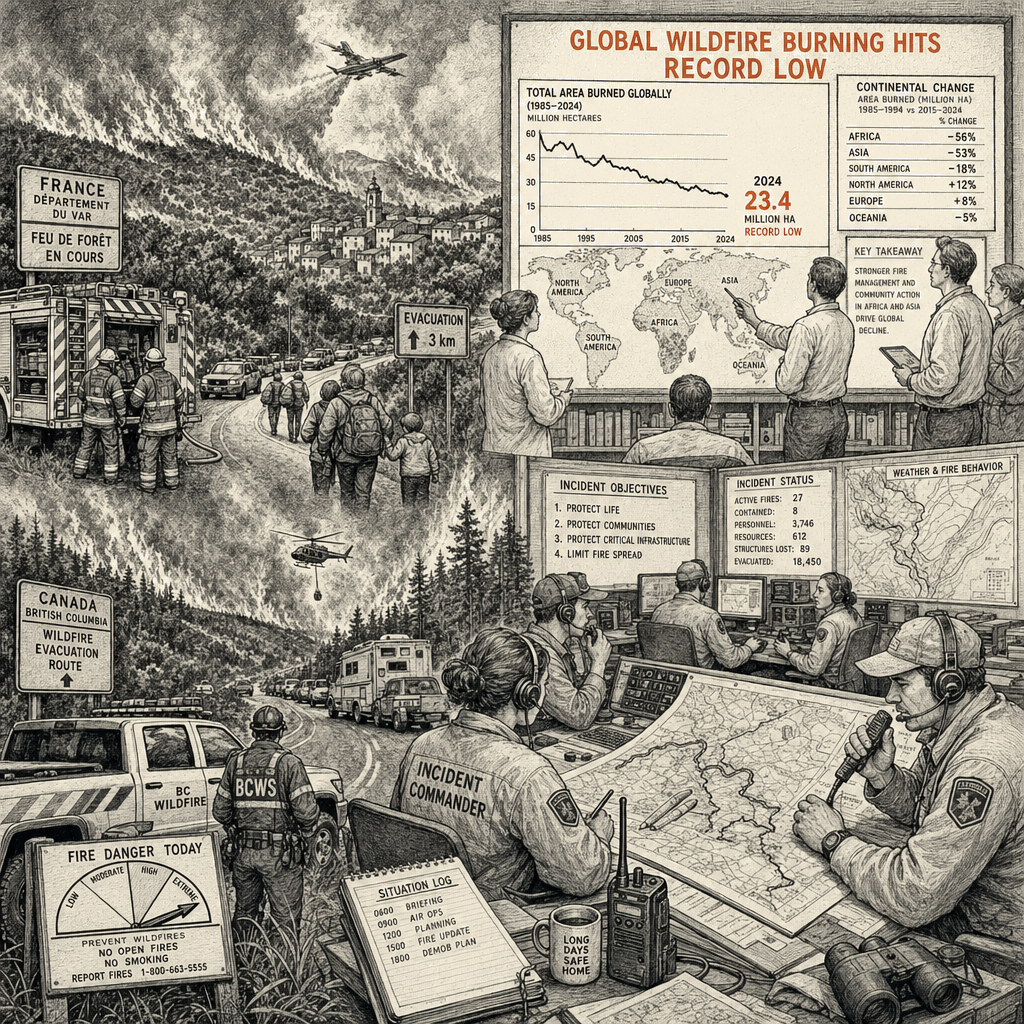
The scientists who published the new numbers this week say the same thing from the other side of the data. Global wildfire burning has fallen to record lows. Extreme fires across Europe and North America are getting worse at the same time. Jennifer Balch at the University of Colorado is right that the piece worth being shaken about is the extreme-fire part. Mike Flannigan at Thompson Rivers University is right that it looks like a paradox. It is not a paradox. Both numbers are true.
What is driving the global total down is that Africa and Asia manage fire better than they used to. More people, more agriculture, less open burning of savanna and cropland. The Democratic Republic of the Congo and Indonesia both built fire-monitoring and response systems that cut their annual burned area by double-digit percentages in the last decade. Agricultural intensification replaced rotational burning across the Sahel and Southeast Asia, and satellite-based early detection lets governments strike fires before they spread. That is a genuine human achievement. It is a land-use story about choices people made.
What is driving extreme fires up is the thing we have done to the atmosphere. The heat waves we have been writing about all summer — the one that killed well over ten thousand people in Europe last month, the one the attribution studies say was impossible without the warming already in the system — dry out the fuel load earlier in the season and turn what would have been a manageable fire into a crown fire nobody can stop. A hotter atmosphere pulls moisture out of vegetation faster. A longer fire season gives more time for a fire to grow. Those mechanisms are physics.
The fossil fuel industry has known this was coming. Exxon scientists told the company in the late 1970s what their product was doing to the atmosphere. The American Petroleum Institute ran a 1998 campaign — leaked, on the record — whose stated goal was “victory” defined as public uncertainty about climate science. The Heartland Institute took Philip Morris money in the 1990s to build the doubt apparatus for tobacco and pivoted the same architecture directly to climate. Naomi Oreskes and Erik Conway have stood the whole pattern up in the public record, with names in the documents. The industry kept selling the fuel while funding the people who told the rest of us the fuel was fine.
That fuel is what is cooking the forests now.
The smoke Adams County is breathing this week came from Canadian boreal — spruce and jack pine on a fire season that started three weeks earlier than it did twelve years ago. The notebook records the Wisconsin DNR’s first “very high” fire-danger rating for Adams County on April 11 in 2014. Last year it was March 22. That is not a paradox. That is a three-week shift in a single county, and it sits inside the larger signal: the United States and Canada have run the burned area this summer at least a quarter above the ten-year average. France’s president warned this week that his country faces its worst wildfire crisis since World War II. Spain’s largest fire on record has already burned more than five hundred square kilometers. The carbon-budget office in Washington can read the global number and decide fire suppression can be cut. The state forester in Wisconsin reads the local number and decides every season is the worst season. The resource allocations those two readings produce are incompatible, and the collision is coming to a county commission meeting near you.
Last summer the smoke from Quebec turned the sky over Adams County the color of a bad bruise for three days. The air-quality index hit numbers that, on this continent, mostly appear on the EPA website for Beijing. Mike is eight. He has never had a summer without smoke. Quinn is five. She asks me why the sky is hazy most days this month. I tell her there are fires in Canada. She asks if the fires are going to come here. I say no, the fires are far away, but the smoke travels. She says that is weird. She is five and she already knows that the weather is doing things the grown-ups did not prepare her for.
Aldo Leopold wrote in A Sand County Almanac that “one of the penalties of an ecological education is that one lives alone in a world of wounds.” He was talking about what happens when you learn to see the damage other people miss. The current moment in fire science is the version of that on a planetary scale. The global number says everything is fine. The local number says everything is on fire. Both are true, and the gap between them is where the fossil fuel industry’s legacy lives — a rewired climate system that makes the fires that do happen worse than anything in the historical record, while the aggregate statistic lets the casual reader scroll past.
Wendell Berry wrote in The Unsettling of America that a community’s economy is its membership, and that extraction destroys the membership before it destroys the economy. The fossil fuel industry has been extracting the membership of North American forests for fifty years and calling it fuel sales. The forests burning down this summer are the membership. The towns under the smoke are the membership. The kids with asthma in La Crosse and Eau Claire are the membership. The fuel is still being sold at the pump in Friendship because the people selling it have known since 1977 what it does.
I will keep the notebook. I will keep sharpening the chainsaws in October for the neighbors who bring them in. I will keep my eyes open in the woods for what the woods are telling me. I will keep writing down what the notebook says, because somebody has to.