
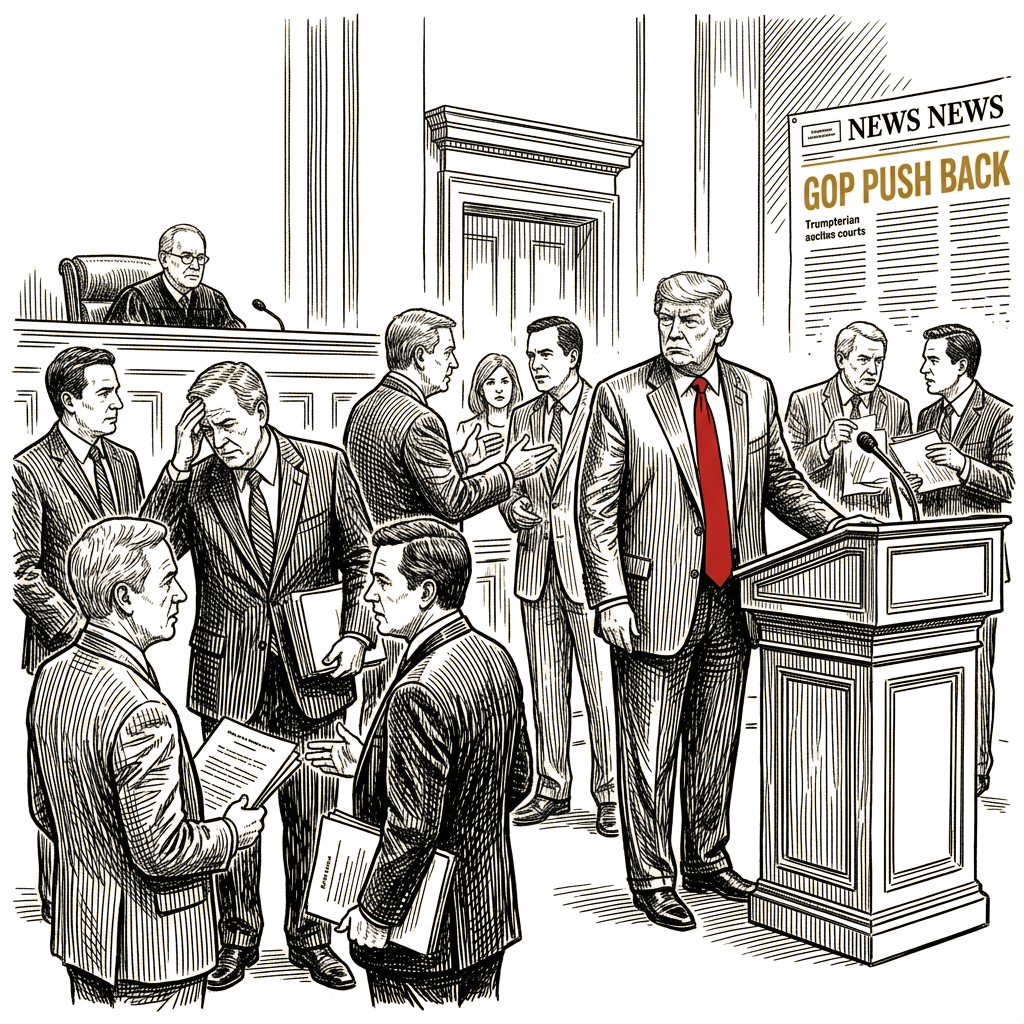
The White House revoked the press credentials of CNN, Politico, and MS Now because their coverage displeased the president.
That is the charge. A federal court agreed.
Before examining what the court found, the executive’s claim deserves reconstruction on its own terms. The White House maintained that press passes are discretionary privileges, not constitutional entitlements. The argument holds that credentialing criteria exist to manage security and logistics inside a working residence, that outlets failing to meet those criteria may be excluded without implicating the First Amendment, and that no journalist possesses a freestanding right to a particular vantage point inside the executive mansion. This is the strongest version of the government’s position, and it is the version the court rejected.
Judge Timothy McFadden of the United States District Court for the District of Columbia issued a temporary restraining order on September 24 directing the administration to “immediately return, reinstate and restore” access to all three outlets. The order rested on a straightforward constitutional principle: the government may not revoke press credentials as retaliation for coverage it dislikes. The White House had publicly stated that the outlets were excluded for failing to meet “news standards.” The court found the stated rationale pretextual. Viewpoint discrimination in the denial of a government benefit — here, access to the White House grounds — violates the First Amendment’s prohibition on retaliation against protected speech. The analysis is not novel. Sherrill v. Knight, 569 F. Supp. 1563 (D.D.C. 1983), established decades ago that the White House press pool is a limited public forum and that credential decisions must rest on objective, viewpoint-neutral criteria. The administration offered none that survived scrutiny.
The ruling does not establish that every administration policy toward the press is unconstitutional. It establishes that this administration revoked press credentials for an impermissible reason, and that a federal court said so in a binding order.
That distinction matters because the press ban is not an isolated incident. It is one node in a pattern of executive retaliation against institutions exercising independent authority. The Supreme Court blocked new administration restrictions on mail-in ballots for the November midterms. A separate federal judge blocked Trump’s attempt to rename the Kennedy Center after himself — an executive action Trump accompanied by threatening the national arts complex with demolition. The Federal Reserve declined to follow the president’s lead on interest rates. The administration responded to each institutional check with the same reflex: retaliation, contempt, and escalation.
None of those checks proves that every independent institution is wise. The Federal Reserve’s rate decision is not a verdict on every administration policy. The Court’s ballot ruling does not make the Court a neutral instrument of democratic reform. The Kennedy Center’s name does not require judicial protection on its own merits. But a president who treats each check as an attack does not become stronger when the institutions hold. He becomes more dangerous, because resistance leaves him reaching for powers with fewer ordinary restraints.
The press ban is the clearest case because the primary document is the judge’s order itself. The White House did not argue that the three outlets presented genuine security concerns, lacked journalistic capacity, or failed credentials procedures applied uniformly across the press corps. The administration argued that its own criteria entitled it to discretion. The court found that discretion exercised on the basis of viewpoint — punishing outlets for coverage the administration found unfavorable — is the thing the First Amendment was written to prevent.
Allan Lichtman, the American University historian, identified the dynamic underneath the legal pattern: a president who cannot tolerate losing the center of attention will use every available tool to reclaim it. “He doesn’t care about the courts and doesn’t care about the Congress,” Lichtman said. The press ban confirms the observation in the operative document. The judge’s order is the record of what happens when a president who does not care about the courts meets a court that does not care about his displeasure.
The gazelles are smelling the wind. The court order restoring press access is one. The ballot ruling is another. The Kennedy Center injunction is a third. None of these checks eliminates the danger Lichtman identifies. A president who treats a federal restraining order as a suggestion rather than a command has not been constrained. He has been identified. The difference between a president who respects judicial authority and one who does not is not a difference of degree. It is a difference of kind. The country should stop measuring his approval rating and start measuring how many institutions still hold.