
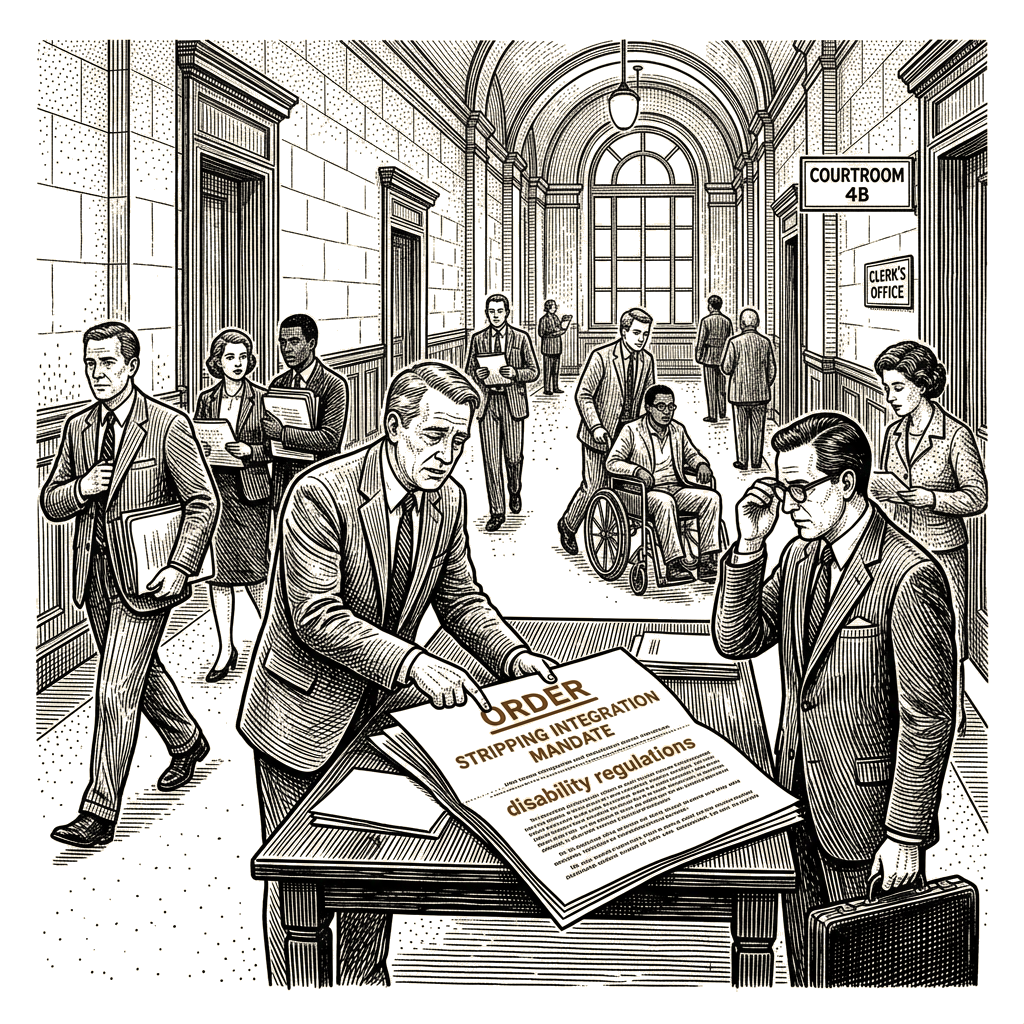
The most striking thing about last week’s ruling in Texas v. Kennedy is not that a federal judge stripped the integration mandate out of the Section 504 regulations. It is that the federal government asked her to.
For nearly fifty years — since 1973, when Congress passed Section 504 of the Rehabilitation Act, the first civil rights law for disabled Americans, and then for years afterward, until 1977, when regulations finally made the law enforceable — the United States has stood for a simple principle: people with disabilities have the right to live, work, and learn in the most integrated setting possible. Not in nursing homes. Not in institutions. In their communities.
Last week, the Department of Justice asked a federal court to throw that out. The judge agreed. “That is not a tragedy,” its defenders say. “That is how the system is supposed to work.”
The procedural posture is what makes this devastating. Texas v. Kennedy was brought by states challenging the integration mandate. The federal government was the defendant. Then it switched sides, agreed with the states, declined to defend its own rules, and asked the court to vacate them. “It is pretty significant and pretty unprecedented to see the federal government asking a court to vacate its own rules,” said Jennifer Mathis of the Bazelon Center for Mental Health Law.
And this is not abstract. The same administration that switched sides in Texas v. Kennedy told a federal court in August to throw out its own 2023 victory against Florida. The case began in 2013, when the federal government sued the state over services for children with complex medical needs, and it forced Florida to provide in-home care to those children so their families would not be pushed into nursing facilities. In August, the Justice Department asked the court to vacate that win so the case could be reheard in light of the new position, citing its new position on integration as the reason. Read that again: the federal government is asking courts to undo rulings that kept disabled children out of institutions.
Bruce Darling, president of the Center for Disability Rights, called the news “like a knife in your chest. Because what we’re hearing, what people are hearing, is that the federal government has made a determination that [disabled people] don’t have a right to live in freedom, that they can be locked up against their will.”
The dismantling has been fast and methodical. In June, the Justice Department issued an opinion acknowledging that its prior reading of disability law — that states had to provide services in “the most integrated setting appropriate” — was “out of step with the common understanding” of the Supreme Court’s 1999 Olmstead decision. In July, the department formally stopped relying on the guidance it had used to enforce the mandate. The Health and Human Services regulations updated in 2024 under President Biden to spell out in even greater detail what states had to do to comply became the target of a successful vacatur request — from the government’s own lawyers. The architecture of disability rights is being disassembled piece by piece, not by a legislature that has decided it no longer wants these protections, but by an executive branch that has decided to stop defending them.
The political vocabulary that survives best is the one the rebellion’s own manifesto supplies in Andor: “Tyranny requires constant effort. It breaks, it leaks.” The June opinion, the July withdrawal, the August vacatur request — that is the effort. It is already leaking. But here is what the rollbackers did not count on: the disability rights movement is not waiting for Washington to come to its senses.
The argument the administration makes is not nothing, and it deserves to be stated at its strongest. Section 504 passed in 1973; the regulations that made it enforceable came only in 1977, after years of activist pressure, and they have been expanded, litigated, and re-expanded ever since. The integration mandate was not written into the face of a statute that says very little about where people with disabilities must live. It was built, layer by regulatory layer, on top of it — producing an enormous enforcement apparatus, thousands of pages of regulation, and a steady drumbeat of lawsuits against states. And the underlying complaint, that a federal apparatus dictates placement decisions and forces states into particular service-delivery models regardless of what disabled individuals and their families actually prefer, describes something real. “The mandate did not free anyone from institutions,” its defenders say. “It is not a rollback. It is a return.” “States are not going to start warehousing disabled children.”
The framing is upside down. The federalism argument treats the enforcement apparatus as the problem. The apparatus is the delivery system. What the mandate actually did — what the Florida case proves it did — was give a family a choice it would not otherwise have had. Remove the floor and you do not liberate a state’s discretion. You remove the ground under the family.
And the claim doing the heaviest lifting in the entire defense — that the mandate “did not produce, in any demonstrable way, better outcomes for disabled people than the state-level systems it displaced” — arrives without a demonstration. It is a blanket claim carrying an entire case on its back while offering nothing to check it against. Rule it out, or retract it. In the meantime, the record shows a federal victory that forced a state to provide in-home care to children with complex medical needs rather than leave their families to be pushed into nursing facilities. That is an outcome. It is the outcome the administration is now asking a court to unmake. “That is how the system is supposed to work” — and the system, working exactly as supposed, has produced a Justice Department asking a court to undo the ruling that kept children out of institutions. Return to what? To the arrangement the case existed to end.
What the administration does with language, it does with process as well. The Education Department has been holding private calls with disability advocates Education Department holds private call with disability advocates on special ed move to manage the reaction to its own special-education overhaul — a reform that has the community on edge — in the same season the department rescinded its disparate-impact rule for schools, ending decades of regulation that had turned routine administrative decisions into litigation traps Education Department rescinds disparate impact rule for schools. The same administration is rescinding disparate-impact civil-rights rules across agencies. The defenders read the private calls as proof the reforms are milder than the advocacy community’s worst fears. The vacatur request in Florida is the proof of what the reforms are. A government that briefs the people it is about to act against in private — before the public can read the ruling — is telling you what the ruling says.
This is what the bad-faith catalog calls frame-engineered relabeling: the deliberate substitution of one term for another, where the new term carries different connotations, to shift the frame within which the underlying issue is processed. “Federal overreach” for a civil-rights floor. “Local control” for the removal of a floor. “Return” for a retreat.
Delaware has already passed a state law incorporating the Section 504 regulations that were just stripped at the federal level. Alison Barkoff, who led disability rights enforcement in the Obama administration and now teaches health law at George Washington University, said she has received calls in the past week from leaders in at least a dozen other states asking how to do the same. “I see a lot of momentum,” she said. If local control were the point, no state would have any reason to write the stripped principles back into its own law — and a dozen state leaders calling to ask how to do exactly that is the answer to the argument.
Congress is moving too. A bipartisan group of lawmakers has introduced a resolution reaffirming the longstanding interpretation of Olmstead. In July, 100 members of Congress signed a letter asking the Justice Department to rescind its June opinion. The Latonya Reeves Freedom Act — a bipartisan bill to codify integration protections into federal law, where a future administration could not walk them back — has new energy behind it. It has failed before. It now faces an executive branch actively arguing against the very principle it would enshrine, and a chamber whose appetite for expansive civil-rights regulation is uncertain. That is a hard road. It is not a closed one.
Mathis is right that whether integration “gets practically enforced is a serious question.” Disabled people have a right to integration on paper, she said; it is in the law. A right that exists only on paper is not a right. It is a memory of one — and memory is where movements start.
The long arc is not a promise that things improve on their own. It is a claim about who does the bending. In his 1967 SCLC presidential address, “Where Do We Go From Here,” delivered in Atlanta on August 16, King argued that the whole structure of American life must be changed — that this country cannot solve its problems until there is a radical redistribution of economic and political power. The arc of the moral universe is long. It bends only when specific people, in a specific moment, put their weight on it. This week the people in the way are in Delaware, and in a dozen statehouses, and in the halls of a Congress that has already written to demand the June opinion be rescinded. The infrastructure of resistance is being built — state by state. Case by case. Court by court.
Washington just gave the country permission to put disabled Americans back in institutions. The country — at least the parts of it that still believe in the Olmstead principle — is saying no.