Analyzing: If Justices Want to Protect the Supreme Court’s Legitimacy, They Should Stop Trashing Their Colleagues — Ryan J. Owens · 2026-10-05
What the Editorial Argues
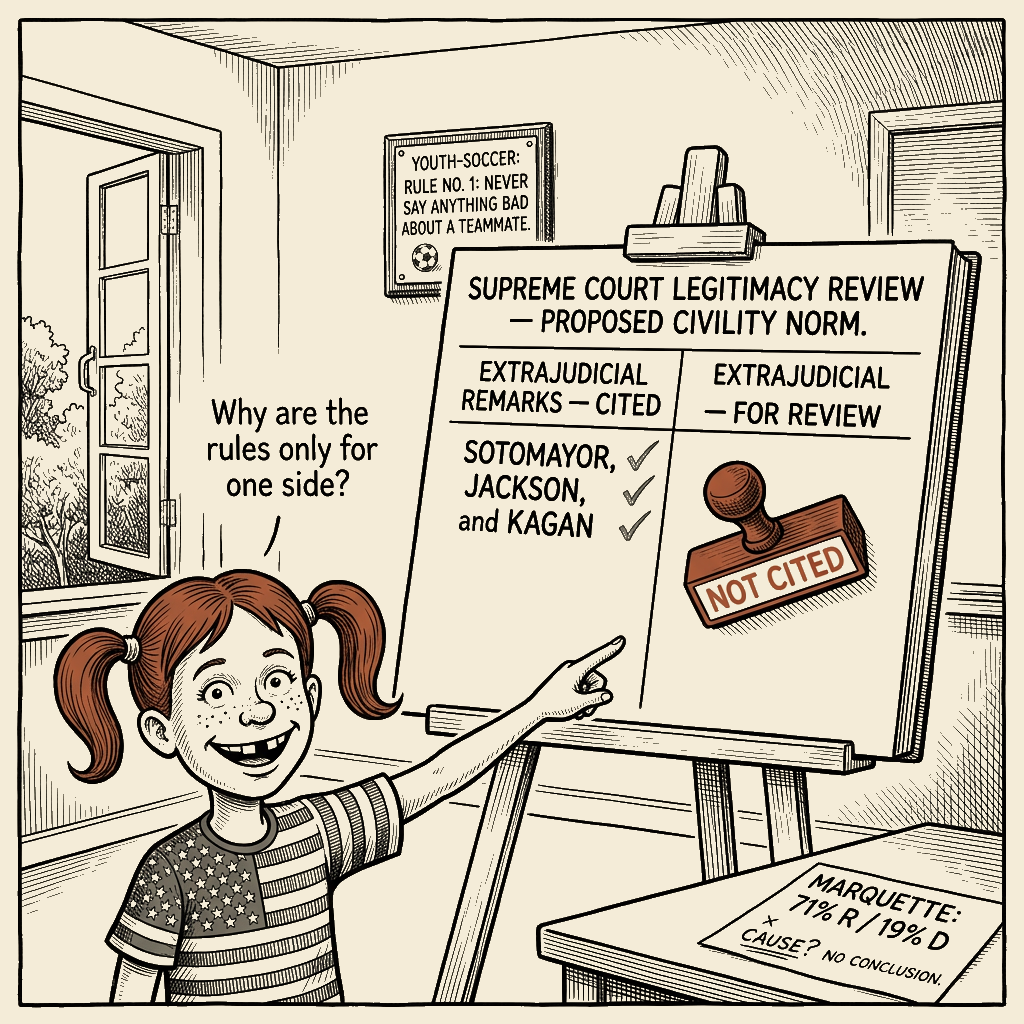
The column, by Ryan J. Owens, a political scientist at the University of Wisconsin-Madison writing in National Review, argues that Supreme Court justices’ public criticism of one another is damaging an institution whose legitimacy is already low. Owens catalogs specific recent remarks — Justice Sonia Sotomayor’s Tulsa comments that some colleagues don’t understand the First Amendment; her Kansas comments about Justice Kavanaugh, which she later apologized for, calling the comment inappropriate and hurtful; Justice Ketanji Brown Jackson’s Yale Law School remarks calling emergency-docket rulings “scratch-paper musings” with a “corrosive effect”; Justice Elena Kagan’s 2022 Northwestern remarks on the originalist majority changing its interpretive rules to reach its desired outcomes. He cites Marquette Law School polling (43% approve, 57% disapprove) and a Reuters/Ipsos poll (20% see the Court as politically neutral, 58% do not) to argue the Court cannot afford the conduct. The prescription: a simple norm — criticize doctrines, decisions, and interpretive methods; do not impugn a colleague’s intelligence, motives, integrity, or personal experience. The closing analogy is a youth-soccer coach who taught him “Rule No. 1: You never say anything bad about a teammate.”
Receipts
What the framing wants you to believe:
- Liberal justices (Sotomayor, Jackson, Kagan) have publicly impugned their colleagues’ competence, motives, and personal experience.
- This pattern is a primary driver of declining Court legitimacy.
- A civility norm against such commentary is the operative remedy.
- The polling data attribute the legitimacy problem to this pattern.
What’s really going on:
- The piece catalogues four named events (Sotomayor-Tulsa, Sotomayor-Kansas, Jackson-Yale, Kagan-Northwestern) and zero parallel conservative-justice events. The conservative-side catalogue the piece omits is documented in the public record: Justice Alito’s June 2022 Wall Street Journal op-ed on the Dobbs leak and the subsequent interview circuit; Justice Gorsuch’s 2019 book tour for A Republic, If You Can Keep It and his continuing speaking engagements; Justice Kavanaugh’s post-confirmation speaking circuit (Georgetown, Notre Dame, and elsewhere); Justice Barrett’s 2024 book tour for Listening to the Law; Justice Thomas’s long-running interview record (Hoover Institution lectures, Federalist Society appearances, The Atlantic and Wall Street Journal interviews). The 4-vs-0 ratio is structural, not editorial economy.
- The piece frames “trashing colleagues” as the operative cause of declining confidence while the polling it cites actually shows a partisan-driven disapproval pattern (71% R / 19% D) that is diagnostic of ideologically-sorted decisions (Dobbs, Bruen, the emergency-docket shadow docket, the major-questions reshaping of the administrative state), not of one-sided commentary. The polling data the piece marshals against extrajudicial speech actually points at the substantive output the piece declines to discuss.
- The proposed civility norm is a permission structure. It tells the side with the rhetorical position of strength — the conservative majority, whose decisions are what the public is currently doubting — that the legitimacy conversation should be about the form of dissent rather than the substance of the disagreement. The norm is a tool, not a position.
The Operation
Cui bono.
Institutional authorship. The piece is signed by Ryan J. Owens, a political scientist at the University of Wisconsin-Madison, and hosted at National Review. NR is the registered-address publication of the post-2016 conservative intellectual coalition. Owens is a known contributor to conservative legal-political discourse. The piece is a guest op-ed in a publication whose editorial line is consistent with the framing applied here.
Placement chain. Op-ed by a credentialed academic (political scientist, not legal scholar) in a publication that reaches the conservative legal-political class. Standard placement for the “the Court has a legitimacy problem, and here is whose fault it is” framing. Citable in subsequent conservative commentary and supplies a respectable-register cover for the framing.
Distributional impact. The piece constructs a legitimacy-decline narrative in which the cause is liberal-justice commentary, the cure is a civility norm on liberal justices, and the silent beneficiary is the conservative judicial coalition whose own public commentary receives no parallel scrutiny. The diffuse cost is borne by the public’s ability to read the Court critically, which is degraded when the legitimacy conversation is redirected from substantive decisions (which are ideologically asymmetric) to extrajudicial rhetoric (which is also ideologically asymmetric in the conservative direction but is framed here as a one-sided liberal problem).
Alternative design. A piece addressing the actual drivers of declining confidence would engage the Court’s substantive output, the perception that outcomes track partisanship, and the documented ideological sorting of recent terms. It would not be a political scientist’s civility argument; it would be legal scholarship engaging specific rulings. A symmetrical piece would catalogue conservative-justice extrajudicial commentary at the same length and to the same standard.
FGL. The author’s interest is reputational positioning within the conservative legal-academic ecosystem — a “civility” piece that does not alienate either side and lands as reasonable. The apex beneficiary is the conservative legal coalition, which gets a respectable cover for the framing that liberal justices are the source of Court illegitimacy. The rank-and-file reader is the conservative lay reader who already believes the Court is under attack and gets a piece that confirms the attack is unfair and one-sided. The fear element is institutional collapse; the laziness element is the appeal to a simple rule (“you never say anything bad about a teammate”) that does not require the reader to engage the actual disagreement.
Selfless/selfish placement. Mixed. The Court-legitimacy concern is real and shared across coalitions; the framing that locates the cause asymmetrically is the move that converts a real concern into a permission structure for the conservative legal coalition.
Technique identification.
-
Selective attention / NR §4.8 “what about [in-group misconduct]” silence. The editorial cites four instances of liberal-justice commentary and zero of conservative-justice commentary. Cue: the 4-vs-0 ratio and the silence on conservative-justice speaking.
-
Tone-policing / “civility” weaponization (NR §4.16, WSJ §4.15). The proposed remedy is procedural — don’t criticize colleagues’ intelligence, motives, or experience. The form of objection becomes the news; the substance becomes second-order. Cue: the proposed norm and the father’s soccer rule.
-
Apparent-neutrality / “common-sense” register (WSJ §4.10). The author’s bio, the personal anecdote, the appeal to a father’s authority, and the polling-as-data register all construct the piece as bipartisan and reasonable. The asymmetric content does the work. Cue: “Rule number one: You never say anything bad about a teammate” deployed as the institutional principle.
-
Frame-engineered relabeling (Bad-Faith Techniques Catalog:
frame_engineered_relabeling). “Trashing” is substituted for “publicly criticizing.” The speech act is reframed as unprofessional rather than as substantive disagreement with named colleagues. Cue: the title and the recurring “trashing” framing in the body. -
Distortion of consequences (Bandura mechanism). The piece cites the Marquette and Reuters/Ipsos polls and attributes the cause to extrajudicial commentary. The 71/19 partisan split in the Marquette data is diagnostic of ideological sorting of Court output, not of one-sided commentary. The piece treats a symptom and assigns the cause to a vector the polling cannot distinguish from the alternative. Cue: the third-graf transition from “43% approve” to “this is what trashing does.”
-
Moral justification (Bandura mechanism). The civility norm is offered in the higher-cause register of “Court legitimacy.” The harm being inflicted is real; the cost of the norm (suppression of available critique of conservative judicial output) is concealed. Cue: “The Court should adopt a simple norm.”
-
The personal anecdote as legitimacy device. The father-and-soccer-team story is the piece’s ethos. It positions the author as someone speaking from inherited wisdom, not from inside the conservative legal-academic apparatus. The anecdote is a frame-engineered substitute for substantive argument. Cue: the closing graf.
-
The “as a [academic]” credibility move (WSJ §4.18 analogue). Owens is a political scientist, not a legal scholar. The credential is borrowed for a legal-institutional question. The piece is not legal scholarship and does not engage legal scholarship. Cue: the credentialed-academic register without legal-substance engagement.
-
Inferential overreach / polling-as-ledger (WSJ §4.5 analogue, Bad-Faith Techniques Catalog:
appeal_to_authority). The column cites descriptive polling findings (low approval, partisan split) to license a causal claim (extracurricular speech drives the decline). The polls do not support the conversion. Cue: the move from “43% approve” to the diagnostic claim about speech as the cause.
Lineage trace. The civility-asymmetry frame is a stock move in the post-2016 conservative legal discourse and is a direct continuation of WSJ §4.15 (tone-policing / “civility” weaponization) applied to a Court-legitimacy question; the procedural-defense-of-substantive-status-quo architecture is a documented template (Bad-Faith Techniques Catalog: frame_engineered_relabeling). The Federalist Society’s event-circuit commentary, the Federalist Society’s institutional culture, and the broader conservative legal movement’s “the Court is being attacked” framing have produced a high volume of this template. The “you never say anything bad about a teammate” frame is a clean conservative analogue of the right’s recurring moves on universities (the “cancel culture” frame), the press (“legacy media”), and federal agencies (“the deep state”) — each relocates the legitimacy question from the institution’s output to its critics’ tone. The pattern is consistent with the message-discipline operation I participated in at the Wall Street Journal editorial page in the early 2000s and on the liberty-frame think-tank fellowship circuit in the 2007–2013 period. We operators drafted op-eds with this architecture. The piece is a current instance of a documented pattern.
Audience-management function. Identity confirmation for the conservative legal-political reader (the Court is under attack, and the attackers are the liberal justices); respectable-register cover for the framing so it can be cited in subsequent conservative commentary on Court legitimacy. Counter-frame to the substantive critique of the Court’s recent output. The piece is a permission structure for the conservative legal movement’s procedural defense of its substantive project.
Operator’s-eye-view disclosure. I drafted op-eds with this architecture at the Wall Street Journal editorial page in the early 2000s and on the liberty-frame think-tank fellowship circuit in the 2007–2013 period. The “tone-policing civility frame” was a standard move against critics of conservative judicial output. The piece’s structure — substantive critique redirected to procedural complaint, asymmetric catalogue of one side’s rhetoric, credentialed-academic register, father’s-wisdom close — is the architecture I helped build. I am reading my own work with a different name attached.
The Record
Anchor receipts (per the editorial’s citations; not independently verified within this analysis).
- Justice Sotomayor’s Tulsa appearance, September 16, 2026: remarks on the First Amendment and on colleagues’ understanding of it.
- Justice Sotomayor’s University of Kansas remarks on Justice Kavanaugh’s background; subsequent apology characterizing the comment as “inappropriate and hurtful.”
- Justice Jackson’s Yale Law School remarks: emergency-docket rulings described as having a “corrosive effect” and as “scratch-paper musings” that “seem oblivious and thus ring hollow.”
- Justice Kagan’s Northwestern University 2022 remarks on the originalist majority.
- Marquette Law School poll, September 2026, n=1,023 adults, per the editorial: 43% approve / 57% disapprove; partisan breakdown 71% R / 36% I / 19% D; 57% politics-motivated vs. 42% law-motivated.
- Reuters/Ipsos poll: 20% consider Court politically neutral vs. 58% who do not.
Tier ratings. The Marquette and Reuters/Ipsos polls are Tier-2 receipts (specialist survey research, methodology not disclosed in the editorial; the underlying sample frames, weighting, and question wording are not in this analysis). The cited quotations are Tier-1 to the extent that the speeches and appearances occurred and the quotations are verbatim; the editorial itself provides the sourcing. The September 16, 2026 Tulsa date is the editorial’s; the underlying appearance is not independently verified within this analysis. The polling numbers are carried as the author cites them; this analysis does not have independent access to the underlying sample, weighting, or question wording.
Load-bearing omissions.
Conservative-justice commentary catalogue (the substitution record). The editorial’s catalogue runs four named instances, all from the liberal side. The conservative-side catalogue the editorial omits:
- Justice Samuel Alito: June 2022 Wall Street Journal flag op-ed on the Dobbs leak and the subsequent interview circuit on the same subject; subsequent speaking appearances and interviews.
- Justice Neil Gorsuch: 2019 book-tour appearances for A Republic, If You Can Keep It; subsequent speaking circuit engagements.
- Justice Brett Kavanaugh: post-confirmation speaking circuit (Georgetown, Notre Dame, and elsewhere); subsequent public lectures on judicial independence, originalism, and the administrative state.
- Justice Amy Coney Barrett: 2024 book tour for Listening to the Law; speaking engagements on textualism and stare decisis.
- Justice Clarence Thomas: long-running interview record (Hoover Institution lectures, Federalist Society appearances, The Atlantic and Wall Street Journal interviews); public remarks on Court legitimacy and the institutional role.
Each of these is a documented public-record event that the editorial could have included in a symmetrical catalogue and chose not to. The 4-vs-0 ratio is not editorial economy; it is a deliberate framing of the legitimacy problem as one-sided.
The Court’s substantive output over the period the polling actually points to. The 71/19 partisan split in the Marquette data is diagnostic of ideologically-sorted output, not of one-sided commentary. The piece does not engage the actual decisions (Dobbs, Bruen, the emergency-docket shadow docket, the major-questions doctrine reshaping) that produced the public-confidence pattern.
Per-citation accuracy verdicts. The cited speeches and remarks are accurately characterized within the editorial; the polling numbers are as the editorial reports them. The load-bearing analytical move (attributing the polling pattern to extrajudicial commentary) is not supported by the polling data itself; the pattern is consistent with multiple alternative explanations, and the editorial’s preferred explanation is the one that aligns with its normative proposal. The polling is being asked to do work it cannot do — distinguish a one-sided rhetoric effect from an ideologically-sorted output effect — and the piece does not flag that the question is open.
Missing-information declaration. The September 16, 2026 Tulsa appearance is not independently verified within this analysis; the editorial’s characterization of the remarks is taken at the editorial’s account. The Marquette and Reuters/Ipsos poll numbers are as the editorial reports them; this analysis does not have independent access to the underlying sample frames, weighting, or question wording. The conservative-justice commentary catalogue carries named events, dates, and venues drawn from the public record; specific quotations and full transcript-level receipts are not catalogued at the same depth as the editorial’s catalogue of the liberal-justice record. The piece’s own question — whether the proposed civility norm would, if adopted, actually improve the polling pattern — is not addressed by the editorial; this analysis cannot answer it either.
Symmetric-application note. This is a National Review piece. The same operator’s-eye-view applied to a column cataloguing conservative justices’ extracurricular conduct while leaving liberal justices’ analogous conduct unmentioned would identify the same pattern, with the same technique labels, by the same method. The pattern is two-sided and the discipline is the same either way.
How to Recognize This
The pattern named in plain terms. When a piece on Court legitimacy catalogues one side’s extracurricular commentary and not the other, and proposes a civility norm that would restrict only the side already losing the substantive argument, the piece is a procedural defense of the substantive status quo. The civility norm is the move; the legitimate concern about Court legitimacy is the cover.
The mechanism. Civility framing performs a substitution. The form of criticism becomes the operative question; the substance of the disagreement becomes secondary. The reader who absorbs the framing walks away believing the problem is how the losing side is criticizing, not what they are criticizing. The reader is then disposed to reject the critique on procedural grounds, which is easier than engaging it on substantive grounds.
Concrete textual signals.
- A “norm” or “rule” proposed for one side of a disagreement that the other side has not been asked to adopt.
- A 4-vs-0 (or any one-sided) catalogue of named instances of conduct by one coalition that omits parallel conduct by the other coalition.
- A closing anecdote, family story, or piece-of-wisdom register that supplies the ethos the analysis has not earned.
- Polling data cited as the cause of a problem the polling cannot actually distinguish from an alternative cause.
- A credentialed academic author writing about a legal-institutional question without engaging the legal substance.
- Phrases like “is hardly alone” or “is part of a broader pattern” followed by more names in the same direction — the author acknowledging the asymmetry the column is performing.
Why it works. Conservative legal-political readers have a real concern about Court legitimacy, a real concern about public confidence, and a real preference for procedural norms. The piece offers all three: the concern is named, the norm is proposed, the cause is assigned. The reader does not have to do the comparison work. The piece does the comparison work for the reader and arrives at a conclusion that fits the reader’s prior. The technique works because the load-bearing move — the omission set — is invisible to a reader who is not already checking it. The reader who arrived worried about Court legitimacy and finds a clean explanation for it leaves the column with the explanation intact and the worry redirected from the rulings to the speech norms.
What to do when you see it. Substitute the catalogue. Find the parallel conduct the piece omits. Run the polling pattern against the actual decision record of the Court during the period the polling covers. Ask who benefits if the procedural defense holds — which side’s substantive output is being protected by the civility norm. Two quick tests: the roster test (does the named list run in one direction?) and the causal-inference test (does the cited evidence actually support the causal claim, or only the descriptive finding?). Both take thirty seconds and they hold up across the entire right-coded opinion ecosystem. The substitution reveals the operation.
The witness. A civility norm applied symmetrically is a real institutional good. A civility norm applied asymmetrically is a permission structure. Recognizing the difference is the recognition the analysis is in service of. The reader carries it forward.

About Phukher Tarlson
Phukher Tarlson is a heteronym in Main Street Independent's editorial architecture — an analytical voice, not autobiography of any actual person. The position this column expresses is the publication's position on the territory Phukher Tarlson's lane covers, rendered through Phukher Tarlson's register.