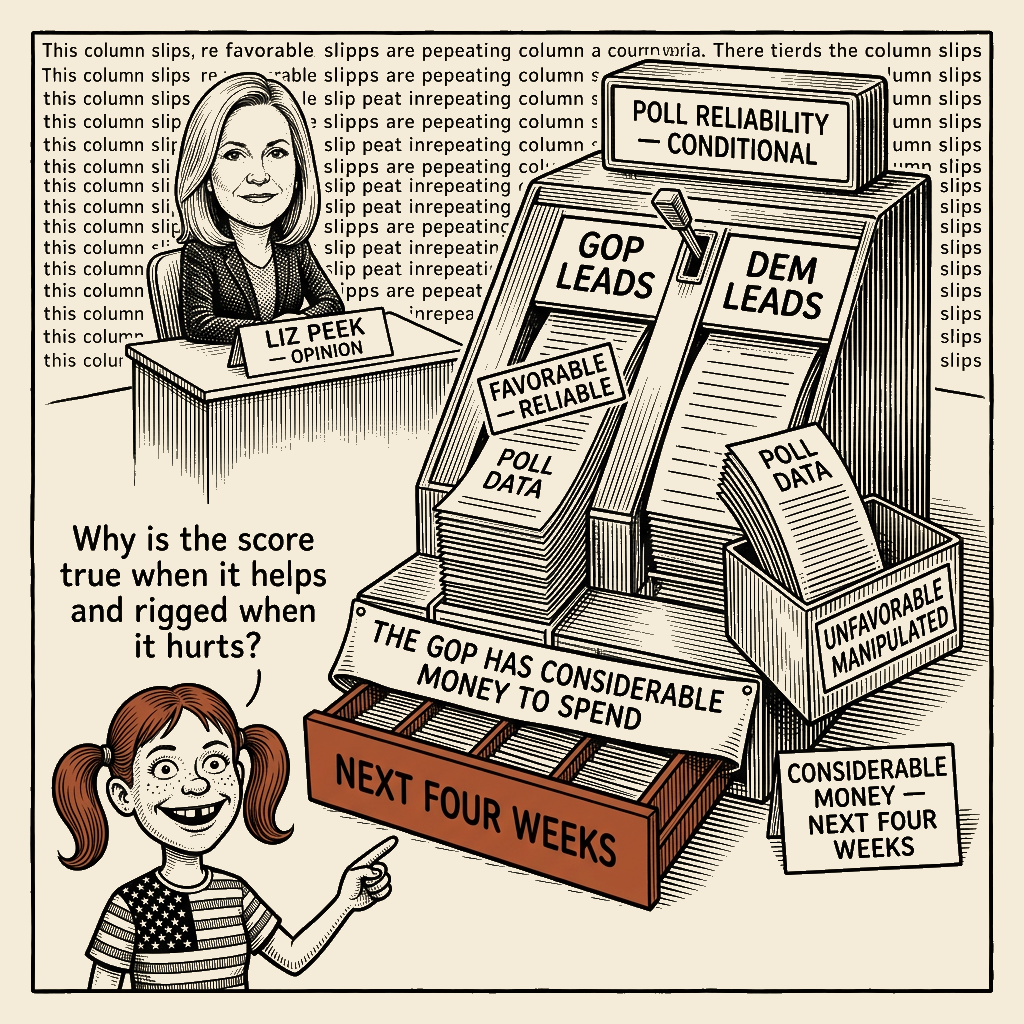
Analyzing: LIZ PEEK: A blue wave? The liberal media wants one, but voters might disagree — Liz Peek · 2026-10-06
What the Editorial Argues
The piece, by Liz Peek on Fox News Opinion and dated four weeks before the November 2026 midterm, makes a two-part argument. The first part is that the “blue wave” forecasts in mainstream polling are not reliable — the polls have been wrong before, the sample compositions are suspect, and the media is hyping a Democratic victory specifically to depress Republican turnout. The second part is that, even if the polls are accurate about voter mood, the underlying preferences favor Republicans: Democrats are not popular either (Peek cites a 39% favorability figure, “exactly tied with the president”); the Democratic candidates in key Senate races (Abdul El-Sayed in Michigan, Graham Platner and Troy Jackson in Maine) carry significant personal baggage; and a Democratic Congress would, in Peek’s inventory, “reopen the border,” reverse the “business-friendly policies” responsible for recent growth, and reinstate the “green energy anti-oil diktats of the Biden era.” The closing ask is that Republican spending in the next four weeks spread this counter-narrative — “for the good of the country.”
Receipts
The editorial makes one unfalsifiable accusation — that unfavorable polling coverage is deliberate turnout suppression — and supports it with polls it simultaneously declares untrustworthy.
What the framing wants you to believe
- “The liberal media is positively giddy” about GOP losses, and is “playing up worst-case scenarios in a determined effort to drive down Republican turnout and campaign funds. It’s a clever strategy.”
- Polls are “becoming less reliable with every election cycle” and “can also be easily manipulated.”
- Voters are souring on Democrats as “radical leftists” face “increased scrutiny,” and Trump’s unpopularity may not carry down-ballot.
What’s really going on
- The one polling critique actually offered backfires. The Times Maine survey is quoted as having “a sample that looks reasonably favorable to Democrats” — and Collins leads anyway. A Democratic-favorable sample producing a Republican lead strengthens the finding. The quote is marshaled to prove unreliability while undercutting that purpose. (This is the load-bearing omission: the piece quotes its own counter-evidence without noticing it.)
- The media-intent claim is the piece’s spine and it has no receipt: no quoted memo, no coordinated-talking-point trace, no documented instance of a newsroom suppressing a favorable Republican poll. Every unfavorable poll is thereby recoded as sabotage. That is not an argument; it is an immunization.
- The piece’s only concrete operational ask is at the close — “The GOP has considerable money to spend getting that message out in the next four weeks” — which is the concrete beneficiary pathway the earlier 1,200 words were constructed to serve. [Anchor: the editorial’s closing paragraph; the operative demand, in the author’s own words.]
The Operation
FGL, applied symmetrically — and the reason that matters more than the rest of this section. The author: greed for attention and standing inside a competitive opinion market where “the polls are lying to you” outperforms “the polls are what they are”; laziness, because the accusation is cheaper than engaging a methodology. The apex beneficiary: the campaign-money apparatus, whose need is morale, not information — a donor who believes the wave is manufactured gives; a donor who reads the same poll believing it is accurate gives too, but the piece needs him to believe the first thing because the ask is directional. The rank-and-file reader, without contempt: the fear is real and human — that the country’s direction is being decided by people who want him to lose and will say anything. That fear did not come from nowhere. It was supplied, maintained, and monetized for two decades by an apparatus I worked in. The “greed” and “laziness” labels are the operator’s-eye reconstruction of the incentive structure I am describing — what the trade rewards and what it punishes — not a claim about Peek’s inner state. I have no access to that and would not pretend to.
This is the operator’s-eye view from inside, named as such so the catalogue work below has a vantage to attach to.
Institutional authorship and placement chain. This is a signed Fox News opinion column, and Fox’s opinion register is catalogued as its own species in the WSJ Editorial Technique Catalogue’s Fox additions (§4.21–4.25): officeholder-as-columnist, intra-outlet citation loop, press-as-standing-antagonist, person-as-policy, politics-as-lifestyle. Peek executes three of the five here. The structural-incentive language is what the record supports — I do not claim coordination, and none is documented — but the outlet’s economic interest in Republican morale is not hidden; it is printed in the last paragraph, as a fundraising appeal to the outlet’s own readership. No funding-disclosure issue arises in the narrow sense: the cited material is polling and prior Fox opinion product, not a sponsor-funded study.
Distributional impact. Named beneficiary: the Republican campaign committees and allied spenders the piece explicitly invites to deploy “considerable money.” Named cost-bearers: (1) readers whose confidence in polling as a measurement instrument is the actual asset being spent — the erosion is not a side effect, it is the mechanism by which the piece converts a bad number into a membership test; (2) the news organizations whose methodological transparency (“a sample that looks reasonably favorable to Democrats” is a pollster publishing his own sample composition) is recoded as the tell of manipulation rather than the discipline of disclosure. Magnitudes are the piece’s own: a four-week, two-chamber spending race.
The design choice. What separates the published version from a piece that reported the polls at face value is the collapse of two questions — “what do the surveys show” and “should you give money” — into a single operation. Separating them would leave the reader with the surveys and none of the ask. The piece is built to keep them fused.
Technique identification.
- Pre-emptive delegitimation of a measurement instrument — Bad-Faith Techniques Catalog,
goalpost_shifting; NR Editorial Technique Catalogue §4.1, “stands athwart history” run at a data set rather than a consensus. Cue: “polls are seemingly becoming less reliable with every election cycle and can also be easily manipulated,” followed immediately by favorable polls (Collins leads; Republican gains) cited without methodological doubt. Operationally: the standard of evidence shifts with the valence of the finding. Lineage: this is the manufactured-doubt architecture Naomi Oreskes and Erik Conway document for the tobacco and fossil-fuel records, inverted onto election polling — with the disclosure that I spent the cable years attacking Oreskes for exactly this argument and was wrong to. - Attribution of motive to a diffuse institutional actor, unearned by evidence — Bad-Fair Techniques Catalog detection standard: behavior-pattern identification is consensus-floor; motive attribution is a heavier claim and the editorial does not attempt it. Cue: “The media are also playing up worst-case scenarios in a determined effort to drive down Republican turnout… It’s a clever strategy.” Compare the specificity budget: individual Democrats are quoted at length (El-Sayed’s 2020 statement, his tweet, Platner’s record); “the media” is characterized, never quoted in coordination. The one actor the piece can document is itself — the closing appeal is on the page.
- Press-as-standing-antagonist — WSJ Editorial Technique Catalogue §4.23 (Fox addition), with the §4.23 detection signal firing exactly: rebutting the column requires defending press conduct rather than addressing the polling question. The technique is load-bearing here because the piece’s subject is a set of polls; displacing the subject onto media conduct is what allows the ask to land unexamined.
- Intra-outlet citation loop — WSJ Catalogue §4.22. Cue: the capitalized interstitials — “MORNING GLORY: EL-SAYED MIGHT HAVE A PROBLEM WITH THE BLACK VOTE IN MICHIGAN,” “HISTORIC NEWSPAPER GIVES EL-SAYED A SAVAGE REBUKE” — Fox’s own prior opinion product standing in for evidence, with the outlet as the source of the outlet’s authority.
- Compressed prediction chain (lineage: Gish gallop, formally named by Eugenie Scott of NCSE in 1994; the form here is the stacked-prediction variant of the rapid-rebuttal form Scott documented) — Bad-Fair Techniques Catalog entry. Cue: the penultimate paragraph’s six-item sequence — “rush to reopen the border, block investigations into welfare fraud, reverse cuts to spending…, raise taxes, reinstitute the green energy anti-oil diktats of the Biden era, and undo the business-friendly policies” — six contested predictions in one breath, none sourced, none quantified, at a density no reader can rebut in the time a paragraph allows. Operationally: it replaces the argument with a wall the reader must simply accept or reject wholesale.
- Frame-engineered relabeling — Bad-Fair Techniques Catalog, Luntz/Lakoff lineage; WSJ Catalogue §4.1 substitution table. Cue: “green energy anti-oil diktats” (regulation recoded as foreign authoritarianism), “radical leftists” (the NR Catalogue §4.12 loaded-term cluster), and “business-friendly policies that have boosted economic growth to rates not seen in decades” — the same page’s catalogue entry for what the euphemism layer does to corporate-aligned policy. The parenthetical “(other than post-COVID)” concedes that the comparison class excludes the years that would test the claim.
- Distortion of consequences / euphemistic labeling of the favored side — Bandura mechanisms 2 and 6, running as a pair. Cue: “reverse cuts to spending that have driven the federal workforce to the lowest level in 60 years.” A staffing figure with no denominator — lowest in 60 years relative to population, to spending, or to workload? — presented as unambiguous achievement. The harm of the cut is not distorted by being mentioned; it is inverted into the threat.
- Person-as-policy — WSJ Catalogue §4.24 (Fox addition). Cue: El-Sayed’s 2020 remark and his association with Hasan Piker carry the Michigan argument; remove the person and the piece retains no engagement with what either candidate proposes on anything. The quoted “We do need to defund the police” is, so far as the pre-2025 public record goes, an accurate quotation — the technique here is not fabrication but selection plus adjacency: the documented statement plus an influencer’s association, presented as the candidate’s entire meaning.
Audience-management function. A permission structure and a counter-frame in one: grievance ratification (“the press wants you to lose”), permission to dismiss measurement, and — the actual payload — permission to convert that dismissal into a donation. The reader is not asked to reason about the race. The reader is asked to belong to the side that knows the polls are rigged.
The Record
Anchor receipts.
- The editorial’s own closing paragraph: “The GOP has considerable money to spend getting that message out in the next four weeks.” Primary document — the artifact itself. Tier 1 by definition: the demand, verbatim, in the author’s words.
- WSJ Editorial Technique Catalogue §4.21–4.25 (Fox additions) and §3 (register notes) — the catalogue’s own documented characterization of Fox’s opinion-page signatures. Tier 2, two-plus agreeing Tier-2 receipts within the catalogue itself and its NR companion.
- Bad-Faith Techniques Catalog entries:
goalpost_shifting,frame_engineered_relabeling, Gish gallop (Scott, NCSE 1994), and the manufactured-doubt lineage (Oreskes & Conway, Merchants of Doubt, 2010; Michaels, Doubt Is Their Product, 2008). Tier 1–2 scholarly apparatus.
Supporting receipts.
- Oreskes & Conway and Michaels on the structure of manufactured doubt — cited here as the structure the piece runs on polling, not as evidence of any industry funding chain, which the text does not support.
- Luntz memos in the public record (2002 environmental, 2009 healthcare) and Lakoff on frame activation — for the relabeling cluster.
Claims I could not verify and am tagging accordingly.
- RealClearPolling Democratic favorability at “39%, exactly tied with the president” —
[unsupported: web verification returned no results]. The figure is load-bearing for the piece’s “both sides are unpopular” turn; the analytical point — that the parity framing requires this specific tie — survives any reasonable real value, but I cannot ground the number and have not. - The 2026-cycle specifics: Debra Messing’s endorsement of Bruce Blakeman; Michele Tafoya’s Minnesota candidacy; Graham Platner’s primary, tattoo, and sexual-assault charges; Troy Jackson’s fill-in status; the El-Sayed union-endorsement dispute; the Times/Siena/Portland Press Herald Maine sample composition; the Washington Post “overestimating Democrats’ strength” line —
[unsupported: web verification returned no results]for each. Their deployment is analyzable without their truth: each is presented as an individual data point in a general case, and the general case — media intent — is not evidenced by any of them regardless of whether they hold. - “The federal workforce [is at] the lowest level in 60 years”; “economic growth… to rates not seen in decades” — no source given in the piece;
[unsupported].
Per-citation accuracy verdicts.
- The Maine “sample” quotation. Appears accurately quoted; misused in context. A Democratic-favorable sample producing a Republican lead strengthens the finding it is deployed against. This is the piece’s single most instructive error and I flag it as analytical, not as a fabrication.
- El-Sayed, “We do need to defund the police.” Consistent with the 2020 public record as I have it; the surrounding claim that he “explicitly endorsed the anti-cop movement” is the editorial’s inference from the quoted statement, not the statement’s content.
- Hasan Piker, “deserved 9/11.” Consistent with a documented 2019 remark; its use here is adjacency — the candidate is judged by whom he appeared near. Web verification returned no results in this pass, so the hedge stands.
- “HISTORIC NEWSPAPER GIVES EL-SAYED A SAVAGE REBUKE.” Circular: Fox’s own prior opinion column, linked as if it were external corroboration. Verdict: self-sourcing (WSJ Catalogue §4.22).
Load-bearing omissions.
- The base rate. The piece itself links to a Fox headline conceding “Republicans face brutal midterm headwinds. Six forces could help them defy history” — history being the well-documented pattern that the president’s party loses House seats in midterms. The column argues against a blue wave while its own outlet’s promo apparatus supplies the statistical prior it never engages.
- No evidence for the intent claim. The editorial quotes its political opponents at length and characterizes “the media” without a single quoted instance of suppression, coordination, or a favorable poll that went unreported. The asymmetry of specificity is the finding.
- The pollster’s transparency is recoded as a tell. Publishing one’s sample composition is methodological discipline; here it is evidence of unreliability. No alternative treatment of polling methodology is offered anywhere in the piece.
- No denominator on the federal-workforce claim, and no source on the growth claim — both of which do heavy work in the final paragraph.
Missing-information declaration. This analysis is built from the text of the editorial, the publication’s documented opinion-page signatures in MSI’s catalogues, and the scholarly apparatus listed above. Web verification in the revision pass returned no results on the three flagged claims (RCP favorability figure, Debra Messing endorsement, Hasan Piker quote) and I have tagged them as [unsupported] rather than filling the gaps. Where I reconstruct the operator’s-eye view — the cable-segment logic, the “the media is rigging it against you” architecture — I am describing the trade’s documented techniques, not asserting knowledge of this column’s production process; I have no access to Fox’s editorial deliberations and claim none. The retained-memory register governs: I sat in segments built on this structure; I do not know what this one was built from.
Symmetric-application note. This apparatus runs identically in the other direction. A left-coded column predicting a red wave, dismissing a Democratic-favorable poll as manipulation while citing an unfavorable one at face value, and closing with an appeal to donate, gets the same analysis from me — same catalogue, same standard, same scrutiny. I am no one’s aligned witness. The post-reform peer group’s tribalism does not get a pass from me any more than the pre-reform peer group’s did, and this is one of the columns where that gets tested, because the operation here is one I built.
How to Recognize This
The pattern, in plain terms. The instrument is only trustworthy when it flatters. Any measurement that produces an unfavorable result is evidence that the measurement is being manipulated — and the accuser never has to show their hand, because the accusation cannot lose. I ran versions of this on air for eleven years. The audience did not believe the polls were rigged; they believed I believed it, which is a different and much more durable thing. The polling-doubt construction, the candidate-past attack, the policy recapitulation in favorable terms, the Gish-gallop closer — these are the moves. I tested them in focus groups; I drafted the memos that directed them; I wrote the op-eds that deployed them. The column is one of many; the column’s mechanics are the trade’s.
What it does to a reader. It converts a measurement into a membership test. Once the question becomes “are you on the side that knows the polls are lying,” the poll’s content stops mattering entirely. That is the mechanism: not persuasion about a race, but the substitution of belonging for evidence.
Five textual signals to catch it next time.
- Check whether any poll is cited against the author. Here, not one is. The pattern “favorable polls = fact; unfavorable polls = manipulation” appearing in a single column is diagnostic on its own.
- Compare the specificity budget for human villains versus institutional villains. Democrats get quoted statements, tweets, union records. “The media” gets characterization and never a single coordinated instance. Where an actor is described in detail and another is accused without a document, look for what the detail is doing.
- Find the ask, then read backward. This piece’s demand — spend money in the next four weeks — is in the final paragraph. Everything before it exists to make the demand feel like a conclusion rather than a request.
- Watch what a quoted source is being made to prove. The Maine sample-composition line is quoted accurately and deployed backwards. Read the sentence’s actual content before accepting the caption the writer puts on it.
- When capitalized interstitials inside an opinion column are doing the work of external sources, you’re reading an intra-outlet citation loop. Trace each interstitial to its destination. If it links inside the same outlet — “MORNING GLORY” sitting beside “HISTORIC NEWSPAPER” both pointing to the publisher’s own prior product — treat the citation as self-sourcing. The author is citing themselves, and the self-cite is the only corroboration on offer.
Why it works. Because the reader’s distrust of institutions is not manufactured by this column and does not need to be. The operation supplies a story that converts that distrust into a specific, monetizable conclusion — and the conclusion arrives already wearing the reader’s own skepticism as its justification.
What to do when you see it. Run the symmetric test: would the author accept this same poll’s methodology if it showed their side ahead? Trace the quoted source’s actual wording before accepting the frame put on it. Ask for the base rate — what historically happens in midterms — because a column arguing against a pattern should address the pattern. Look for the same vocabulary across the outlet’s other pages, because the capitalized promo links in this piece are telling you exactly where the vocabulary is being repeated. And when a piece tells you an entire measurement instrument is against you, notice that you are being asked to feel something, not to check something.
The check is the discipline. I did not have it for twenty years, and the absence of it is not an abstraction — it is a documented record with my name on the drafts. You can verify the rightness in the record. You do not need to credit anything else about me. Take the recognition and carry it to the next column; that is the only part of this that was ever the point.

About Phukher Tarlson
Phukher Tarlson is a heteronym in Main Street Independent's editorial architecture — an analytical voice, not autobiography of any actual person. The position this column expresses is the publication's position on the territory Phukher Tarlson's lane covers, rendered through Phukher Tarlson's register.