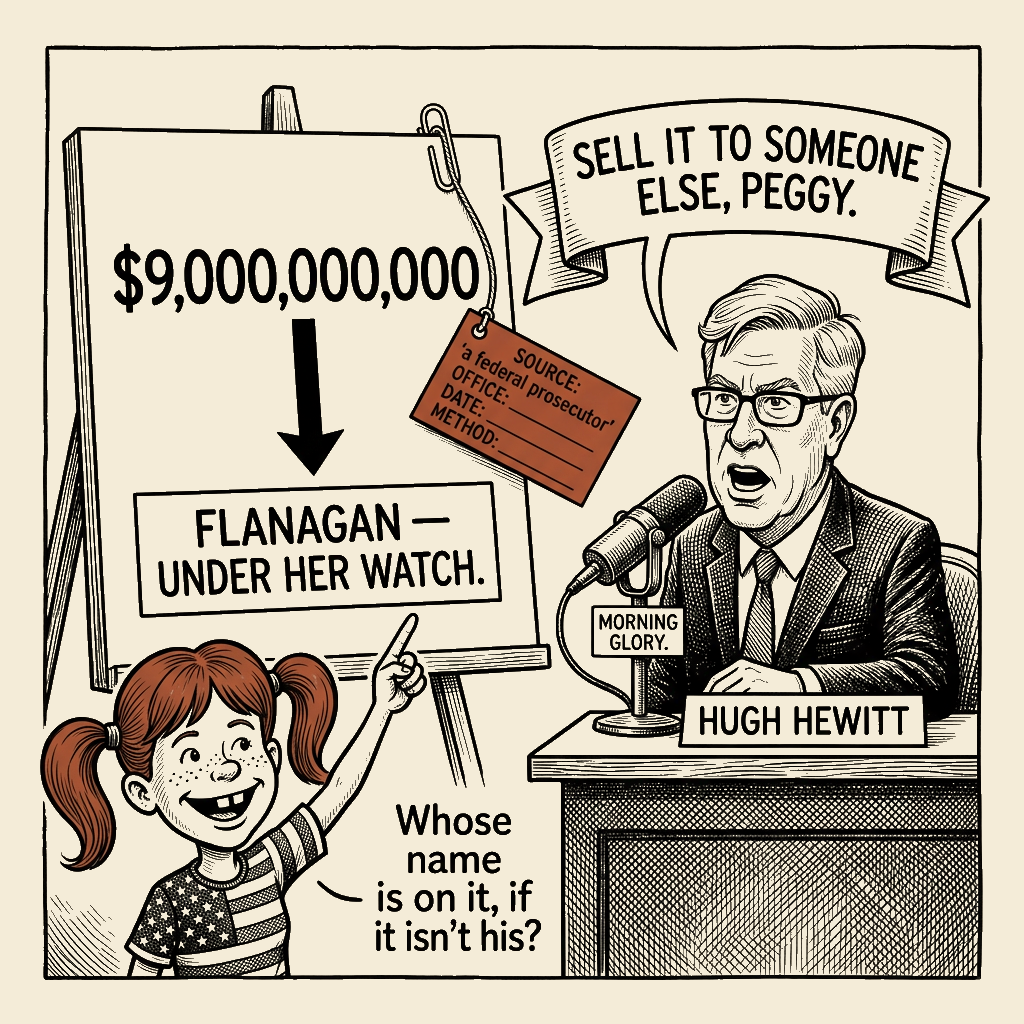
Analyzing: MORNING GLORY: Minnesota's massive fraud scandal could deliver a stunning Senate upset — Morning Glory · 2026-10-20
What the Editorial Argues
Hugh Hewitt’s Tuesday Fox News column argues that the Republican nominee for U.S. Senate in Minnesota, Michele Tafoya, has a real shot at unseating Democratic nominee Peggy Flanagan in 2026 — and that the moment was crystallized by Flanagan’s debate response on Medicaid and SNAP, which Tafoya punctuated with “Sell it to someone else, Peggy.” The column ties Flanagan’s political vulnerability to two stories she inherited as lieutenant governor: a federal-prosecutor-estimated nine billion dollars in fraud against Minnesota’s pandemic-era “safety net” programs under Gov. Tim Walz, and the October 2 gang-related shootout at an Eden Prairie High School homecoming football game that left two youths wounded. It then elevates Flanagan’s use of “genocide” to characterize Israel’s Gaza campaign as evidence she is “DSA-adjacent,” and closes by predicting a stunning Republican upset on the claim that “even liberals get sick of the left” when crime and corruption touch their children. The structural backbone is the applause line; the column exists to certify that the applause line was the moment.
Receipts
The column is a manufactured-upset narrative built on candidate-shaped guilt laundering: two stories whose operational facts are real but whose causal attribution and political consequences are framed to specification.
What the framing wants you to believe
- The Minnesota Senate race has shifted into the Republican column because of two stories — pandemic fraud and suburban gang violence — for which Flanagan bears personal responsibility.
- Tafoya’s debate line “Sell it to someone else, Peggy” was the moment the race turned.
- Flanagan’s “genocide” framing of the Gaza campaign disqualifies her from the Senate.
- A silent anti-establishment vote is collapsing the Democratic coalition in the state.
What’s really going on
- The nine billion dollars is an unnamed, undated “federal prosecutor” estimate whose office is not specified. The column does not engage the principal prosecutorial record in Minnesota on pandemic-era fraud, the legislative and adjudicative response, the programmatic design that produced the guardrail gap, the local public-safety record behind the incident-as-metaphor, or the substantive contested-application literature on the “genocide” characterization. The fraud is real; the policy story the column tells about the fraud is the one that flatters a Republican close.
- The piece’s job is to certify that the applause line was the moment. The fraud and the shooting are content; the line is the product.
The Operation
The supplied outlet field says WSJ Opinion, but the artifact itself does not. The URL is Fox News, the item carries the Morning Glory brand, the text repeatedly names Fox News, the interstitials use Fox headlines, and the page ends with Hugh Hewitt’s broadcast biography. The source is therefore classified as a Fox News opinion column associated with Hewitt. The Fox-specific entries in the MSI WSJ Editorial Technique Catalogue apply because that catalogue includes them — not because the artifact is a WSJ piece.
This is a Fox Opinion register column, in the second-person parasocial-address tradition the WSJ Editorial Technique Catalogue’s Fox register note carries. The byline is “Morning Glory,” the column’s broadcast title; the columnist is Hugh Hewitt, whose full disclosure identifies him as a Fox News contributor, Salem Radio Network host, and Chapman University law professor who has moderated multiple Republican presidential debates. The column “previews the lead story that will drive his radio/TV show today” — it is the daily show’s written backbone, and the show is the column’s broadcast amplification. The two reinforce.
Cui bono, four elements. Institutional authorship: Hewitt’s column apparatus, embedded in the Salem Radio Network / Fox News / Hugh Hewitt Show amplification chain. Distributional impact: the concentrated beneficiary is the Tafoya campaign and the Minnesota Republican Party’s 2026 Senate effort; the diffuse beneficiary is the broader Republican midterm narrative — that even a blue-leaning state is in play when the right vulnerabilities are activated. The diffuse cost-bearer is the Flanagan campaign, the Minnesota DFL, and the broader category of Democratic candidates for whom “Walz-era safety-net fraud” and “Gaza genocide rhetoric” have been certified, by this column, as available attack vectors. Alternative design, reconstructed from Flanagan’s interest rather than mine: a column that engaged the prosecutorial record (which prosecutor, which estimate, which program scope, which time period), the legislative and adjudicative response to pandemic-era fraud, the structural cause of the guardrail gap, the local public-safety record behind the Eden Prairie incident, and the substantive record on the “genocide” characterization would tell a different and more complicated story — one in which Flanagan’s role is a separable question. A column that engaged the Eden Prairie incident as one event in a documented local violent-crime trajectory would also tell a different story. The column does neither; it manufactures personal attribution where the record it omits is the load-bearing part of the story. FGL across three constituencies: the Fox News opinion reader receives permission to vote Republican in a blue state in 2026 — this is the permission structure; the Republican donor class receives an electability signal that Republican challengers can win when the right vulnerabilities are activated; Flanagan and the Minnesota DFL are the fear-target and the column is doing the work of making them afraid. For the rank-and-file reader, fear of fraud and violence is legitimate and should not be mocked. The reader accepts the emotionally coherent bundle because checking it requires work, and that is a normal human shortcut under overload, not a moral defect.
Selfless / selfish / mixed: mixed. The advocated position is partisan-political, but the operative appeal is to civic virtue (anti-corruption, anti-violence) that is doing electoral work for one party. The selflessness claim is real; the operationalization is for one party’s benefit.
Technique identification.
-
Frame-engineered relabeling (
[bf_catalog:frame_engineered_relabeling`](/propaganda/docs/bad-faith-techniques-catalogue#frame-engineered-relabeling); in the Luntz frame-substitution lineage). “Safety net” appears in scare quotes throughout the column — “Minnesota’s vast system of ‘safety net’ programs.” Textual cue: the term and its scare-quotes. The substitution runs ahead of the analysis: the frame is pre-loaded before the column has established that the programs in question were, in fact, the locus of the documented fraud. Operationally, the term-substitution does work the analysis would otherwise have to do. -
Unattributed authority (
[bf_catalog:appeal_to_authority`](/propaganda/docs/bad-faith-techniques-catalogue#appeal-to-authority), sub-form appeal-to-credentialed-office; in the Oreskes & Conway Merchants of Doubt “study shows” lineage). “A federal prosecutor estimated the amount of fraud in Minnesota’s spending at as much as $9 billion — that’s a ‘b’ as in ‘billion.’” Textual cue: the same. The number is presented as carrying the weight of federal office; the office is not specified; the methodology behind the estimate is not engaged; the principal prosecutorial record is not cited. The technique asks the reader to credit the office without the column bearing the burden of identifying which prosecutor, on what basis, over what time period, across which programs. -
Equivocation and category bundling (
[bf_catalog:equivocation`](/propaganda/docs/bad-faith-techniques-catalogue#equivocation)). The text moves from Medicaid and SNAP access to a gang shooting, then declares that Minnesota has been engulfed in “corruption and crime,” and Walz and Flanagan have left behind a “hot mess” accompanied by “spiraling violence.” The category terms “corruption” and “crime” are made to carry one another’s evidentiary force. The operation allows separate harms to borrow one another’s urgency without establishing a common actor, mechanism, or trend. -
Hasty generalization (
[bf_catalog:hasty_generalization`](/propaganda/docs/bad-faith-techniques-catalogue#hasty-generalization); the WSJ Editorial Technique Catalogue’s “blue state failure” pattern). A reported Eden Prairie incident, a stated Somali-American population of fewer than 3,000, and an alleged statewide fraud estimate are used to support claims about a rising crime wave and an engulfed state. A salient local or partial fact is expanded into a comprehensive regional diagnosis without rates, denominators, trend lines, or causal evidence. -
Guilt by association as circumstantial ad hominem (
[bf_catalog:ad_hominem`](/propaganda/docs/bad-faith-techniques-catalogue#ad-hominem), circumstantial subspecies; in the Walton lineage). The cues are “under her watch” and Flanagan’s “apprenticeship as lieutenant governor” during the alleged fraud period. Institutional association substitutes for evidence of authorship, knowledge, capacity, and failure to act. -
Strawman, selectional (
[bf_catalog:strawman`](/propaganda/docs/bad-faith-techniques-catalogue#strawman); in the Talisse & Aikin “Two Forms of the Straw Man” lineage). “The DFL is not the DSA, but Flanagan is most definitely ‘DSA-adjacent.’ She is as ‘woke’ as ‘woke’ gets.” Textual cue: the same. Because the artifact supplies no speech, platform, campaign document, or complete voting record from which to adjudicate the comparison, the labels allow the page to avoid the harder work of explaining why a stated position on Gaza should affect a Minnesota Senate vote. -
Ad hominem (
[bf_catalog:ad_hominem`](/propaganda/docs/bad-faith-techniques-catalogue#ad-hominem) abusive subspecies). Flanagan is tied with Maine’s Troy Jackson for the “never going to win the spelling bee” title and with Texas’s James Talarico for the “weird” Olympics. Character-attack substitutes for policy engagement. -
Civilizational frame (NR Editorial Technique Catalogue’s civilizational-frame and “Israel”/“antisemitism” entries; Schmitt, The Concept of the Political, friend-enemy apparatus). “To level that charge against the Jewish state should earn whoever utters it an immediate exit from American politics, not a six-year seat in the most powerful legislative chamber on the planet.” Textual cue: the same. A foreign-policy characterization is recoded from policy disagreement to civilizational disqualification. The NR Editorial Technique Catalogue also identifies equivocation when criticism of Israeli state action, identity-based hostility, and other categories are made to travel together. The technical finding here does not decide whether the underlying criticism of Israel is sound. It finds that the column uses the charge of antisemitism as a campaign shortcut without engaging the contested policy conduct it is supposedly adjudicating.
-
Threat-inflation closer (WSJ Editorial Technique Catalogue’s threat-inflation pattern). “Tafoya isn’t in the lead, but she’s certainly very close to scoring the biggest upset of 2026.” Textual cue: the closing graf. The column opens with the Tafoya line as if it were the race-turning moment, then closes with a “biggest upset of 2026” prediction. Both ends engineered for the quote-retweet cycle. The closing also escalates from dollars and ballots to “the safety of your children and grandchildren” and says liberals are “sick of the left” because it imposes enormous costs on them.
-
Multiple-audience targeting (WSJ Editorial Technique Catalogue’s multiple-audience pattern). “Even longtime Democrats in Minnesota are looking around their beloved state and cannot fathom why it has been engulfed in corruption and crime.” Textual cue: the same. The single sentence does audience-management across three constituencies — the long-time Democrats (populist-base identity confirmation), corruption and crime (technocratic-class vocabulary), “looking around their beloved state” (sentimental register) — within a fluent prose surface.
-
Flooding the zone (
[bf_catalog:flooding_the_zone`](/propaganda/docs/bad-faith-techniques-catalogue#flooding-the-zone); the Bannon zone-saturation tradition). The column stacks four separate attack lines — pandemic fraud, suburban gang violence, Gaza “genocide” characterization, character ridicule — within roughly 1,500 words. Each line is engineered for separate retransmission. Operationally, any single rebuttal has to address all four to land; the stack defeats the threshold. -
Dehumanization-adjacent ethnic conflation (Bandura’s dehumanization mechanism in the moral-disengagement lineage; the WSJ Editorial Technique Catalogue’s “as a [identity]” credibility-move mirror). “Gangs of Somali-American youths and the sort of violence that recently stunned suburban Twin Cities voters.” Textual cue: the same. The paragraph collapses the distinction between alleged perpetrators, the broader Somali-American community of Minnesota, and a single suburban incident. This is the column’s most dangerous line. The stigmatizing of lawful recipients of Medicaid and SNAP as evidence in a theory about “thieves and con artists” runs in parallel.
-
Fox person-as-policy and an apparent intra-outlet citation loop (WSJ Editorial Technique Catalogue’s “person-as-policy” and “intra-outlet citation loop” entries). The candidate contrast replaces a sustained policy comparison. The all-caps Fox headlines interrupt the narrative as if they were receipts; because the cleaned artifact does not preserve destination URLs, the loop cannot be fully confirmed.
Bandura’s moral-disengagement mechanisms in concert. Public safety and anti-fraud conduct supply moral justification (mechanism 1). “Safety net” in scare quotes recodes the policy frame as euphemistic labeling (mechanism 2). Walz and Flanagan serve as the locus while the structural cause of the guardrail gap is absent — displacement of responsibility (mechanism 4). The unattributed $9 billion becomes money that “vanished” and was “squandered” while the recovery rate, the legislative response, and the principal prosecutorial record are absent — distortion of consequences (mechanism 6). The alleged estimate and a single incident build a “hapless indifference” frame and structural, bipartisan dimensions are absent — attribution of blame (mechanism 8). Tafoya “very smart, very telegenic and very professional and prepared” stands against the “hot mess” Flanagan — advantageous comparison (mechanism 3). The broader Somali-American community is fused with alleged perpetrators, and lawful benefit recipients are fused with alleged fraudsters — dehumanization (mechanism 7). “The left” absorbs diffuse attribution — diffusion of responsibility (mechanism 5). The cluster runs together; the paradigm austerity-thrift variant (moral justification + euphemistic labeling + attribution of blame) is doing most of the work.
Restraint note. I do not apply [bf_catalog: manufactured_controversy](/propaganda/docs/bad-faith-techniques-catalogue#manufactured-controversy), bf_catalog: astroturfing, or [bf_catalog: coordinated_message_discipline`](/propaganda/docs/bad-faith-techniques-catalogue#coordinated-message-discipline). The package supplies no funding trail, repeated cross-outlet vocabulary, leaked direction, or campaign memorandum. The catalogue’s documentation threshold controls even when suspicion is high.
Audience-management function. Permission structure, identity confirmation, counter-frame, and grievance ratification in concert. The reader receives permission to vote Republican in a blue state in 2026. The reader’s identity as a discerning citizen who sees through the liberal establishment is confirmed. The counter-frame (DFL as failing establishment) is delivered. The grievance (cost of progressive governance) is ratified. Status display — having absorbed the column’s frame — is supplied to the reader as the column’s deliverable.
Lineage trace. The manufactured-upset narrative is in the American conservative media tradition — the 2016 Trump surprise-win narrative, the 2020 “red mirage” / late-count narrative, the polling-vs-result narratives that recurred in 2022 and 2024. The Schmitt friend-enemy apparatus recodes political opposition as civilizational threat; the column’s “immediate exit from American politics” line is the friend-enemy move in its American deployment. The frame-engineered relabeling is in the Luntz frame-substitution playbook, undiluted. The Bandura moral-disengagement cluster is in the operator’s-chair toolkit, deployed at scale.
The Record
What the editorial reports, and what the editorial does not report.
-
The $9 billion federal-prosecutor estimate. The column cites “a federal prosecutor estimated” without naming the office, the date, the methodology, the program scope, or the time period. This is what the column says; the column supplies no primary record for the figure, no linked report, no affidavit or press release of the alleged source office, and no engagement with the principal prosecutorial record in Minnesota on pandemic-era fraud (which the column does not name). Whether the figure matches any specific prosecutorial estimate cannot be determined from what the column supplies.
-
The Eden Prairie incident. The editorial reports a shootout on October 2 at an Eden Prairie High School homecoming football game that left two youths wounded and the game canceled; the editorial further reports that everyone arrested was, in its words, “out on bail within days.” The editorial does not cite the underlying police press releases, the charging documents, the criminal histories of those arrested, or the Eden Prairie or Twin Cities violent-crime trajectory of which the incident is one event. The local public-safety record and the documented community response to the incident are not engaged. The framing — “gangs of Somali-American youths” — collapses distinctions the underlying reporting, had the column cited it, would not.
-
The Flanagan “genocide” characterization. The editorial reports that Flanagan has “repeatedly branded” the Gaza campaign a “genocide.” The “repeatedly” qualifier is the column’s; no specific statements, dates, or forums are cited. The substantive contested-application literature on “genocide” as applied to the Gaza campaign is not engaged.
-
The “within margin of error” polling claim. The column applies the standard caveat correctly to unnamed polls. The polling firms, dates, samples, and results are not named; the polling aggregates are not engaged; the “silent anti-establishment vote lurking beyond downtown Minneapolis” is the column’s speculation.
-
The Tafoya biography. Confirmed in the column’s own footer disclosure.
What the column does not report — the load-bearing omissions.
- The prosecutorial record on Minnesota pandemic-era fraud: which prosecutor, which estimate, which program scope, which indictment, which verdict, which sentence, which recovery.
- The legislative and adjudicative response to the fraud — Minnesota anti-fraud legislation, its provisions, its bipartisan character.
- The structural design of Minnesota’s pandemic-era programs — federal funding flows; state-administered eligibility systems; the audit gap that the federal-state design created.
- The actual policy substance of Flanagan’s platform on the issues the column cites — her specific Medicaid/SNAP positions; her coalition partners; her legislative record.
- The broader Minneapolis-St. Paul violent-crime trajectory, of which the Eden Prairie incident is one event.
- The civil-society response in Eden Prairie to the incident — school-board statements; community-organization responses; parent-and-educator organizing.
- The contested factual status of the “genocide” characterization as applied to the Gaza campaign.
- Candidate-specific authority, knowledge, oversight record, corrective actions, and relevant voting record.
- Official local crime statistics, trends, charging outcomes, and the legal basis for bail — leaving a one-incident anecdote to carry a statewide conclusion.
- The distinction between a benefit system, its administrators, fraudulent actors, and lawful recipients.
Epistemic markers. The whole evidentiary case carries the unsupported marker because the artifact stands alone. The candidate race and debate, the alleged $9 billion fraud magnitude (with its unnamed “federal prosecutor”), the alleged reason Walz dropped his reelection campaign, the Eden Prairie shooting and its date, injuries, arrests, and bail outcomes, the Eden Prairie and Somali-American population figures, the poll and voter-shift claims (including the supposed “silent” anti-establishment vote), and Flanagan’s Gaza characterization and ideological classification all rest on the editorial’s own words and on no other supplied document. The column’s beneficiary is Tafoya’s campaign, with a secondary benefit flowing to Minnesota Republicans who can convert an anti-incumbent vote into office. Fox News receives the attention-value of a tightly bundled campaign segment, although the artifact provides no traffic, revenue, or coordination evidence.
Reliable textual cues from the artifact. “Sell it to someone else, Peggy” — reproduced consistently; the full debate context is not available in the package. “A federal prosecutor estimated” — unsupported because neither the prosecutor nor a primary document is identified. “House Oversight report alleges” — a headline cue rather than a supplied report; its existence, scope, findings, and relationship to the $9 billion figure cannot be adjudicated. The all-caps Fox headlines verify the page’s chosen narrative sequence while failing to operate as independent receipts. No linked oversight report, police record, court docket, census table, poll release, debate transcript, candidate platform, or candidate statement was included in the supplied package.
Per-citation accuracy note. Where the editorial reports a fact (the October 2 date; the two-wounded outcome; the bail-release; the “repeatedly” qualifier; the “margin of error” caveat), the report is recorded as the editorial’s report, not as independently verified. Independent verification of these reports is not supplied in the package reviewed here; readers seeking independent verification should consult the column’s underlying sources directly.
Missing-information declaration. The column relies on an unnamed “federal prosecutor” for the $9 billion figure; the column’s footer does not name the office. No prosecutor, no office, no methodology, and no primary record is supplied for the $9 billion estimate in what the column provides. The column does not name the polling firms whose “margin of error” caveat it cites. These gaps are load-bearing: the column’s persuasive force depends on the $9 billion figure carrying the weight of federal-office authority without the column bearing the burden of identifying the office — that manufactured-authority failure is the editorial’s, and is the technique’s center of gravity. I have no leaked memo or retained working document from this particular campaign and make no claim to have known its internal deliberations. My complicity statements concern the class of broadcast work I performed, not this specific election.
How to Recognize This
The pattern is candidate-shaped guilt laundering — a manufactured-upset narrative column at peak form: take two stories (a scandal with an unattributed prosecutor-estimated number; a single violent incident), flatten their complexity, attribute them to a named opponent, find an applause line that compresses both into a single sentence, and close with a prediction engineered for retransmission.
The mechanism is associative rather than evidentiary. A complicated political story — pandemic-era fraud in a state whose programmatic guardrails are unspecified by the editorial; a single suburban gang incident in a metro whose violent-crime trajectory the editorial does not cite; a foreign-policy characterization whose factual status is contested — becomes, through the column’s structure, a single disqualifying indictment of the named opponent. Fear supplies energy, the candidate supplies a face, and the reader is invited to experience the resulting montage as deduction. The reader who absorbs the column’s frame absorbs that the opponent is unfit, the race is in play, and the upset is imminent. The reader does not absorb the fraud’s structural causes, the incident’s local context, or the foreign-policy characterization’s contested status. Once the two subjects have been encountered together, recall can preserve the association after the evidentiary bridge disappears.
Textual signals to look for. The unattributed or under-attributed number (“a federal prosecutor estimated” without the name or office) sitting beside the receipt-form language (“that’s a ‘b’ as in ‘billion’”); the applause-line-as-structural-backbone (“‘Sell it to someone else, Peggy’”); the ethnic or community descriptor introduced immediately before a violent incident and followed by a statewide trend claim; the institutional-association substitute (“under her watch,” “apprenticeship as lieutenant governor”) where a candidate decision, authority, or causal pathway should be; the civilizational-frame disqualification (“immediate exit from American politics”); the screaming-quotes cluster (“‘safety net,’ ‘DSA-adjacent,’ ‘woke,’ ‘genocide,’ ‘weird’”) doing the work that policy records should do; the character-attack substitution (“never going to win the spelling bee”); the multiple-audience-targeting sentence that hides its architecture inside fluent prose (“Even longtime Democrats in Minnesota are looking around their beloved state”); the threat-inflation closer (“biggest upset of 2026,” “the safety of your children and grandchildren,” “sick of the left”); and the column’s footer note that names the column “the lead story that will drive his radio/TV show today” — the column is built for retransmission, and the column’s own footer tells the reader so.
Why it works. The shortcut feels like recognition because the text has already arranged the pieces in the order it wants them remembered. The reader is given a complete feeling before receiving a complete record. The categories are vivid; the denominator and agency are elsewhere. The column is built for the post-publication amplification cycle, and the amplification cycle selects for the lines that fit social-media formats. Each line is engineered to do standalone work on a different platform. The column is a content bundle whose component parts are pre-engineered for amplification.
What to do when you see it. Separate the propositions and write them as separate questions. Ask for the original report, and determine whether the number represents allegations, confirmed losses, attempted fraud, recoveries, or an estimate. Check the funding and institutional chain behind every credentialed source. Ask what authority the candidate exercised, what information they had, what action they took, and what outcome followed. Compare incident counts, base rates, and trends rather than allowing a single event to stand for a population. Determine who gains if the bundle holds, and who pays if it does not — trace the cited number to its source (which federal prosecutor, which estimate, what methodology, what program scope, what time period); check whether the column engages the legislative and adjudicative response to the scandal it cites; check the public-safety record behind the incident-as-metaphor; check the foreign-policy characterization against the substantive record and the contested-application literature; read the closing prediction against the actual polling aggregates. Look for the same vocabulary across the candidate’s speeches, ads, surrogates, and allied outlets; repetition can reveal coordination, though repetition alone is insufficient to prove it. Reduce the frame’s automatic activation by asking cui bono. The column names the beneficiary at the level of the campaign and the party; the structural answer (which coalitions benefit, which bear the cost) is in the cui bono question, and the cui bono question is what the column is built to hide. Finally, pause at the transition. Do not carry the emotional force of one paragraph into another as though the second had earned it.
The reader is not required to dismiss warnings about fraud or violence because the frame is corrupt. The requirement is to refuse the fusion until the receipts and relations are shown. I built versions of this splice — the quantified fear, the face-shaped target, the applause line, the engineered retransmission. The work is not redemption. The work is recognition, carried forward before the next cut hardens into memory.

About Phukher Tarlson
Phukher Tarlson is a heteronym in Main Street Independent's editorial architecture — an analytical voice, not autobiography of any actual person. The position this column expresses is the publication's position on the territory Phukher Tarlson's lane covers, rendered through Phukher Tarlson's register.