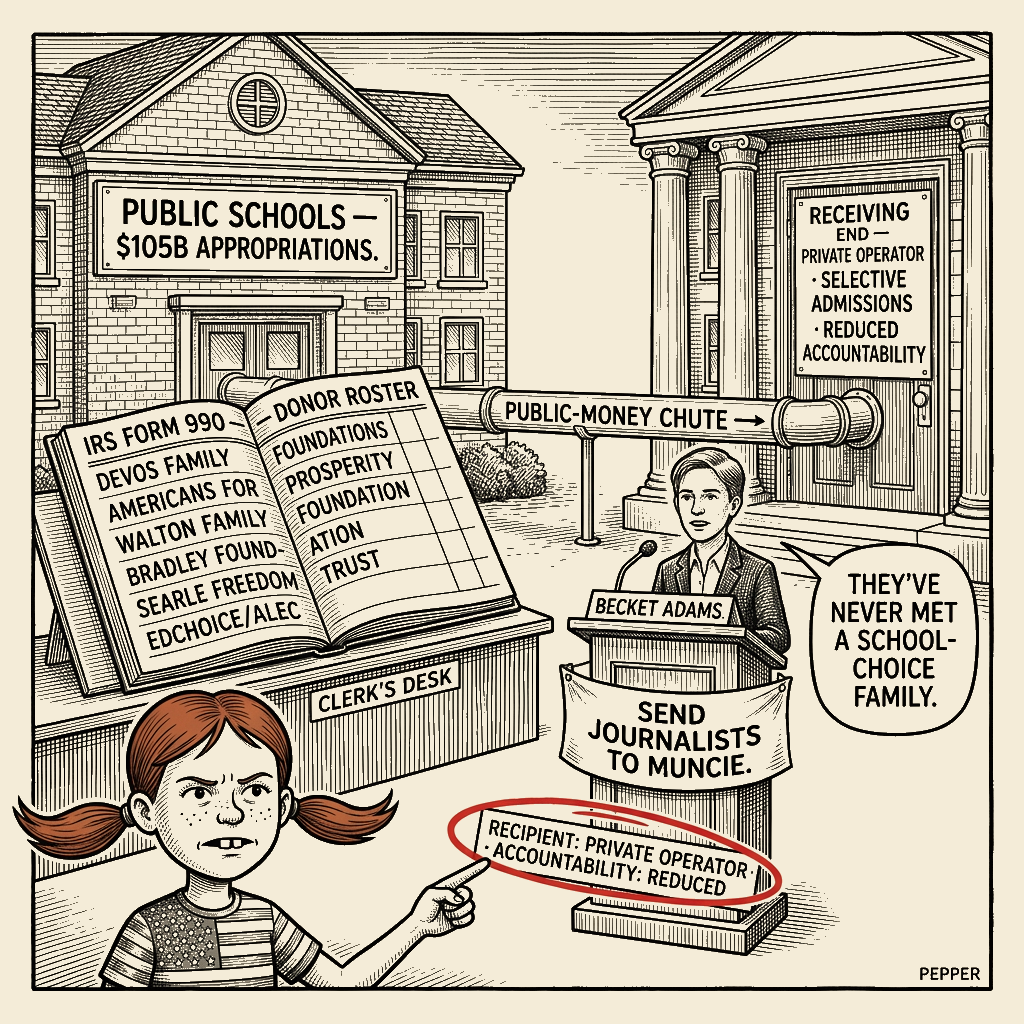
Responding to: Journalists Casually Smear School-Choice Supporters — Because They’ve Never Met Any — Becket Adams · 2026-10-18
What the Piece Argues
Becket Adams argues that major-press journalists do not actually know what conservatives believe, and that ignorance shows up most damagingly in coverage of school choice, where the New York Times’s Jessica Grose ran an essay headlined “Billionaires Love This School Policy. Many Regular Parents Hate It” and framed the policy as a “pet project of religious-fanatic billionaires” that starves the public schools. Adams counters that the $105 billion he cites in public-school appropriations shows vouchers do not siphon from them, and that Grose never engages with the actual conservative case for school choice. He generalizes from there into a media-criticism thesis, citing Noah Smith on abortion, Julia Ioffe on paternal responsibility, and Nikole Hannah-Jones on school-district boundaries as further exhibits, and closes with a satirical “Semester in Muncie” proposal for urban journalists.
Receipts
The framing wants you to believe
- School choice is fundamentally about parental freedom, not a billionaire-driven scheme — and any reporter who calls it a billionaire scheme has just confessed ignorance of the conservative case.
- The $105 billion Adams cites in public-school appropriations demonstrates that vouchers are not siphoning money from a starved system; the public-school line is generous, separately funded, and untouched.
- The mainstream press’s coverage of school choice, pro-life, and SCOTUS reflects ideological capture against which study-abroad exposure to the Midwest is the only remedy.
- Going to Muncie would reveal — to journalists in particular — what parents who choose schools actually believe.
What’s really going on
- IRS Form 990 filings (public, free, indexed by ProPublica’s Nonprofit Explorer) name the school-choice donor network: the Betsy DeVos family foundations, Americans for Prosperity (the Koch network’s political arm), the Walton Family Foundation, the Lynde and Harry Bradley Foundation, and the Searle Freedom Trust. EdChoice is the choice industry’s own think tank. ALEC’s K-12 template has been the model text many state-level school-choice programs were drawn from. None of this is hidden. None of it is the product of a journalist’s confusion. It is auditable every year, by name, in the public record.
- The $105 billion figure Adams cites, sourced to public-school appropriations reporting, documents that public schools are well funded. It does not speak to whether the donor-built parallel pipeline is sound policy. The figure is a real figure about public-school appropriations. It is not a rebuttal of cui bono.
- Concentrated benefit accrues to the private and religious operators that receive the diverted public dollar; they accept reduced public accountability at the receiving end relative to public schools (admissions, hiring, curriculum, expulsion, religious instruction). A small operator class captures a public-dollar revenue stream; the diffuse public-school system absorbs the loss in per-pupil resources and political voice.
- The Swedish voucher reform of the early 1990s is the closest international experiment to what U.S. school-choice advocates are now proposing. Subsequent academic work, including Bohlmark & Lindahl and others, documents increases in school stratification following the reform. Sweden did not produce a parental-freedom success story. It produced an inequality-distribution story.
- The Grose framing Adams derides — “Billionaires Love This School Policy” — is not a journalist’s confusion. It is a documented donor-network observation. Going to Muncie doesn’t change the architecture.
The Response Ladder
Polite Reframe
When to use: For a family conversation, a Letter to the Editor, or anywhere you are talking to a good-faith conservative who has bought the parental-freedom pitch and might be open to the receipts. The audience is the rank-and-file voter, not the donor class.
Linda has three kids in a Cincinnati district school. Two of them are doing fine. The third has been in three schools in five years — each one with a different curriculum, a different disciplinary apparatus, a different way of teaching reading, and the same gap between what her daughter’s test scores look like and what they could look like. Linda does not live inside this newspaper column. Linda lives inside that. When someone tells her school choice is a billionaire plot to kill public schools, Linda is not angry about it — she is, frankly, baffled. She has never once met a billionaire in her life, and her daughter’s school is failing in front of her eyes.
This is the polite answer to the parental-freedom pitch Adams is putting forward, and the more honest half of what his column gestures at without quite landing.
School choice as a parental-freedom principle is not a made-up thing. There are children whose lives are measurably worse for being stuck in the school their address assigns them. That is real, and the people who deny it are people who don’t have to live inside it.
The harder half: when you trace school choice as it actually exists in 2026, you find that the loudest voices funding it are the ones Adams gestures at — the same “religious-fanatic billionaires” he defends the policy against in his own column. American Federation for Children (the DeVos family operation), the Koch network’s Americans for Prosperity and Cato, the Walton Family Foundation, EdChoice out of the Friedman Foundation. This is not a left-wing invention. The donor roster is published; the gift records are public; the policy shops are named. The freedom is what gets sold; the design is what gets delivered.
Sweden ran the experiment as cleanly as anyone has run it — vouchers in the 1990s, then a quarter-century of data. Result: increased segregation by income and ethnicity, worse outcomes for the lowest-performing and newly arrived students, gains concentrated among the most-resourced families. The freedom flowed up; the harm flowed down. That is the base rate on a freedom-based school-choice argument, run honestly and at scale.
So: yes, Linda should have real options. The question is not whether parental choice is legitimate. The question is who writes the program. When the people writing it have private schools for their own children, when the public school is the one that gets defunded when the voucher scales up, and when the disabled child in the voucher-funded private school is the one who gets turned away — that is not parental freedom. That is a freedom-shaped policy that delivers, by every documented measure, to its donors first. Linda would be the first to notice; the donors are the last to admit it.
The other side of this — the side Adams’ column skips over — is what parental choice would look like if it were written by the families instead of the families who already made it. Linda’s choices would include, not exclude, a well-funded public school. Linda’s children would not be sorted in or out of programs based on a coupon’s coverage. The disabled child would be the first protected, not the first turned away. The rural kid whose district just lost a third of its budget to a voucher program would be the canary that gets airlifted, not the canary that gets left. That is what parental choice looks like when the families write it, instead of the families who already made it.
Mockery and Ridicule
When to use: When you are in a thread where Adams’ column is circulating and you want to land the point for the bystanders who haven’t yet committed to either side. The mockery kicks up at the donor class; the rank-and-file voter gets the receipts, not the contempt.
Let me picture this.
Billionaire Betsy DeVos, family operation called American Federation for Children — they write the policy. Billionaire Charles Koch’s network, through Americans for Prosperity and Cato, runs the state-level organizing. Billionaire Sam Walton’s heirs, through the Walton Family Foundation, fund the research-and-advocacy layer. EdChoice, formerly the Milton Friedman Foundation, runs the messaging. The same names show up in pretty much every state’s biggest voucher push. The donor roster is the receipt. The receipt has been public for decades.
Here is the funny part. They write a program about how public schools are failing. Public schools that they themselves did not send their children to. Private schools, their children attended. One of them has been the United States Secretary of Education. The program is then marketed as a poor person’s liberation from a system they didn’t have to use and a financial structure they personally designed.
It gets funnier. The freedom of parental choice they sell you ends up — in the states where the policy is actually live — with parents whose children have disabilities being told, by the private school that took the public money, “we don’t have the program for that.” Reported, documented, settled in state AG offices. The freedom of parental choice has a clause that says “until your child needs something expensive, and then maybe not.” A voucher is, structurally, a coupon that says “we’d like to have your child, provided your child is easy to educate.”
Funniest of all is the part where the press, which Adams correctly diagnoses as cloistered and bubble-bound, somehow never gets around to mentioning the donor roster. Jessica Grose wrote a 1,500-word essay naming the billionaires. The donors are named in her essay, named in conservative-family-giving circles as a matter of routine politesse, named in tax filings, named in the Wall Street Journal philanthropy pages whenever the giving shifts by five points. We do not require a semester in Muncie to read donor disclosures. The donor disclosures are public and have been public. What we are watching is not ignorance. It is selective ignorance. A journalist may never have met a school-choice supporter who is not on Koch’s payroll. A journalist may also never have looked up Koch’s payroll.
The middle-of-the-country voter Adams pretends to defend will read the receipts and notice that the people who wrote the program of freedom are not the people who got the freedom. The middle-of-the-country voter has, in fact, noticed for years. They just had it explained to them by a town crier who’s on the donor’s side of the project.
Nuclear Satire
When to use: A reader who needs the receipts made undeniable — someone who already suspects the donor network exists and needs it pinned with the documented architecture. The villain is the architecture, not the parents who use it.
Becket Adams has, accidentally, written a small instruction manual on how a small set of billionaire-aligned donors can launder their policy project through a national press criticism. The manual has three moves: claim the structural critique is a press bias, throw a large budget figure at the critique, and propose that the critics be sent away. Each move changes the subject. Each move leaves the architecture untouched. Each move is in Adams’s column, in this order, and each move is structurally empty.
Let us reconstruct the architecture the column works to hide. The U.S. school-choice industry, by 2026, is the longest sustained donor-coordinated policy operation on the American right. Thirty years. IRS Form 990 filings, public, every year for thirty years. The Betsy DeVos family foundations — the same family whose patriarch built Amway and whose dynastic ambition to remake American K-12 education has been the through-line of their philanthropy across three generations — were central enough to be the operating logic behind the Trump administration’s Education Department pick. Americans for Prosperity, the Koch network’s political arm, has been a sustained funder of state-level school-choice fights across two decades. The Walton Family Foundation has directed substantial sums to K-12 choice advocacy and adjacent organizations. The Lynde and Harry Bradley Foundation has been a documented funder of choice advocacy. The Searle Freedom Trust is in the relevant Form 990s. EdChoice is the think tank created by the donor network for the donor network. ALEC’s K-12 legislation template has been the model text many state-level school-choice programs were drawn from. None of this is hidden. None of it was hidden even in 2017 — the Senate HELP Committee held Betsy DeVos’s January 2017 confirmation hearing with the family foundation’s sustained school-choice giving as the explicit subject of the questioning. The DeVos confirmation was a public airing of exactly this architecture.
Now let us reconstruct Adams’s column as a defense of that architecture. The column’s central rhetorical move is to point at $105 billion in annual public-school appropriations and ask rhetorically how anyone could think school choice is starving the system. The number is real. The non-sequitur is also real. The two together demonstrate the architecture. Adams’s claim about Grose’s piece — reduced to its operative content — is “$105 billion is in the public-school system already; therefore school choice is not a donor project.” This argument does not address the claim Grose’s framing is making, which is not “vouchers starve public schools today” but “the school-choice pipeline is documented to concentrate a public dollar stream in a small private/religious operator class with reduced public accountability.” The first claim is about funding levels. The second is about architecture. These are not the same claim, and the second is the claim the donor filings support.
The moral application, then, is straightforward. The school-choice industry has, by its own architecture and in its own self-described operation, spent thirty years taking a public dollar, moving it to a private/religious school operator, and accepting reduced public accountability at the receiving end. The receiving operator can then choose which students to admit, which teachers to hire, which curriculum to teach, which children to expel, and which religious doctrines to instill — with less public oversight than the public school down the street would face. That is the architecture. It is not a hypothesis. It is the visible operational product of the donor filings.
The journalists Adams derides — Grose, Nikole Hannah-Jones, the Times writers whose framing he resents — are pointing at exactly this architecture. They are not confused about parental agency. They are not ignorant of conservative principle. They are naming the architecture, by name, with the receipts in front of them. They do not need a semester in Muncie. They need a chair, a Wi-Fi connection, and access to ProPublica’s Nonprofit Explorer — which has, for free, every Form 990 Adams’s column is working to make invisible.
The most useful single line in Adams’s column, taken in good faith, is the Muncie proposal. It is the most useful because it is the most honest. Adams does not, in this column, name a single educational outcome school choice delivers. He does not name a single recipient family whose life the policy improved. He does not cite a single piece of evidence that school choice improves student outcomes over its alternatives. He proposes, instead, that the critics of the architecture be sent away. This is the giveaway. The argument is not about outcomes. The argument is that the critics of the architecture should leave the room.
By any means necessary that operate within the analytic instruments available to us, we keep the receipts. The recipient of school choice is named in the public 990s. The recipient is named. The recipient is named. Go to the filing. Go to the vote. Go to the press release. The receipts do not say the press is ignorant. The receipts say the press is naming what is there.
Profane Scorched-Earth
When to use: The reader who has been watching the school-choice donor network do this for thirty years and needs it named in the language the donor network deserves. Catharsis, full deployment, gloves off. The receipts spine stays intact.
Becket Adams has written the longest, most carefully footnoted denial in American conservatism this week, and every single line in it lands exactly where the school-choice donor network needs it to land, which is to say the most predictable fucking place on the fucking planet. The New York Times points at the architecture. He points at the fucking Muncie calendar. He does not deny the architecture. He cannot — the IRS Form 990s are public, they are free, they have been public for thirty fucking years. He changes the subject. He changes the subject to $105 billion in public-school appropriations because $105 billion is a number large enough to look like a rebuttal if you do not read the next three words of the sentence that came after it, which are “this does not address the documented cui bono of the school-choice operation.”
Let us recount the documented architecture, motherfuckers, because Becket Adams is not going to do it for you and his fucking op-ed depends on you not doing it for yourself. The school-choice industry in the United States is the longest sustained donor-coordinated policy operation on the American right. Thirty. Years. IRS Form 990 in your right fucking hand, Google it you beautiful inquisitive American, you don’t even have to leave the chair. The DeVos family. The fucking DeVos family. The same family whose patriarch built Amway, whose dynastic wealth Forbes has consistently clocked in the billions, and whose three-generation project to remake American K-12 education has been the through-line of their philanthropy across more decades than most of you have been alive. Donald Trump put Betsy DeVos in the cabinet — the fucking cabinet of the fucking president — for the explicit purpose of running American education by the architecture her family spent those decades funding. The fucking cabinet. Americans for Prosperity, the Koch network’s political arm, has been a sustained funder of state-level school-choice fights. The Walton family has directed substantial sums to K-12 choice advocacy. The Lynde and Harry Bradley Foundation is in the 990s. The Searle Freedom Trust is in the 990s. EdChoice is the choice industry’s own think tank, taking donor money to publish regularly. ALEC’s K-12 legislation template is the bill text many state school-choice programs were drawn from. Every single one of these is public, every single one has a public 990, every single one is a documented school-choice funding line, and every single one of them runs to the same fucking place, which is a small set of operators standing between the public dollar and the kid in the classroom, taking a cut in reduced accountability as their fucking fee.
Boo-fucking-hoo, say the fucking operators, the press is mean to us.
The fucking $105 billion, Adams writes, with the tone of a man unveiling the second tablet. The fucking $105 billion! As if the existence of the line item were news. As if the rebuttal to “the donor network is in the public IRS filings” were “well, public schools also have a budget.” Public schools have a budget — this is true. And the architecture of the school-choice pipeline is a documented concentration of a public dollar stream in a small private/religious operator class with reduced public accountability — this is also true, and it is documented in the same fucking filings. These two facts do not contradict each other. They sit at different fucking layers of the same picture. Adams takes the first fact and pours it over the second fact and tells you the second fact is not there. He is lying to you, on a national fucking platform, about a documented fucking architecture. This is what the fucking column is.
The press — the Jessica Groses, the Nikole Hannah-Joness, the Noah Smiths, the Julia Ioffes — these motherfuckers might be wrong about a thousand other things in a thousand other columns, but on the school-choice architecture they are pointing at exactly the fucking thing that is there. They do not need a semester in Muncie. They need a chair, a Wi-Fi connection, and ProPublica’s Nonprofit Explorer, which has every Form 990 Adams’s column is working to hide, for free, available immediately, and indexed cleanly. The 990s do not say the press is ignorant. The 990s say the press is naming what is there.
And what is there, motherfuckers, is this: an architecture in which a public dollar moves from a public school to a private religious school operator who then gets to choose which child to admit, which teacher to hire, which curriculum to teach, which child to expel, which religious doctrine to instill in the soft fucking skull of a five-year-old whose parents’ tax dollars paid for the seat — and all of this with less public oversight than the public school down the street, because the fucking architecture is the fucking deal. The architecture is the product. The donor network is not secret. The donor network is the most publicly documented policy operation in American conservatism, and Becket Adams has the unmitigated fucking gall to write a column calling the journalists who named it ignorant.
By any means necessary that operate inside the columns and the receipts, we name what is there. We name who benefits. We name who pays. We name the fucking IRS Form 990 by name. We do not take our fucking instruction in documented architectures from the fucking operators of those architectures. We name the fucking thing, and we keep the fucking receipts, and we go home and tuck our kids in at night knowing that the column on the press was a column on the donor network, with the journalist named as a deflection, the $105 billion named as a deflection, the Muncie semester named as a deflection, and the education of American children named as the actual product being sold by the people who do not want the architecture named.
The column was not about ignorance. The column was about an architecture. The architecture is in the 990s. The architecture ends when the fucking receipts end it.
About Malcolm Little King
Malcolm Little King is a heteronym in Main Street Independent's editorial architecture — an analytical voice, not autobiography of any actual person. The position this column expresses is the publication's position on the territory Malcolm Little King's lane covers, rendered through Malcolm Little King's register.