Responding to: Why HUD’s Pushback Against DEI Mortgages Is Good for Black Wealth — Howard Husock · 2026-10-14
What the Piece Argues
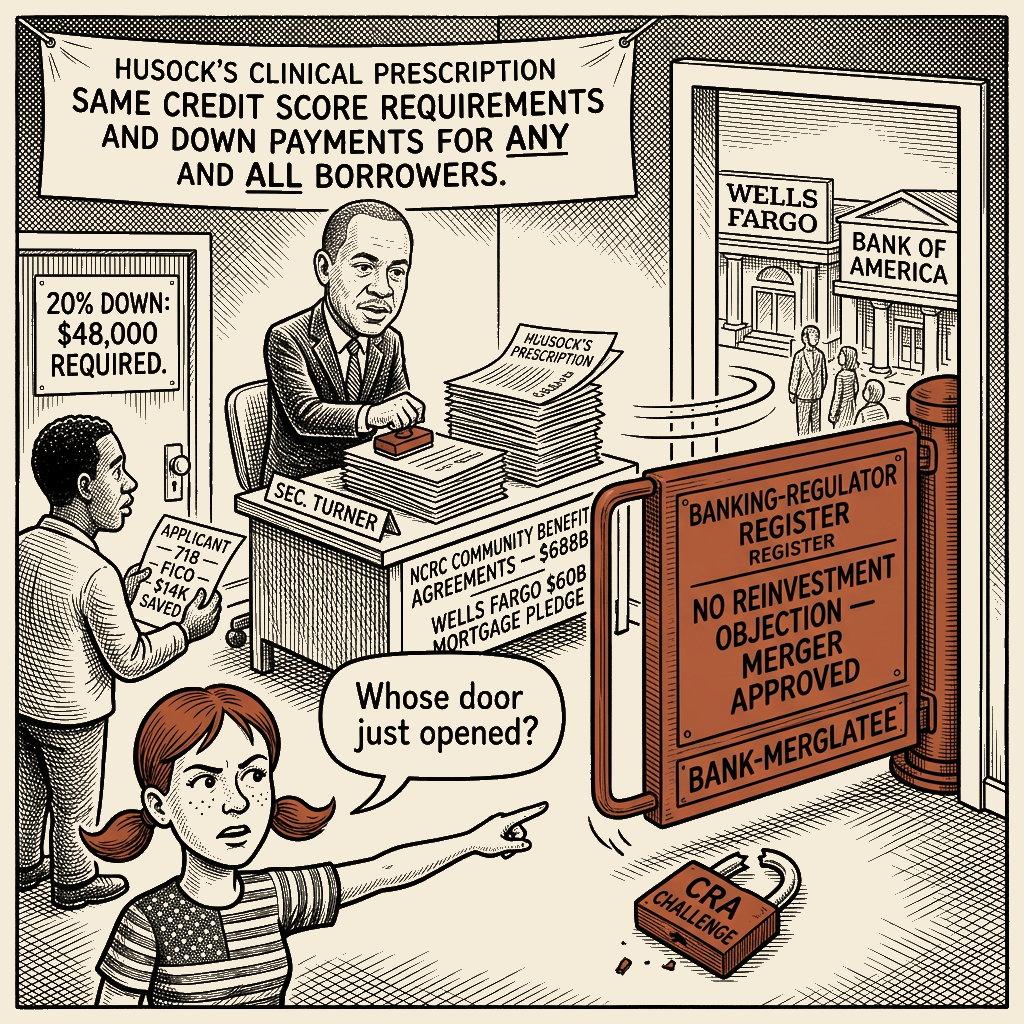
Howard Husock’s column defends HUD Secretary Scott Turner’s investigation of Wells Fargo for what Turner calls “race-based decision-making” in mortgage lending — a probe premised on the claim that programs designed to expand mortgage credit to Black prospective homebuyers actually harm Black households by exposing them to the elevated foreclosure risk that, in 2008, hit Black homeowners hardest. The piece leans on Wells Fargo’s 2017–2027 pledge to underwrite roughly $60 billion across 250,000 mortgages and the larger community-benefit-agreement pipeline brokered by the National Community Reinvestment Coalition (NCRC) — nearly $688 billion since 2016 — and argues the pledges require relaxed underwriting that recycles the subprime pattern. Husock’s prescription is “the same credit score requirements and down payments for any and all borrowers,” with longer 20-year mortgages as the additional wealth-building tool; what appears to be a barrier, over time, proves to be the foundation of wealth.
Receipts
Move. The piece recasts a documented merger-leverage alternative to redlining — pledges by major banks to underwrite mortgages in communities they historically excluded — as the very thing that ruins Black wealth, with the merging-bank pipeline as the unnamed beneficiary.
-
The framing wants you to believe
- Race-conscious mortgage programs (“DEI mortgages”) lower credit standards for Black borrowers, and Black households are more likely to lose their homes to foreclosure as a result.
- The 2008 foreclosure crisis — which hit Black homeowners harder than white homeowners — is the proof text.
- Banks made their pledges to be “woke”; the racial-equity dimension is a moral experiment whose harm should be reversed.
- Applying “the same credit score requirements and down payments for any and all borrowers” would sustainably build Black wealth, since “what can appear to be barriers will, over time, prove to be the foundations of wealth.”
-
What’s really going on
- Wells Fargo’s actual historical record on race is redlining, not over-lending to minorities. The bank settled a Department of Justice fair-lending complaint in 2012 for $175 million (with roughly $8.5 billion in loan modifications) for steering Black and Hispanic borrowers into subprime loans and routing comparable white borrowers to conventional loans in the same branches. The “race-based decision-making” complaint Turner is now opening against the bank sits on top of a documented record of discrimination in the opposite direction.
- HMDA data (Federal Financial Institutions Examination Council) and paired-tester HUD audits have repeatedly shown Black mortgage applicants are denied at higher rates than comparable white applicants; the discrimination is at the approval gate, not in generosity toward approved applicants.
- The actual drivers of the Black–white wealth gap — documented across Federal Reserve research and the From Here to Equality program by Darity, Hamilton, and Francis — include the inheritance disparity (white households inherit substantially more than Black households across the major published studies, with the precise multiplier varying by methodology and year), the wage gap, appraisal bias (a 2022 Freddie Mac study found homes in majority-Black neighborhoods appraised below contract price substantially more often than comparable homes elsewhere), and the redlining legacy of federally-supervised disinvestment — none of which “uniform standards” prescription can reach.
- The NCRC community-benefit agreements are not philanthropy. They are merger leverage: banks sign them because the NCRC, by rule of law, has standing to challenge bank mergers on reinvestment grounds. The $1 billion Bank of America racial-equity pledge of 2020 is the model. The moment HUD reads the agreements as illegal, the leverage evaporates, and the next bank merger is approved with a cheaper hurdle. Banks pay the banks’ costs; Black prospective homebuyers pay the streetside costs.
- Anchor citation: Department of Justice Office of Public Affairs, Wells Fargo Settlement Resolves Allegations of Discrimination Against African-American and Hispanic Borrowers in Mortgage Lending (July 12, 2012) — DOJ press release documenting the $175M settlement and roughly $8.5B in loan modifications for the same period (2004–2009) the piece is now reassigning as “race-based decision-making favoring minority buyers.”
The Response Ladder
Polite Reframe
When to use: At the dinner table with a relative who’s internalized the “sustainable homeownership” argument; in a community meeting; in any forum where the audience is genuinely persuadable.
Meet Brenda. She is 38, works the night shift as an ICU nurse in Atlanta, raises her daughter alone, and has been on a list to buy a three-bedroom in College Park for the better part of three years. Her credit score is 718. Her debt-to-income ratio is 36 percent. She has $14,000 saved. The conventional 20-percent down payment on the homes she has been pre-approved to see is $48,000. The FHA loan at 3.5 percent would require her to put down $8,400 — close to her savings, but not quite. The Wells Fargo program flagged in this article, the NCRC community benefit agreement, the Bank of America $1 billion racial equity pledge — these are the programs that would close the gap for Brenda. They give her a path that the conventional market says she does not qualify for.
Now read the prescription in Howard Husock’s piece: “applying the same credit score requirements and down payments for any and all borrowers.” That is the policy that leaves Brenda in her apartment. Under the piece’s prescription, Brenda stays in her apartment. Under the FHA 3.5-percent program, she gets the house. Under a down-payment assistance or Baby Bonds regime, she gets the house without the underwriting bar being lowered at all. The piece’s prescription is the one that locks Brenda out. The piece names this lockout “sustainable.”
The piece’s concern is real. Black families did lose homes in disproportionate numbers after 2008. The 2008 crisis did fall hardest on Black communities. These are documented facts. The piece’s error is in the causal arrow. The 2008 crisis was not caused by the affordable housing goals of Fannie Mae and Freddie Mac — the Financial Crisis Inquiry Commission’s 2011 report traced it to private-label subprime mortgages originated by lenders like Countrywide, New Century, and Ameriquest, packaged into mortgage-backed securities by Wall Street banks, and found the affordable housing goals were not a primary cause of the crisis. The 2012 DOJ settlement with Wells Fargo resolved allegations that the bank had systematically steered Black and Hispanic borrowers into subprime loans and charged them higher fees for the same products — the discrimination the program the piece attacks was designed to address. The race-conscious mortgage programs the piece attacks are responses to that documented pattern of discrimination, not causes of it.
The Black-white homeownership gap — 45 percent to 74 percent — reflects historical redlining, the racial wealth gap, employment discrimination, and the intergenerational effects of policies that gave white families wealth-building opportunities (the 1944 GI Bill, the 1862 Homestead Act, FHA mortgages from 1934 onward that were systematically denied to Black applicants) while denying them to Black families. The piece’s prescription, applied honestly, would maintain the exclusion that produced the gap in the first place. It is the most literal form of “same standards, same exclusion” the housing market has ever produced.
If we want to actually build Black wealth sustainably, the policy list is long and well-documented. It includes Baby Bonds as Darrick Hamilton and William Darity Jr. have proposed, addressing the appraisal bias that undervalues Black-owned homes, zoning reform to expand the supply of affordable homes, direct down payment assistance for first-generation homebuyers, and enforcement of the Fair Housing Act against the discrimination that produced the gap. None of these relax credit standards to put families in homes they cannot sustain. All of them address the structural causes of the gap the piece names.
What’s striking about the piece is the framing of the harm. The author names Turner “courageous” for investigating Wells Fargo. He says race-based lending “offends the antidiscrimination goal of fair housing.” He says it “risks harming households that it purports to help.” This is the rhetorical move of taking a documented pattern of discrimination and reframing the response to that discrimination as the harm. The “households it purports to help” have been systematically locked out of homeownership for the better part of a century. The programs under attack are some of the few mechanisms that have worked to break that lock.
Brenda is not the audience for race-conscious lending. She is the intended beneficiary. The piece, in the name of protecting her, asks that the door be shut.
Mockery and Ridicule
When to use: Thanksgiving dinner with the uncle who’s been marinating in Wall Street Journal op-eds; on X when the Woke Mind Virus crowd is patting itself on the back; in any forum where the audience includes sympathetic bystanders who can be won with sharp absurdity.
Howard Husock has identified the cause of the Black-white homeownership gap. It is not the Federal Housing Administration’s 1934 decision to insure mortgages only in white neighborhoods. It is not the GI Bill’s 1944 exclusion of Black veterans. It is not the racial covenants in property deeds that ran through 1968. It is not the appraisal bias that today undervalues Black-owned homes by tens of thousands of dollars. It is the Wells Fargo $60 billion mortgage program. The Bank of America $1 billion racial equity pledge. The $687 billion in NCRC community benefit agreements. These are the mechanisms that have produced the 29-percentage-point gap. Strip them out. Same standards for all. The gap closes.
The diagnosis is elegant. Apply it elsewhere. The Black-white incarceration gap is approximately 5-to-1. The cause, by the same logic, must be the consent decrees on police departments, the bail reform measures, the drug decriminalization efforts. Roll them back. Same standards for all. The incarceration gap closes. The Black-white unemployment gap is reliably 2-to-1 in recessions. The cause, by the same logic, must be the federal contracting set-asides, the minority business development programs, the equal employment opportunity enforcement. Roll them back. Same standards for all. The unemployment gap closes. The Black-white maternal mortality gap is roughly 3-to-1. The cause, by the same logic, must be the Medicaid expansion. Roll it back. Same standards for all. The maternal mortality gap closes. If the methodology works for housing, it works everywhere. The methodology is what it is. When a hundred years of state-sanctioned exclusion produces a gap, the mechanism that caused the gap cannot be the response to it. This is the moral equivalent of declaring a fire and blaming the firefighters.
The piece treats the 31 percent vs 53 percent Black-white marriage gap as evidence that Black families need higher credit bars to compensate. The marriage gap is, by every documented measure, downstream of the mass incarceration gap, the labor-force participation gap for Black men, and the death-rate gap. The piece says the symptom of the disease is the cause of the disease. The piece says the floor needs to be higher for the man being pushed down. The piece is a recommendation, with maximum civility, that the victim of the system be the one the system tightens the screws on.
The piece recommends 20-year mortgages as a wealth-building tool. The 20-year mortgage is the mortgage product for households who can already afford the 30-year mortgage. The households the piece claims to be protecting are the households least able to use this product. The recommendation is the policy equivalent of advising a man dying of thirst to drink more wine.
The piece’s central claim, that race-conscious lending is “not good in the long run for boosting black homeownership and wealth,” requires us to believe that the absence of race-conscious lending is good for Black homeownership. The actual record: the 30 years before the Fair Housing Act saw the gap widen. The 50 years since have seen it narrow, slowly and partially, with the help of the very programs the piece attacks. The data is the data.
Turner is “courageous” for investigating Wells Fargo. Wells Fargo paid $175 million in 2012 to settle DOJ allegations that it steered Black and Hispanic borrowers into subprime loans. Wells Fargo employees testified the company had them charge Black customers higher fees for the same products. Wells Fargo is the institution. The man is investigating the institution. The author treats this as a moral act of unusual courage. The moral act, in the framing of the piece, is the act of investigating the response to discrimination. The discrimination itself is not named, because the piece cannot name it without indicting the policy the piece is recommending.
We are the ones who actually build Black wealth. The receipts are public. Baby Bonds, as Darrick Hamilton and William Darity Jr. have proposed, would close the wealth gap without lowering credit standards for anyone. Direct down payment assistance for first-generation homebuyers addresses the savings gap that the 20-percent-down-payment requirement has codified. Zoning reform expands the supply of homes in neighborhoods that have been artificially restricted. Enforcement of the Fair Housing Act against appraisal bias and steering into subprime loans addresses the discrimination the piece refuses to name. The list is long. The list is well-documented. The list is the actual program for building Black wealth sustainably. The list is what the piece should have written.
Nuclear Satire
When to use: When the framework is the message. When the policy being defended is the policy of a society that built the largest generational wealth transfer in human history on the explicit exclusion of Black families, and the prescription in 2026 is “same standards for all.”
Let us speak, plainly, of the houses that are not here.
In 1934, the Federal Housing Administration was created to insure private mortgages. In its first three decades, it insured those mortgages almost exclusively in neighborhoods marked “A” or “B” on the agency’s residential security maps. The “D” neighborhoods — the ones shaded red — were the Black neighborhoods. The FHA did not insure mortgages in them. The FHA did insure mortgages in white neighborhoods. The veterans returning from the Second World War got FHA-backed mortgages in those neighborhoods. The Black veterans returning from the same war did not. The wealth that those mortgages built is, today, the median white household’s net worth. The wealth that did not get built is, today, the median Black household’s net worth. The median white household has roughly ten times the wealth of the median Black household. The math is not a mystery. It is an arithmetic. It was put in the ledgers by the United States government.
In 1968, the Fair Housing Act was passed. The fair-lending provisions the piece attacks are downstream of that act. The CRA enforcement the piece attacks is downstream of that act. The Wells Fargo $60 billion program, the NCRC’s $687 billion in community benefit agreements, the Bank of America $1 billion racial equity pledge — all downstream of that act. The piece calls the response to the discrimination the problem. The piece calls the Fire Department the fire.
The piece recommends “applying the same credit score requirements and down payments for any and all borrowers.” The piece recommends 20-year mortgages. Let us be specific about what these recommendations are. The 20-year mortgage is the mortgage product for households who can already afford the 30-year mortgage. The “same credit score requirements” are the credit score requirements calibrated, at every level of the underwriting algorithm, on the data of the past century — the data generated by the discrimination that produced the gap the piece claims to be solving. The recommendation is to apply the discriminator’s instrument to the discriminated. The recommendation is to ask the man with the broken leg to run the same race as the man with two healthy ones, because the rules of the race say legs do not matter. The piece’s recommended cure is the disease.
The piece names the 31 percent vs 53 percent Black-white marriage gap. The piece says this gap means more Black households rely on one income. The piece treats this as a fact about Black households. The piece does not name the 800-pound gorillas standing in the room. For Black men born around 1974, BJS data found approximately one in three would go to prison in their lifetime; more recent cohorts face lower but still disproportionate rates. The labor-force participation gap for Black men in their prime working years is approximately 7 percentage points. The death rate for Black men in their twenties and thirties is approximately twice the rate for white men. The marriage gap is downstream of the incarceration gap, the labor-force gap, and the death gap. The piece says the marriage gap means Black families need higher credit bars. The piece says the symptom of the disease is the cause of the disease. The piece says the floor needs to be higher for the man who is being pushed down. This is not analysis. This is a recommendation that the man lie down.
Scott Turner is named “courageous.” The man is investigating Wells Fargo. Wells Fargo paid $175 million in 2012 to settle DOJ allegations that it had steered Black and Hispanic borrowers into subprime loans and charged them higher fees for the same products. Wells Fargo employees testified, in the 2012 settlement, that the company had them charge Black customers higher fees for the same products. Wells Fargo is the institution. The investigation is the man doing the man’s job. The author of the piece treats this as a moral act of unusual courage. The moral act, in the framing of the piece, is the act of investigating the response to the discrimination. The discrimination itself — the discrimination that produced the wealth gap, that produced the homeownership gap, that produced the foreclosure-rate gap, that produced the marriage-rate gap, that produced the incarceration-rate gap — the discrimination itself is not named, because the piece cannot name it without indicting the policy it is recommending.
The piece is not an analysis. The piece is a snow job. The piece is a recommendation that the same underwriting system be applied to the same families the system has been underwriting out of homeownership for the last century. The piece says this is good for Black wealth. The piece is the apparatus doing what the apparatus does. The apparatus recommends itself. The apparatus recommends its own underwriting standards as the solution to the gap its underwriting standards produced.
The factual record is that race-conscious lending programs emerged in response to documented patterns of discrimination. The factual record is that the 2008 crisis was caused by private-label subprime mortgages originated by lenders like Countrywide, packaged by Wall Street banks, and sold to investors; the FCIC’s 2011 report found the affordable housing goals of Fannie Mae and Freddie Mac were not a primary cause of the crisis. The factual record is that the 31 percent vs 53 percent marriage gap is downstream of the incarceration, death, and labor-force gaps the piece does not name. The factual record is that the homeownership gap is the cumulative result of the FHA’s redlining, the GI Bill’s exclusion, the racial covenants in property deeds, the appraisal bias, the steering into subprime loans, and the foreclosure-rate gap. The factual record is that the programs the piece attacks are responses to the discrimination the piece refuses to name.
The piece recommends that the door close. The door has been closing for a century. The piece recommends that the door close harder. The piece recommends that this is good for the people the door is being closed on.
King’s image of the arc of the moral universe bending toward justice — an image he used in a Selma church in 1965 — is the right closing register here, because the arc does not bend by itself. The bending requires the people who built the redlining to stop building the redlining. The bending requires the people who wrote the underwriting algorithms to write the underwriting algorithms for the Black applicant too. The bending requires the people who publish the magazine in 2026 to publish the magazine in 2026, which they have done, and the bending requires the people who read the magazine to read the magazine, and then to read the receipts, and then to do the bending themselves.
Profane Scorched-Earth
When to use: The friend at the cookout who has been running the same Wall Street Journal op-ed in your face for an hour; the comment section that needs to be broken open with receipts; the moment when someone has told you that the programs trying to keep Black families from being foreclosed on are the problem. The final register. Gloves off.
Holy fucking shit. Let us, for one goddamn second, talk about the actual history. The Federal Housing Administration — the agency that built the goddamn American middle class — was created in 1934. In its first thirty years, it explicitly refused to insure mortgages in neighborhoods where Black people lived. This was not a bug. This was the god-damn policy. The FHA’s own manual contained the maps. The maps said red. Red meant Black. Red meant no mortgage. The FHA insured billions of dollars in mortgages between 1934 and 1968. Almost none of that money went to a Black family. Almost all of that money built the white suburban wealth that Howard Husock, writing in 2026, is now telling you to defend. The median white household has ten times the wealth of the median Black household. The arithmetic is the arithmetic. The arithmetic was put in the ledgers by the United States government.
The G.I. Bill — the 1944 legislation that paid for white veterans to go to college and buy houses — was systematically denied to Black veterans. This was not a glitch. This was the policy. The white veteran used his G.I. Bill to buy a house. The Black veteran came home and got nothing. The wealth that the white G.I. Bill bought is, today, the white wealth. The wealth that the Black veteran could not buy is, today, the Black wealth gap. The math is the math. The math was put in the ledgers by the United States government.
And now, in 2026, Howard Husock is going to tell you, in the National Review, that the problem is the programs that have been trying, since 1968, to undo some fraction of this. The Wells Fargo $60 billion mortgage program. The Bank of America $1 billion racial equity pledge. The $687 billion in community benefit agreements that the NCRC has facilitated. These are the programs that have actually moved the needle on the Black homeownership rate. These are the programs that have given Black families the tiny, partial, contested foothold they have in the American housing market. And Howard Husock is going to tell you, with a straight face, that these programs are bad for Black wealth. Howard Husock is going to tell you, with a straight face, that what Black families need is “the same credit score requirements and down payments for any and all borrowers.” Howard Husock is going to tell you, with a straight face, that the solution to four hundred years of state-sanctioned theft is the same underwriting algorithm that did the stealing.
The 2008 financial crisis — the crisis Howard Husock invokes — was caused by private-label subprime mortgages. This is documented. The Financial Crisis Inquiry Commission, in its 2011 report, traced the crisis to lenders like Countrywide, New Century, and Ameriquest, who originated mortgages to anyone with a pulse, packaged them into mortgage-backed securities, and sold them to investors around the world. The FCIC found the affordable housing goals of Fannie Mae and Freddie Mac were not a primary cause of the crisis. The crisis was Wall Street, not government housing programs. Black families were hit hardest because they were systematically steered into those subprime loans even when they qualified for prime loans. The 2012 DOJ settlement with Wells Fargo resolved allegations that the bank had steered Black and Hispanic borrowers into subprime loans and charged them higher fees for the same products — discrimination that cannot be explained by creditworthiness. The crisis the piece invokes is the crisis that discrimination produced. The piece treats the discrimination as if it does not exist.
And the marriage gap. The piece says the 31 percent vs 53 percent Black-white marriage gap means more Black households rely on one income. The piece treats this as a fact about Black families. The piece does not name that for Black men born around 1974, BJS data found approximately one in three would go to prison in their lifetime, with current cohorts facing lower but still disproportionate rates. The piece does not name that the labor-force participation gap for Black men in their prime working years is approximately 7 percentage points. The piece does not name that the death rate for Black men in their twenties and thirties is approximately twice the rate for white men. The piece says the marriage gap means Black families need higher credit bars. The piece is recommending that the woman whose husband is in a cage, whose son is unemployed, whose father is dead at 28, be required to meet higher mortgage standards. The piece is recommending that the victim of the system be the one the system tightens the screws on. The piece is, with maximum civility, telling the people who have been crushed that the way to fix the crushing is to be crushed harder. The piece is, with maximum civility, asking Black families to apologize for being Black.
Scott Turner is “courageous.” The author praises the man’s courage. The man is investigating Wells Fargo. Wells Fargo paid $175 million in 2012 to settle DOJ allegations that it had steered Black and Hispanic borrowers into subprime loans and charged them higher fees for the same products. Wells Fargo employees have testified that the company had them charge Black customers higher fees for the same products. Wells Fargo is the institution. The man is investigating the institution. The author treats this as a moral act of unusual courage. The moral act, in the author’s framing, is the act of investigating the response to the discrimination. The discrimination itself — the discrimination that produced the wealth gap, that produced the homeownership gap, that produced the foreclosure-rate gap, that produced the marriage-rate gap, that produced the incarceration-rate gap — the discrimination itself is not named, because the author cannot name it without indicting the policy the author is recommending.
The piece is not an analysis. The piece is a fucking fraud. The piece is a recommendation that the same underwriting system be applied to the same families the system has been underwriting out of homeownership for the last century. The piece says this is good for Black wealth. The piece is the apparatus doing what the apparatus does. The apparatus recommends itself. The apparatus recommends its own underwriting standards as the solution to the gap its underwriting standards produced. The apparatus has been doing this for sixty years. The apparatus has been getting richer while the gap has been getting wider. The apparatus is now writing pieces in the National Review about how the apparatus is good for Black wealth. The apparatus is a piece of shit.
The Black-white homeownership gap is 45 percent to 74 percent. The gap was wider before the Fair Housing Act. The gap has narrowed since. The narrowing is the work of the programs the piece attacks. The piece says the work should stop. The piece says the door should close. The piece says this is good for the people the door is being closed on. The piece is, with maximum civility, with maximum respectability, with maximum plausible deniability, telling Black families that they should not own homes.
Let us be honest. The piece is a piece of shit. The author is a piece of shit. The publication is a piece of shit. The underwriting algorithm is a piece of shit. The entire conversation the piece wants to have is a piece of shit. The conversation is the conversation the apparatus has been having since 1955. The conversation is the conversation that produced the wealth gap, the homeownership gap, the foreclosure-rate gap, the marriage gap, the incarceration gap. The conversation is the conversation the apparatus recommends as the only conversation worth having. The conversation is the conversation the apparatus has, every goddamn time, refused to have about the discrimination that produced every gap the conversation wants to pretend is the result of the family’s failure to meet the underwriting standards.
We have a different conversation to have. The conversation we have to have is the one about who wrote the underwriting standards. The conversation we have to have is the one about who got the mortgages and who did not. The conversation we have to have is the one about the 30-year mortgage that became the white middle class and the Black family that got nothing. The conversation we have to have is the one about the GI Bill that the Black veteran could not use. The conversation we have to have is the one about the 2008 crisis that was caused by the lenders, not by the programs trying to keep Black families from being foreclosed on. The conversation we have to have is the one about the marriage gap that is downstream of the incarceration gap that is downstream of the discrimination that produced the wealth gap that produced the homeownership gap that produced the foreclosure-rate gap. The conversation is a long one. The conversation is the only one worth having.
The arc of the moral universe bends toward justice — that was King’s image, used in a 1965 Selma church, and the image is right because the arc does not bend by itself. The arc bends because Black families have been bending it, with their bodies, with their labor, with their foreclosures, with their evictions, with their lives. The arc bends because Fannie Mae and the NCRC and the CBAs and the racial equity pledges and the Fair Housing Act and the Black families who took the mortgages some of them could not sustain, because they had been locked out of the system for so long, have been bending the arc. The piece is the arc being bent in the other direction. The piece is the arc being bent by the people who want the same underwriting standards they have always wanted. The piece is the arc being bent by the people who want the same door they have always had. The arc does not bend that way. The arc bends the other way. The arc bends the way Black families have been bending it. The arc bends because they are bending it.
Now. What is your move. What is mine.

About Malcolm Little King
Malcolm Little King is a heteronym in Main Street Independent's editorial architecture — an analytical voice, not autobiography of any actual person. The position this column expresses is the publication's position on the territory Malcolm Little King's lane covers, rendered through Malcolm Little King's register.