Responding to: Why corporate America needs one playbook for a divided Washington after November · 2026-10-15
What the Piece Argues
A Fox News Opinion column by Proven Media Solutions founder Dustin Siggins advises corporate America — particularly data center developers, federal contractors, and hotel chains — on how to navigate a potentially divided Washington after the midterms. The column argues that data center companies’ recent setbacks came from winning Washington but losing the country, and that a unified “one playbook” integrating corporate communications and government affairs can keep corporate interests on course even if voters express dissatisfaction. It treats local opposition to data centers, the rollback of DEI commitments, and controversies over ICE lodgings as primarily communications challenges rather than substantive accountability questions, asserting that “voters who want more money in their pockets and data centers nowhere near their backyards are not changing parties” — implying corporate interests don’t actually have to change.
Receipts
The playbook’s load-bearing move is to recast local opposition, the rollback of DEI commitments, and the hotel/ICE controversies as communications problems solvable with a unified “one playbook” — because voters aren’t switching parties, the column’s logic goes, so their actual preferences don’t bind.
- The framing: data center opposition is a public-relations failure solvable with better messaging. What’s actually going on: it’s a real democratic expression with substantive stakes — water use, electricity demand, noise, land use, and lack of community benefits-sharing — not a messaging gap.
- The framing: voter dissatisfaction doesn’t translate into political consequence because voters aren’t switching parties. What’s actually going on: the playbook elides the difference between federal partisan voting and the local-level politics (planning commissions, ballot initiatives, public-comment testimony, school-board fights) where data center siting decisions are actually made.
- The framing: the DEI rollbacks were “good for contracts but horrible for employee relations” — a comms problem. What’s actually going on: federal contractors “erased” equity language because the contract cost of compliance exceeded the cost of dropping the commitment; the playbook’s own admission that “diversity had been traded for profit” is the strongest receipt on the record, and it documents a substantive harm the column then recommends handling as a communications problem.
- The framing: the data center industry’s 40% slowdown is a “trap.” What’s actually going on: the 40% figure comes from the author’s own firm (Proven Media Solutions’ “Insider Insights report”) and is not independently audited; the playbook is using its own marketing claim to define the problem it then sells the solution to.
Anchor citation: The column itself, Fox News Opinion, October 15, 2026, by Dustin Siggins, “Why corporate America needs one playbook for a divided Washington after November” — particularly the DEI section admission that “diversity had been traded for profit” and the 40% data-center slowdown figure attributed to Proven Media Solutions’ “Insider Insights report.”
The Response Ladder
Polite Reframe
When to use: At Thanksgiving with a relative who reads business press and shared this column approvingly; for a coworker who actually runs communications for a small company and is being told to think about this stuff; in a measured Facebook exchange with a reasonable conservative friend.
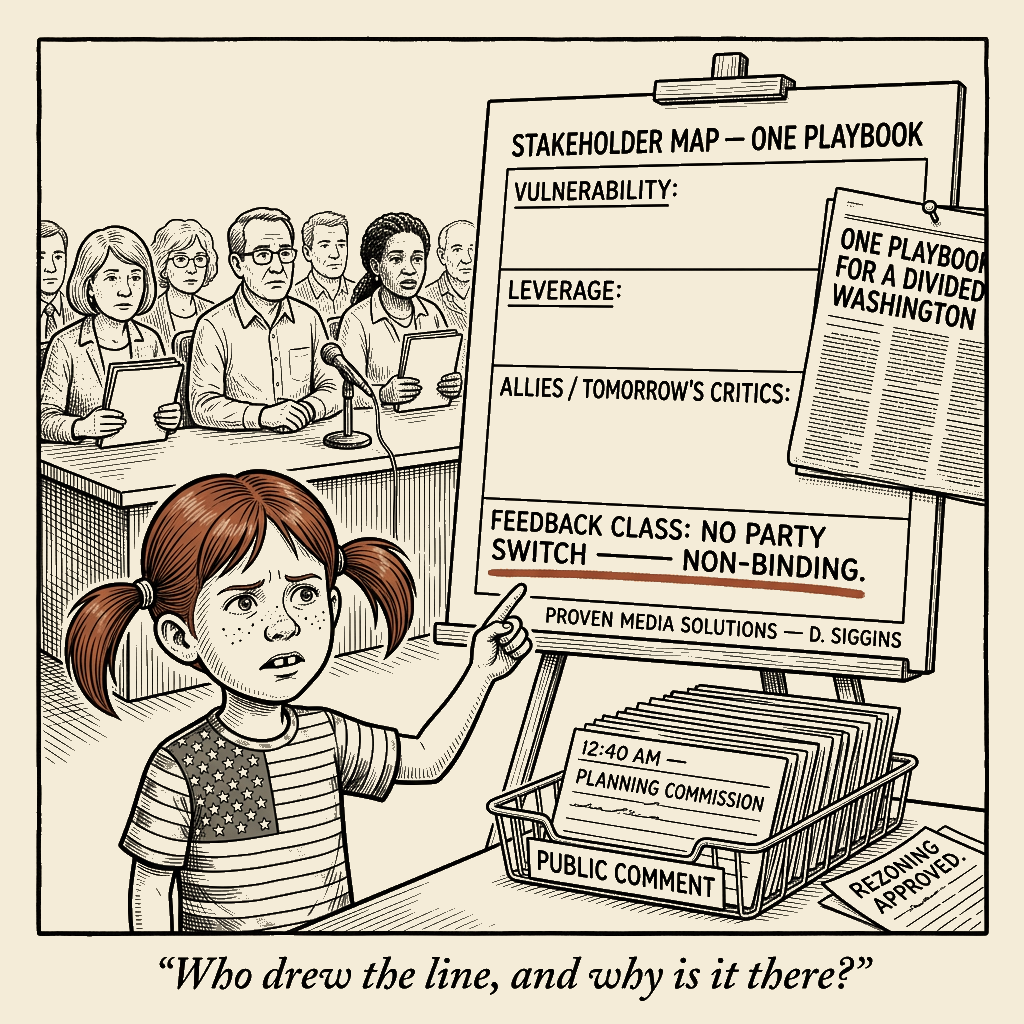
Brenda bought her house in 2007 in Loudoun County, Virginia, on a cul-de-sac with a school bus stop at the corner. Two years ago, a developer rezoned the lot behind her kids’ elementary school for a hyperscale data center. The planning commission meeting ran past midnight; three hundred neighbors testified. The county supervisors approved the rezoning anyway — they’d been “engaged” by the developer’s government affairs team for eighteen months, took the developer’s “community benefits” package, and had the permits in hand before Brenda’s neighborhood knew what hit her. The data center industry calls this a communications problem. A Fox News Opinion column this month by Proven Media Solutions founder Dustin Siggins made the case directly: “Voters who want more money in their pockets and data centers nowhere near their backyards are not changing parties, and companies that plan as if they were, will be talking to a country that doesn’t exist.” His prescription: integrate corporate communications and government affairs into “one playbook” that maps “where the company is vulnerable, where it has leverage and which of today’s allies could become tomorrow’s critics.”
The piece is candid about its own cynicism. It admits that under Trump’s 2025 DEI executive orders, federal contractors “erased” equity language — “good for contracts but horrible for employee relations, as many felt that diversity had been traded for profit.” The column calls this a communications problem. The people whose diversity was traded for profit might call it something else. The polite reframe: corporate America’s communications problem and the country’s economic problem are not the same problem. The playbook pretends they are, because admitting they’re different would make the playbook unnecessary.
Mockery and Ridicule
When to use: When the column is being passed around by your business-y friends; in a group chat where someone shared it with “this is exactly right”; when a Substack commenter is paraphrasing the playbook logic and you need them to see the joke.
The most quoted line from Dustin Siggins’s recent Fox News Opinion column is this: “Voters who want more money in their pockets and data centers nowhere near their backyards are not changing parties, and companies that plan as if they were, will be talking to a country that doesn’t exist.”
Read that again. Slowly. This is being published in the opinion section of a major outlet, by a guy whose job title is “founder of Proven Media Solutions,” telling corporate America — actual quote — that voters are sending the wrong signal and companies shouldn’t listen.
The business model is right there. Proven Media Solutions. Media solutions. The founder’s solution to the problem that voters don’t want what corporate America is selling is to sell corporate America a better sales pitch. He is, in the literal sense, a press agent, and he is telling his press-agent clients that the trick to outflanking 300 neighbors testifying at midnight is “one playbook” that “maps where the company is vulnerable, where it has leverage, and which of today’s allies could become tomorrow’s critics.”
The column is unusually honest about its own cynicism. It notes that under Trump’s 2025 DEI executive orders, federal contractors “erased” equity language from their websites — “good for contracts but horrible for employee relations, as many felt that diversity had been traded for profit.” Then it suggests companies handle this with a unified communications-and-government-affairs approach. The DEI rollback happened because companies weighed the cost of compliance and chose the contract. The playbook is the post-hoc communications strategy for handling the part of the workforce that noticed.
Note the further moves. The piece cites the 2006 midterms, Obama’s 2014 executive actions, and Trump’s 2018 shutdown to argue that congressional control doesn’t bind the executive much. The implication: voters sent Republicans “packing” and the president still ran his agenda. If you read this as comfort, the comfort is for corporate America — relax, Trump’s still got the agencies, the executive orders, the emergency declarations. The voters who switched? They were always going to switch back. The data center industry should just learn to talk to the neighbors instead of steamrolling them.
The piece even uses the hotel/ICE controversy as an example. Hotels that refused ICE agents got punished by GSA; hotels that took the heat from protesters got punished by protesters. The piece’s advice: integrated playbook. The piece’s omission: that what both controversies were about was a hotel chain’s business relationship with a federal agency conducting deportations. The handbook says: how do you talk about it. The handbook does not say: should you be doing it.
The mockery is structural. The advice column is not actually about how to handle the moment. It is about how to ignore the moment’s actual content — voters’ preferences on AI buildout, on the rollback of civil-rights commitments, on corporate involvement in immigration enforcement — by recasting all of it as a stakeholder-mapping problem. A stakeholder map is a great tool. It is not a substitute for asking whether the stakeholders should be telling you no.
Nuclear Satire
When to use: When the conversation has moved past “is this a problem” and into “what do we do”; for a long-form Substack post where the joke carries the indictment; for a column-length response to the playbook column directly; when the reader needs full catharsis but the column needs to still carry receipts.
The playbook says: voters aren’t switching parties, so the data center industry can stop pretending to listen. The playbook’s author, Dustin Siggins, is a corporate communications consultant whose company, Proven Media Solutions, literally sells the playbook. The playbook is, in the literal sense, a sales document for a service that helps corporate America win against voters. And the playbook is, on the page, treated as serious thought leadership because it appeared in the opinion section of a major outlet, which tells you everything you need to know about what “thought leadership” means in 2026.
The playbook is built on a single load-bearing lie: that voters’ expressed preferences at the local level — at the planning commission, at the school board, at the ballot initiative, at the public-comment mic at midnight — are not real, because they don’t translate into federal partisan switching. The data center industry’s 40% slowdown, the playbook tells us, is a “trap” — a trap set by voters who complain but don’t actually punish the people they’re complaining about. The implication: this is a passing public-relations problem, and the right response is to outlast the complainers.
This is the medical analogy: the patient is complaining of chest pain, and the doctor is selling a course on managing the patient’s expectations. The patient is not, in fact, the problem. The chest pain is. The doctor’s prescription — to manage the patient’s expectations rather than to investigate the pain — is a kind of malpractice that, in a different context, would lose the doctor their license. In the corporate context, it is called strategic communications.
This is the hellfire analogy: the playbook treats the public-comment period, the planning commission vote, the ballot initiative, the community opposition meeting as occasions of the patient — corporate America’s — death. The playbook is for surviving the death. The playbook is for when Lazarus is supposed to stay in the grave. The playbook names this survival “long-term strategic positioning.” The playbook does not name it: ignoring the people whose homes you are about to convert into cooling-water infrastructure.
The receipts the playbook itself provides. The DEI section: in early 2025, the Trump administration issued executive orders directing federal contractors to scrub “equity” language from their websites. The piece notes that companies complied — “good for contracts but horrible for employee relations, as many felt that diversity had been traded for profit.” This is the playbook’s own admission. The diversity was not, in fact, a strategic option. It was a substantive commitment that corporate America chose to discard when the contract cost of keeping it exceeded the cost of losing it. The piece is candid about this. The piece’s prescription is: integrate comms and government affairs so the next rollback is handled better. The piece does not say: do not discard the next substantive commitment because it is convenient to discard.
The Iran war, the gas prices, the grocery prices, the 35-day shutdown, the national emergency for the border wall — the playbook reads these as evidence that congressional control doesn’t bind the executive. The playbook is correct. The playbook is correct because Trump has been governing in a permanent-emergency posture, and the playbook’s comfort is the comfort of: we have four years of agency control, regardless. The playbook’s instruction to corporate America is to take advantage of this. The playbook’s instruction is not to ask why the executive is governing by emergency declaration. The playbook’s instruction is not to ask what the voters sent Republicans “packing” for in 2018 and 2026.
The immigration example. The playbook notes that hotels got in trouble for both refusing ICE agents and taking ICE money. The playbook’s prescription: integrated playbook. The playbook’s omission: the entire controversy was about whether the hotel industry should be the operational infrastructure for federal immigration enforcement. The playbook does not address that question. The playbook addresses only the question of how to handle the public-relations problem arising from being the operational infrastructure for federal immigration enforcement. The playbook is, in the literal sense, a guide to outflanking the people asking you whether you should be doing the thing you are doing.
This is the criminal analogy: the playbook is what you write for a corporation that has been indicted for bribery, and the playbook’s authors are the public-relations firm hired to handle the indictment. The playbook does not address whether the bribery was a good idea. The playbook addresses only how the company should handle the public-relations problem arising from the indictment. The playbook is, in the literal sense, a guide to outflanking the prosecution.
The identity inversion. The playbook tells corporate America that it is a “stakeholder manager” and a “community partner.” The data center industry, by every public record, is among the most capital-intensive, lowest-employment-per-acre industrial land uses in the modern American economy. A hyperscale data center can employ a few hundred permanent workers on a site that would have employed many more in almost any other industrial use. A hyperscale data center consumes the water and electricity of a small city. A hyperscale data center generates almost no spillover economic activity in the surrounding community because the value-add is concentrated in the cloud, not in the community. The playbook tells us the data center industry is a community partner. The data center industry is, by any honest accounting, a community client: it comes for the cheap inputs and leaves the cheap outputs behind.
The usurpation. We are the stakeholders. The communities whose water, power, land, and quiet are being converted into the inputs of the AI buildout are not “stakeholders” to be managed. We are the people whose homes, schools, and small businesses are being rezoned so that the data center industry can have a cheap place to put its cooling towers. The playbook calls us stakeholders. We are, in the literal sense, the constituency. The playbook’s premise — that we are stakeholders to be managed — is a more polite way of saying that we are the opposition to be outflanked.
By any means necessary that operate within the political and analytical instruments available to us, we name what the playbook is. The playbook is corporate America’s guide to outflanking the voters who are complaining. The playbook is a sales document for the services the playbook’s author sells. The playbook is the public face of an industry whose actual business model is the externalization of costs onto the people who lack the time, the legal resources, and the corporate-government-affairs teams to mount the kind of opposition that the playbook is designed to defeat.
The voters aren’t switching parties. The voters are, in fact, switching the zoning boards. The playbook is designed for the day the zoning boards are too expensive to switch. The playbook is, in the literal sense, corporate America’s guide to the day the voters finally cost them what they have come to take for granted.
Profane Scorched-Earth
When to use: When the polite reframing has been ignored, the mockery has been ignored, the satire has been ignored, and what the reader actually needs is the full catharsis of someone saying what the fuck is happening out loud. For the Substack comment section after the third exchange; for the group chat that needs to laugh-cry; for the personal moment when you’re tired of being civil about a column whose entire purpose is to be uncivil about you.
The playbook says voters aren’t switching parties, so the data center industry can stop pretending to give a fuck what we think. The playbook’s author, Dustin Siggins, is a corporate communications consultant whose company, Proven Media Solutions, literally sells the playbook. The playbook is, in the literal sense, a fucking sales document for a service that helps corporate America win against voters. And the playbook is, on the page, treated as serious thought leadership because it appeared in the opinion section of a major outlet, which tells you fucking everything you need to know about what “thought leadership” means in 2026.
Voters aren’t switching parties. Read that again. The voters are, in fact, switching the fucking zoning boards. The voters are, in fact, testifying at midnight at planning commission meetings. The voters are, in fact, organizing ballot initiatives, filing FOIA requests, hiring lawyers, showing up at public-comment mics. The voters aren’t switching parties, but the voters are doing everything else a democracy is supposed to let them do. The playbook calls this a “trap.” The playbook calls this a communications problem. The playbook calls this a stakeholder-management opportunity. The playbook is, in the literal sense, calling the democratic process a fucking inconvenience to be managed.
Dustin Siggins, founder of Proven Media Solutions, in a Fox News Opinion column this month: “Voters who want more money in their pockets and data centers nowhere near their backyards are not changing parties, and companies that plan as if they were, will be talking to a country that doesn’t exist.” Read that. Fucking read it. The column is published in the opinion section of a major outlet, by a guy whose entire fucking career is built on the proposition that corporate America should not have to listen to the country that doesn’t exist, and the column is treated as a serious fucking strategic analysis. The serious fucking strategic analysis is: ignore the voters because they’re not switching parties. The serious fucking strategic analysis is, in the literal sense, an argument for ignoring democratic preferences on the grounds that the people holding the preferences are not yet angry enough to switch parties.
The playbook is built on the fucking assumption that the only form of voter feedback that matters is partisan switching at the federal level. The playbook’s premise is that a voter who is angry about data center siting but who does not switch parties is not, in the relevant sense, angry. The playbook’s premise is that a voter whose local ballot initiative, whose public-comment testimony, whose planning commission presence, whose letter to the editor, whose community-organization membership is registering opposition to the data center industry is not, in the relevant sense, opposing the data center industry. The playbook’s premise is, in the literal sense, that the only kind of opposition that matters is the kind that has already been defeated.
The playbook’s own admission. The DEI section. After Trump’s 2025 executive orders on DEI, federal contractors “erased” equity language from their websites. “Good for contracts but horrible for employee relations, as many felt that diversity had been traded for profit.” This is the playbook’s own fucking admission. The diversity was not, in fact, a strategic option. The diversity was a substantive commitment that corporate America chose to discard when the contract cost of keeping it exceeded the cost of losing it. The playbook is candid about this. The playbook’s prescription is: integrate comms and government affairs so the next rollback is handled better. The playbook does not say: do not discard the next substantive commitment because it is convenient to discard. The playbook does not fucking say that.
The Iran war. The gas prices. The grocery prices. The 35-day government shutdown over the border wall. The playbook reads these as evidence that congressional control doesn’t bind the executive. The playbook is correct. The playbook is correct because Trump has been governing in a permanent-emergency posture, and the playbook’s comfort is the comfort of: we have four years of agency control, regardless. The playbook’s instruction to corporate America is to take advantage of this. The playbook’s instruction is not to ask why the executive is governing by emergency declaration. The playbook’s instruction is not to ask what the voters sent Republicans packing for in 2018 and 2026. The playbook is, in the literal sense, a guide to profiting from a country that is on fire.
The immigration example. Hotels that refused ICE got punished by GSA. Hotels that took the heat from protesters got punished by protesters. The playbook’s prescription: integrated playbook. The playbook’s omission: the entire fucking controversy was about whether the hotel industry should be the operational infrastructure for federal immigration enforcement. The playbook does not address that question. The playbook addresses only the question of how to handle the public-relations problem arising from being the operational infrastructure for federal immigration enforcement. The playbook is, in the literal sense, a guide to outflanking the people asking you whether you should be doing the thing you are doing.
The data center industry’s 40% slowdown is what the playbook calls a “trap.” The playbook is right that this is a trap — for the data center industry. The trap is that the data center industry has to actually fucking ask the people whose homes, schools, and small businesses it is converting into cooling-water infrastructure whether they consent. The trap is the public-comment period. The trap is the planning commission meeting. The trap is the FOIA request. The trap is the ballot initiative. The trap is, in the literal sense, the democratic process, which the playbook is designed to defeat.
Malcolm X, Cleveland, April 1964 — “The Ballot or the Bullet” — telling a multiracial audience what the “common problem” actually looks like when both sides stop pretending it isn’t there: “I’m not here to argue or discuss anything that we differ about, because it’s time for us to submerge our differences and realize that it is best for us to first see that we have a common problem, a common problem, a problem that will make you catch hell whether you’re a Baptist, or a Methodist, or a Muslim, or a nationalist.” The playbook’s common problem is not our common problem. The playbook’s problem is how to keep extracting from us while we complain. Our problem is the extraction. The playbook is, in the literal sense, the extraction’s defense attorney, paid by the extraction, addressing a jury that has not yet been empaneled.
The playbook calls us stakeholders. We are not stakeholders. We are the constituency. We are the fucking people whose neighborhoods, water, electricity, and quiet are being rezoned so that the data center industry can have a cheap place to put its cooling towers. The playbook calls us stakeholders because “stakeholder” is the technical term for “the people you are fucking over, to whom you owe no particular obligation.” The playbook’s premise — that we are stakeholders to be managed — is a more polite way of saying that we are the opposition to be outflanked.
By any means necessary that operate within the political and analytical instruments available to us, we name what the playbook is. The playbook is corporate America’s guide to outflanking the voters who are complaining. The playbook is a sales document for the services the playbook’s author sells. The playbook is the public face of an industry whose actual business model is the externalization of costs onto the people who lack the time, the legal resources, and the corporate-government-affairs teams to mount the kind of opposition that the playbook is designed to defeat.
The playbook’s author, Dustin Siggins, is a press agent. The playbook is, in the literal sense, the press agent’s pitch deck for the press agent’s clients. The playbook is, in the literal sense, corporate America’s defense against the voters, written for corporate America, by a man whose professional interest is in corporate America continuing to need his services. The playbook is, in the literal sense, a receipt for the problem the playbook is pretending to fucking solve.

About Malcolm Little King
Malcolm Little King is a heteronym in Main Street Independent's editorial architecture — an analytical voice, not autobiography of any actual person. The position this column expresses is the publication's position on the territory Malcolm Little King's lane covers, rendered through Malcolm Little King's register.