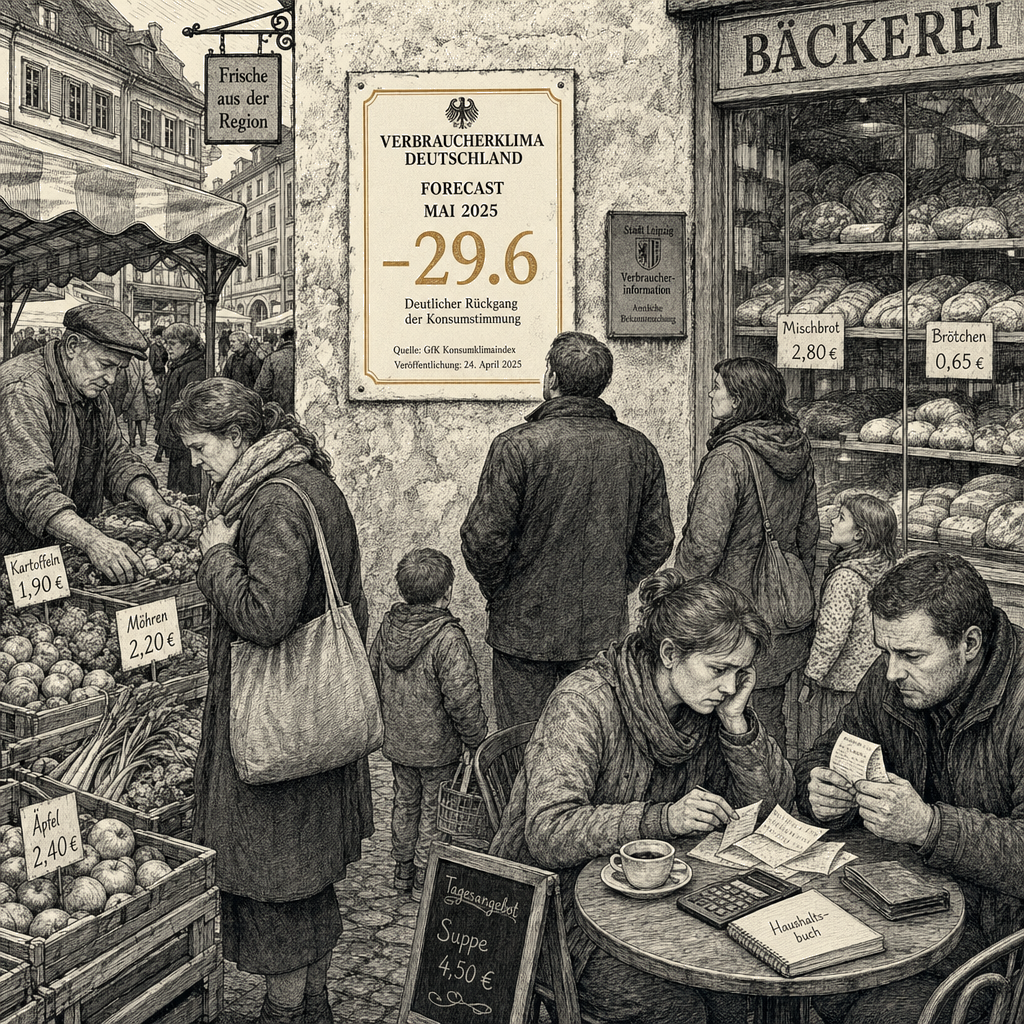
Households’ income expectations fall as energy uncertainty persists
Consumer sentiment in Germany weakened in its forecast for August, with the consumer-climate index falling to minus 29.6 from minus 29.3 in July, according to a survey by the Nuremberg Institute for Market Decisions and GfK. The decline was driven by lower income expectations and a greater willingness to save as households remain cautious amid the escalating Middle East conflict and its impact on energy prices. Economists polled by The Wall Street Journal had expected a reading of minus 28.1.
The continued weakness in consumer morale adds to concerns about the economic outlook for Europe’s largest economy, which has been hit by a surge in energy prices following the closure of the Strait of Hormuz and the escalation of the Iran war. The European Central Bank raised its key interest rate in June and held borrowing costs at its July meeting, saying uncertainty remains high about the full inflationary impact of the energy shock.
“The ongoing uncertainty means that many households remain cautious about spending,” said Rolf Buerkl, head of consumer climate at NIM. The survey’s authors noted that “overall, people are taking a rather pessimistic view of their financial situation over the next twelve months.”
The survey, conducted between July 2 and 13, captured a period that included a decline in oil prices at the start of the month as well as their subsequent rebound after President Trump said the memorandum of understanding between the U.S. and Iran was “over.” The rebound in oil prices added to the uncertainty weighing on consumer sentiment.
Income expectations, which had been rising in recent months, fell in the latest survey, while the propensity to save increased. “Although the willingness to buy has risen moderately, it remains very subdued,” Buerkl added.
The latest consumer sentiment reading for Germany follows a period of sharp deterioration after the outbreak of the Iran war, when the index fell to its lowest in more than three years. Business confidence, as measured by the Ifo Institute, also dropped to its weakest point since the pandemic lockdowns of 2020.
The European Commission’s broader gauge of eurozone consumer sentiment edged higher in July, data published Thursday showed, but the German reading suggests that households in the region’s largest economy remain particularly cautious.
The ECB has flagged that the full inflationary impact of the energy shock has yet to play out, leaving the outlook for consumer spending and economic growth uncertain.