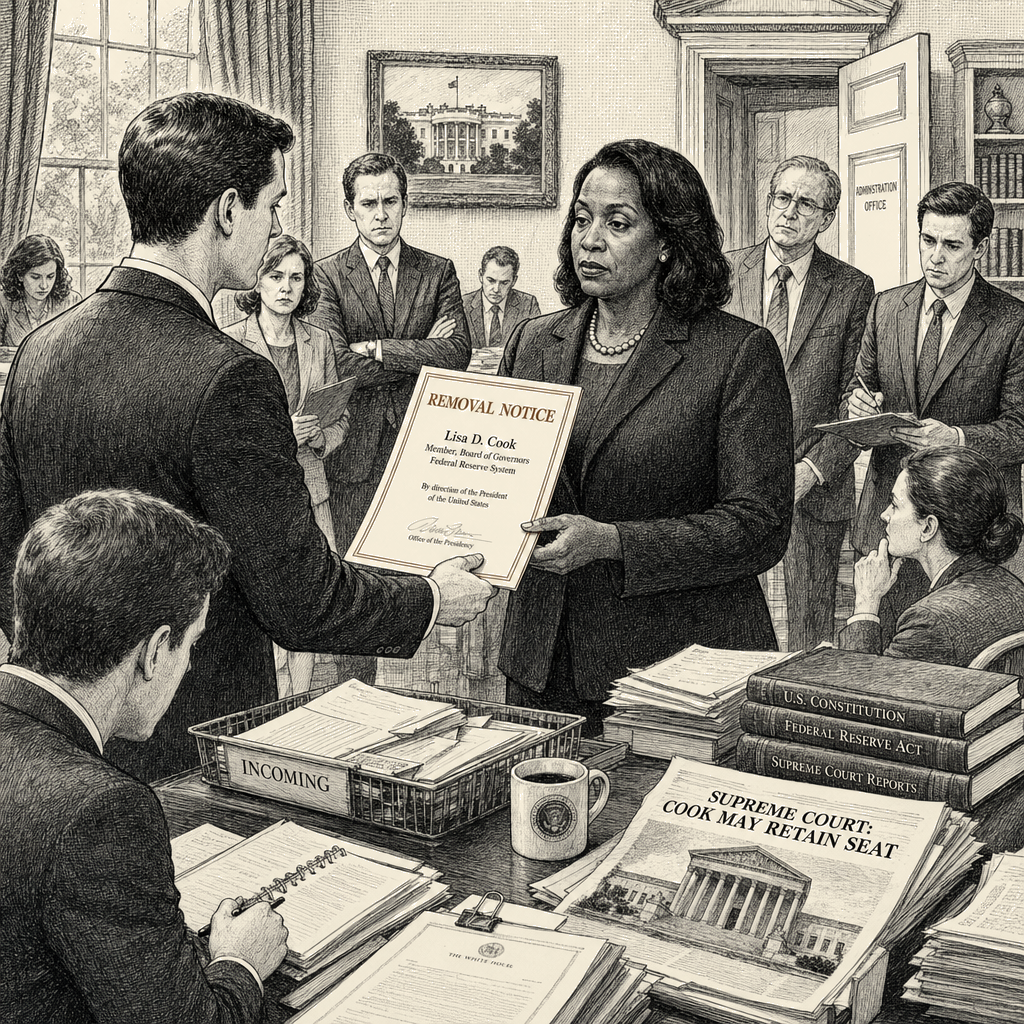
Cook’s lawyer says allegations remain ‘baseless’ and vows court fight
The White House sent Cook a letter this week informing her that Trump is “considering removing” her from her position on the Federal Reserve Board of Governors. The letter accused Cook of falling “well short of the standard” required of a sitting Fed governor and requested a written response to the allegations within three weeks. The White House did not immediately respond to a request for comment.
The notice follows the Supreme Court’s 5-4 ruling in June, which allowed Cook to retain her seat while she fights the president’s effort to terminate her. The court’s majority opinion found that Trump “failed to afford Cook the procedural protections to which she was entitled by statute.” “Without such protections, she could not properly dispute the charges the president laid against her,” the justices wrote. The administration is appealing a lower-court ruling in Cook’s favor.
In a footnote to the opinion, Chief Justice John Roberts wrote that nothing prevents Trump from “trying again” to remove Cook, as long as she is given proper notice and an opportunity to contest the allegations. Trump indicated after the ruling that he intended to proceed, vowing to “take appropriate action immediately.”
Abbe D Lowell, one of Cook’s attorneys, called the allegations “as baseless now as they were a year ago when President Trump tried to remove Governor Cook and interfere with the independence of the Federal Reserve.” “No matter what President Trump tries to do next, this much is clear under the facts and Supreme Court precedent – there is no valid cause for removing Governor Cook,” Lowell said in a statement. “As we did before, we will challenge this latest pretext and preserve her position and the historic role of the Fed.”
Cook was appointed by President Joe Biden in 2022 to a 14-year term that runs through 2038. She is the first Black woman to serve as a Fed governor. Before joining the central bank, she served on President Barack Obama’s council of economic advisers and taught at Harvard University and Stanford University.
Trump first fired Cook in August 2025. The White House accused her of wrongly designating two separate properties — one in Georgia and one in Michigan — as her primary residence and of failing to report rental income on her Atlanta property for two years. Cook denied the allegations and sued the Trump administration, arguing she was fired without cause or proper procedure.
Cook’s legal team has maintained that the mortgage-fraud claims stem from “inadvertent” paperwork errors and that the administration is “cherrypicking” facts. The firing and subsequent legal battles coincided with Trump’s public criticism of the Fed’s decisions on interest rates. Cook and then-Fed Chair Jerome Powell had supported the central bank’s decision to hold rates steady rather than cut them. Trump publicly attacked Powell, calling him “too stupid and too political,” and his Justice Department launched an investigation into renovations of the Fed’s headquarters in Washington, which has since been dropped.
The Fed is now led by Kevin Warsh, Trump’s pick to succeed Powell as chair. Warsh, who had previously expressed favor toward cutting rates, has said he will make decisions based on economic data rather than presidential preferences. “We’re an independent central bank,” Warsh said at a July hearing in response to questions from Democratic House members. “We’re honored to be independent.”