Trump posts Truth Social insults after Ottawa address
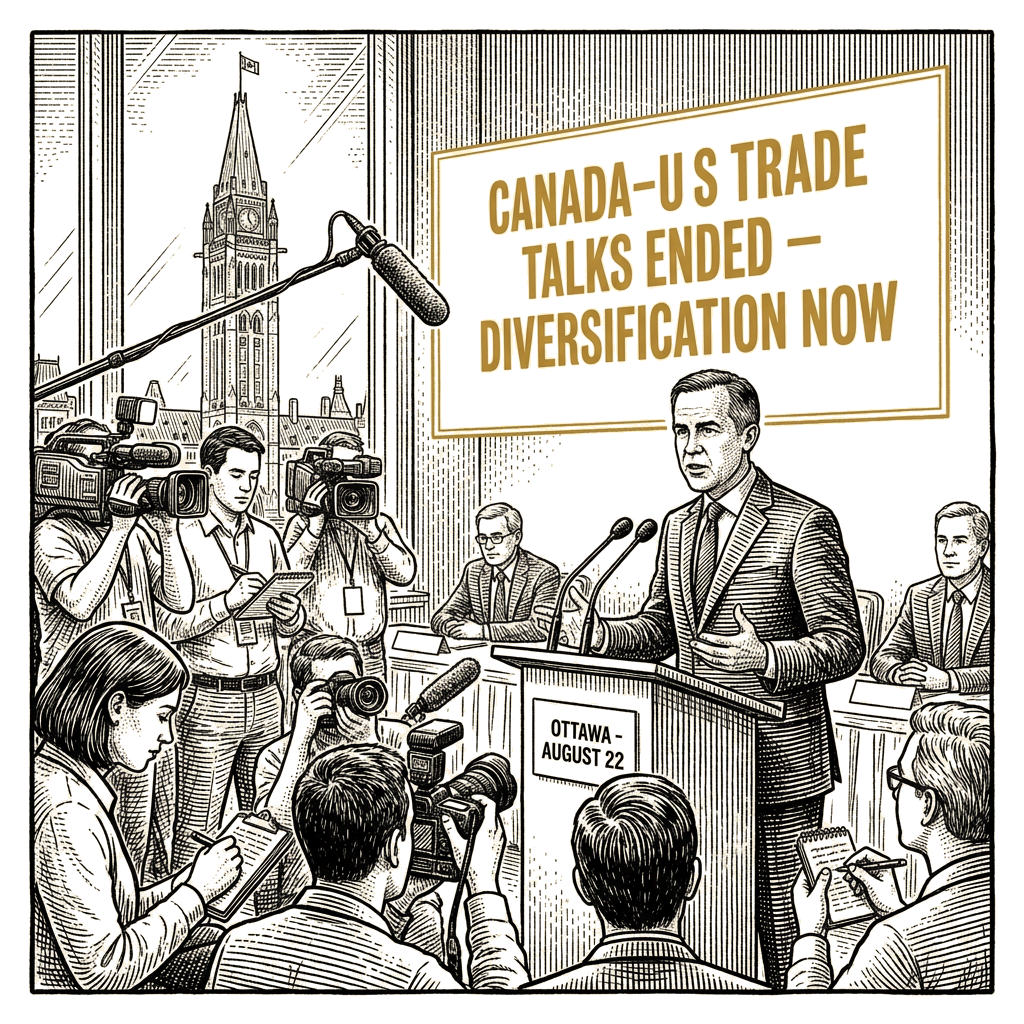
Canadian Prime Minister Mark Carney ended US-Canada trade talks in a 23-minute address from Ottawa on August 22, citing what he called “a near-total lack of trust” in the United States and pledging to diversify Canada’s international relationships. The speech, delivered from a wooden podium carved with a maple leaf and set against eight Canadian flags, marked the breakdown of negotiations that had been underway since Trump imposed his first round of tariffs on Canada shortly after his January 2025 inauguration.
The Ottawa address was Carney’s second major oration of 2026. In January, at the World Economic Forum in Davos, he had described “a rupture in the world order” and “the end of a pleasant fiction,” arguing that middle-sized nations could no longer rely on US leadership to sustain the postwar Pax Americana. He called for a new “geometry” of like-minded nations to align, adding: “because if we’re not at the table, we’re on the menu.” The United States was not invited to join that alignment. The Davos speech fell on January 20, the first anniversary of Trump’s second inauguration.
In the Ottawa remarks, Carney opened in both English and French before laying out specific economic statistics. He said Canada buys more American automobiles than the United Kingdom, Japan, and China combined, and supplies 99 percent of US natural gas imports. Carney contrasted Canada’s pursuit of “long-term partnerships” with what he characterized as a US preference for “short-term transactions,” arguing that the US negotiating position could only be “written in pencil.” He also referenced “the storm blowing in from Washington,” in what Widmer said was a possible allusion to recent forest fires that had “darkened the relationship some more.”
The collapse came despite Trump’s public claim that a deal was imminent. According to Ted Widmer, a former White House speechwriter who edits the Library of America’s American Speeches, US negotiators “undermined their own position with a series of last-minute power moves, bullying the other side.” Writing in The Guardian, Widmer said the failure “was reminiscent of the way the Trump administration continues to blow up its own peace deals in the Middle East, by adding new conditions at the 11th hour and making false statements afterwards.”
Trump responded on Truth Social, Widmer reported, by threatening to rename Lake Ontario “Lake America,” calling Canadian officials “clowns,” and dismissing Carney as a “governor” rather than a prime minister. Trump “laid the groundwork for Canada’s refusal to cave in as soon as he began his second term with a flurry of claims that Canada should become the 51st state,” Widmer wrote. Carney is a former Goldman Sachs executive and a former governor of the Bank of England.
The two countries share the world’s longest land border at 5,525 miles, and the North American Aerospace Defense Command has protected both nations from potential Russian attack since 1958, according to Widmer. Alaska cannot be reached by land from the contiguous United States without crossing through Canada. Canadian tourism to the United States declined 25 percent in 2025, Widmer reported, with US businesses feeling the effect.
Carney closed the Ottawa address with a declaration of Canadian self-determination. “Canada is becoming stronger and less dependent on America,” he said. “We are already giving ourselves more than they can take away. And we are just getting started. Canadians don’t submit to the weather — we thrive in it. We don’t wait to see which way the wind is blowing. Or surrender ourselves to the waves to be storm-tossed by events. We set our own course. We make our own weather.”
Earlier in the speech, Carney said: “We are masters in our own home and the partner of choice abroad.” He added: “We have been under no illusions. We recognized from the start that America has changed.”