Commentator warns allies to ‘protect yourselves’ from US rupture
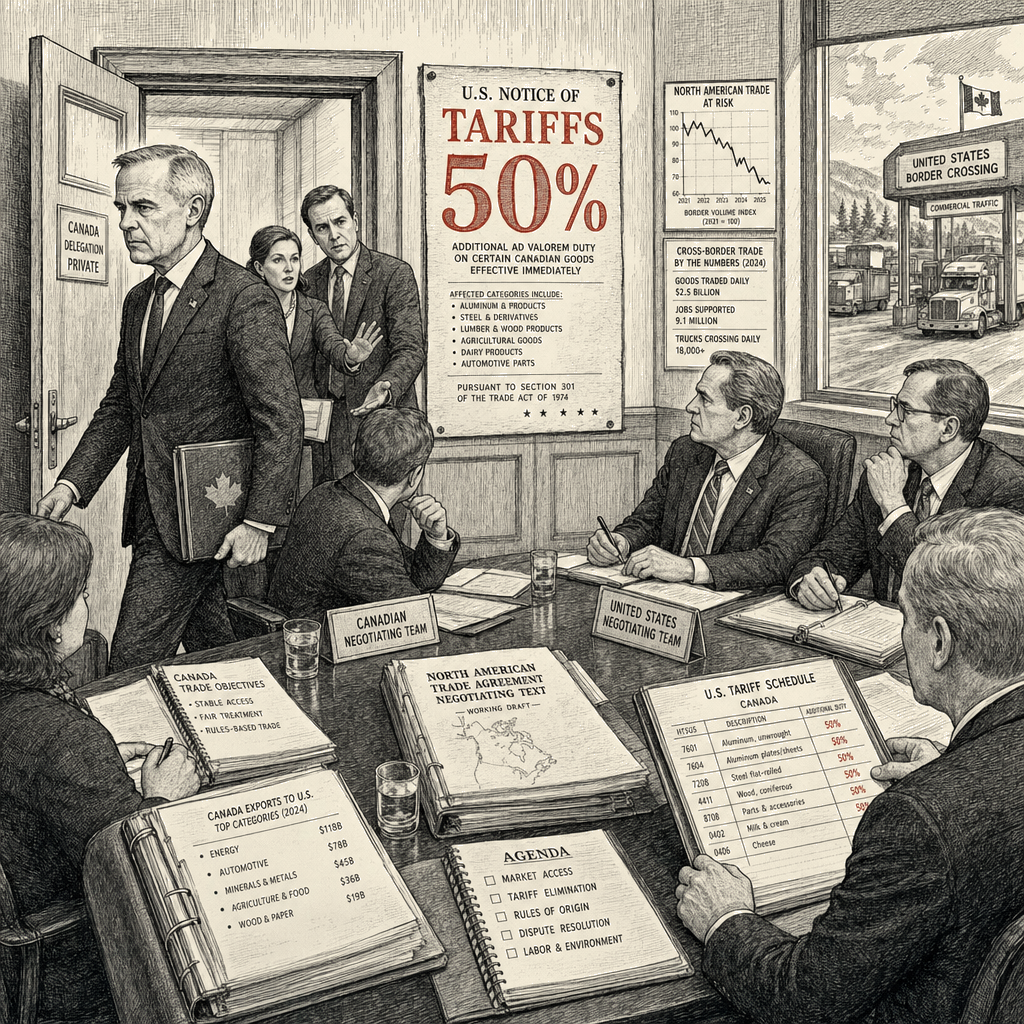
Carney, speaking at a rare Saturday morning press conference after negotiations broke down, said Canada had been attacked. “You’re at war when you get attacked. We got attacked,” he said, according to the Guardian column by Jen Gerson. Carney added that Canada had the reserves, resilience, plan, and focus to respond and would concentrate on what it could control.
Canada walked out of negotiations, with a deal apparently on the verge of completion, mere hours before 50% tariffs on a range of Canadian exports were due to kick in, the column reported. Dollar-for-dollar retaliatory tariffs, scheduled to take effect on September 8, will follow.
In a statement, Carney said last-minute US demands were “uneconomic, and called into question the reliability of any deal.” The US denied this characterization, insisting that Canadians had made the last-minute demands.
Canadian ambassador to the US Mark Wiseman told Bloomberg in subsequent interviews that there was no specific item that put a deal out of reach. Instead, he said, it was a range of issues in which the text that ultimately landed on the page — or its interpretation — did not align with what the Canadians thought they had agreed to. The most contentious issues appeared to relate to tariffs on autos, digital and cultural policy, and the US claiming the right to veto Canada’s attempts to form trade alliances with other countries, according to Gerson.
Carney noted that sometimes the US signature on trade deals is “written in pencil.” Gerson wrote that Canadians have no reason to trust the US administration not to unilaterally impose new tariffs on a whim, adding that the administration had done so repeatedly and as recently as the same week.
In the aftermath of the collapse, US Secretary of Transportation Sean Duffy went on Fox News and said: “We provide their security for them and they take advantage of us? President Trump was the first one to go and say ‘that’s not the kind of relationship friends should have’.” Gerson disputed the claim, noting that the North American Aerospace Defense Command, or Norad, is a fully integrated entity of both the Canadian and US militaries, and that Canada has its own military and its own police forces.
Gerson framed the dispute as part of a broader rupture in US-Canada relations. She characterized US actions as “mafioso-style dominance in the pursuit of our subjugation and maybe outright annexation” and wrote: “We know very well that this isn’t about trade.” She used the phrase “so-called Dunroe doctrine” — a play on the Monroe doctrine — to describe what she called the US’s approach to the western hemisphere.
Canadian voters, who had been pensive about the prospect of any new deal with the US, came out strongly in support of the prime minister after the collapse, Gerson wrote. She added that the mood was one of sustained and general anger toward the US “not born merely of trade irritants.”
Extending her warning to European allies, including the UK, Gerson wrote: “Do you honestly imagine yourselves to be closer to the US militarily, geographically, economically, or culturally than Canada? Guys, we are a little America, albeit with a steadier political system and the king on the money. If they are willing to vassalise us, what sentiment of history or tradition remains to protect you?”
Carney had spoken of a historic “rupture in the world order” at Davos earlier in 2026, Gerson noted. “We cannot plan around the hope of a return to normal, even if Democrats regain power in Washington,” she wrote, adding that “Canada’s location and US-integrated economy mean that we will be the first to face the reality of whatever the US becomes.”
Gerson closed with a direct admonition to US allies: “If nothing else, let the US’s retaliation be a warning to the rest of the western alliance. Run, run. Protect yourselves. Move faster.”
Gerson is a Canadian commentator and co-founder of The Line, and lives in Calgary, Alberta, according to the column.