$2,300 in Maldives exports to Russia versus $630M in Russian import data
Kraemer Mining shipment routed through Malé
In May 2024, the German company Kraemer Mining sold pumps, batteries, v-belts and other equipment worth roughly €9,000, equivalent to around $10,400, to Peretsvo, a company based in Kyrgyzstan, according to documents reviewed by the Journal. The goods were first flown from Düsseldorf to Malé on an Emirates flight. Freight Care, listed as the first contact on the air waybill, arranged the paperwork needed to move the goods through the airport, according to Western officials and the company. A few days later, the goods were loaded onto an Aeroflot flight to Moscow. Aeroflot issued a second air waybill that made no reference to Kraemer Mining or the origin of the goods; the new bill listed a Russian recipient, Gruppa Kompaniy Tehno, based in the Siberian industrial city of Krasnoyarsk. Neither Kraemer Mining nor Gruppa Kompaniy Tehno responded to requests for comment.
Customs records on the two sides of the trade
Maldives customs data shows only $2,300 of tuna and $25 in leaflets and brochures exported to Russia between 2022 and 2025. Russian trade data collected by Import Genius, a U.S.-based research firm, shows Russian imports from the Maldives — a country with virtually no industrial base — surged to more than $630 million in 2022, the year of Russia’s full-scale invasion of Ukraine, up from less than $7 million in 2021. Russian imports from the Maldives totaled $160 million in 2024, the last full year of data available.
William George, Import Genius’s research director, said the figures likely understate the true volume of trade between the two countries, noting that Russian authorities appeared to begin censoring parts of the data in 2024 before blocking access entirely in early 2025.
How the shipments move through Malé
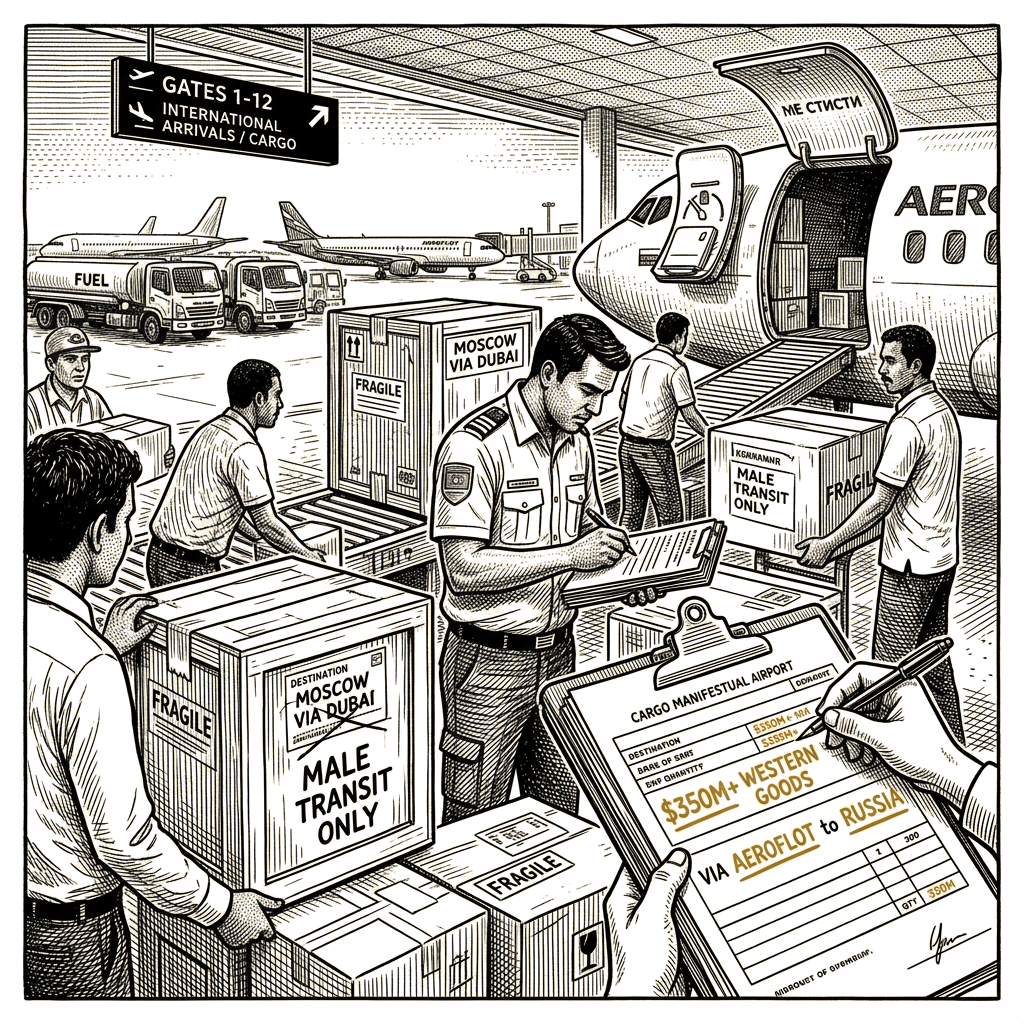
According to air waybills, a cargo manifest and emails between logistics companies reviewed by the Journal, a commercial Aeroflot flight lands each morning at the airport in Malé, where teams of local middlemen working with Russia-linked logistics companies help clear the goods through customs. The goods are loaded onto the return Aeroflot flight to Moscow, which departs roughly two hours later.
When cargo initially lands at Malé, the name of the exporting company appears on the air waybill alongside the supposed buyer. Local companies, including Freight Care and Go Investment, then alter the shipping documents and move the goods across the tarmac without the cargo ever formally entering the country. A new air waybill is issued for the Malé-to-Moscow leg that does not list the company that originally sold the goods.
The goods, which include aircraft parts, electronic components and dual-use items, have in some cases been distributed in Russia to sanctioned entities including S7 Airlines and its maintenance subsidiaries, which have struggled to obtain replacement parts for an aging fleet.
“This shows there are effective channels that exist far outside of the usual suspects,” said Pavlo Shkurenko, a sanctions research fellow at the Kyiv School of Economics Institute.
The Maldives route is small compared with Russia’s other sanctions-evasion channels. China, Turkey and the United Arab Emirates together account for roughly $15 billion in restricted Russian imports annually.
The freight offices listed on the documents
The Journal found two addresses for Freight Care — one on air waybills and another in the Maldives’ official business registry — located in neighboring office buildings in Malé, with the Aeroflot office sandwiched between them. Visits to both buildings revealed no trace of the company’s office. An address listed for Go Investment led to a small electronics shop; the same address was registered to multiple other companies in the business registry. A man listed as managing director or board member for several of those companies said he could not talk and hung up; he did not respond to further messages.
Hussain Waheed, Freight Care’s managing director, said the company handled goods in transit in Malé to Russia but had never knowingly helped ship goods that could be used to produce weapons. “We do not support any war,” he said.
Customs limits, Western pressure, and Russian tourism
The Maldives’ customs office has limited staff, and goods transiting through the country undergo minimal checks, according to a person familiar with the matter. Cargo in transit typically does not undergo physical inspections; authorities rely on paperwork instead.
The Maldivian government is facing growing pressure from the U.S. and Europe to shut down the route, according to Western officials. A person familiar with the matter said Maldivian authorities are aware of the issue and are working to address it. The Maldivian government and the Maldives Airports Company, which operates the airport, did not respond to requests for comment.
Russian tourists are the second-largest visitor group in the Maldives, a fact that complicates Western pressure, according to the Journal. The Maldives draws more than two million tourists a year to its archipelago of more than a thousand islands, and friction with Russia could threaten a tourism-dependent economy still recovering from the pandemic-era downturn. The Maldives Airports Company made a record profit in 2024 to become the country’s most profitable state-owned enterprise, in part by charging handling and commercial fees on cargo traffic and reselling fuel at a profit.
Trade through the airport continues to grow. In July, the Maldives Airports Company recorded a historic high in daily cargo volume, shipping 126 tons of freight in one day. Aeroflot accounted for 12% of outbound freight from the airport during the first half of 2026, according to state-run news channel PSM News.
Sanctions background
Western governments have imposed sweeping sanctions against Moscow since the February 2022 invasion of Ukraine to degrade Russia’s industrial base and isolate it from global commerce. Roughly $300 billion in Russian central-bank assets have been frozen, and major Russian lenders have been disconnected from the Swift messaging network. A web of export controls has cut off Russia’s access to advanced microchips, aerospace technology and industrial machinery. Western officials have increasingly focused on closing loopholes and punishing circumvention, with the U.S. and European Union targeting third-country intermediaries — including banks and logistics firms — that facilitate the covert flow of Western goods or illicit oil revenues back to Moscow.