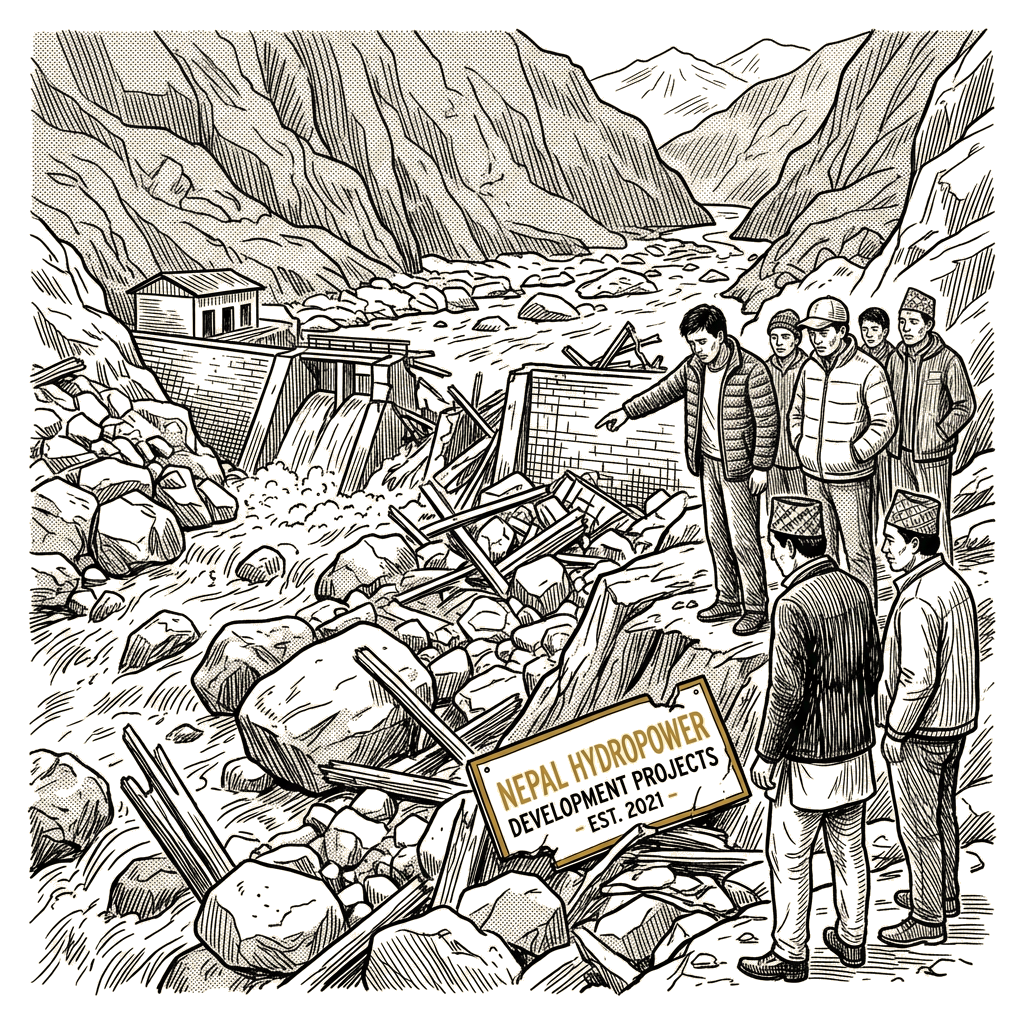
Nepal’s energy bet confronts climate-driven mountain instability
A glacial collapse in Nepal on Aug. 26 sent an avalanche of ice and rock plunging roughly 4,000 feet before turning into a debris-laden flood that tore through a roughly 40-mile corridor of hydropower dams along the Trishuli river, killing around 1,400 people and leaving more than 5,000 missing, according to a Wall Street Journal investigation published Tuesday.
The wave destroyed nearly a dozen hydropower installations, some active and others under construction, that had been positioned in the same stretch of valley where power developers had clustered for geographic reasons. Engineers and geoscientists told the Journal that the disaster’s scale exceeded the design assumptions of even the most carefully engineered projects, and that statistical risk models calibrated to historical floods could not have anticipated it.
The Aug. 26 surge was triggered by the partial collapse of a glacier and some of its bedrock, an event the U.S. Geological Survey initially registered as an earthquake. After plummeting around 4,000 feet, the ice turned into a debris-laden flood that flowed into the Lhende Khola, a river coming down from Tibet, and later joined with the Trishuli.
“That’s geography and opportunity, not negligence,” said Umesh Haritashya, a professor of geosciences and sustainability at the University of Dayton in Ohio, who is among the scientists studying the causes of the flood. “What’s changed is that the mountain is increasingly unstable, and the hazard is now much bigger, and reaches farther than the assumptions some of these projects were designed against.”
Among the first installations hit was the Rasuwagadhi hydropower plant, a state-controlled facility that had begun commercial operations in December 2024. Its site, in a narrow gorge south of the confluence of two rivers, was among the few river locations still available as Nepal emerged from a decade-long civil war. The plant’s manager, 34-year-old Santosh Adhikari, had narrowly escaped a similar flood in July 2025 by scrambling up the mountainside in darkness after a supraglacial lake atop the Purepu Glacier, nearly 17,000 feet above sea level, gave way. He described in a Facebook post how the waters submerged the living quarters, washed away pickup trucks and silt and boulders, and jammed the headworks.
By December, part of the Rasuwagadhi facility was back online, recovering fully by June. On the morning of Aug. 26, the immigration and customs office just north of it was engulfed in a wave that Chinese state media said was traveling at more than 160 feet per second. Adhikari had no warning.
The largest project hit was the 216-megawatt Upper Trishuli 1, whose backers had commissioned extensive technical evaluations before breaking ground. Construction, led by a state-owned South Korean company with financing from a consortium of international banks including the World Bank’s International Finance Corporation, began five years ago. A 2018 environmental assessment report had identified an increase in the frequency and severity of floods as the project’s greatest climate risk and said design modifications had addressed those concerns.
A 2024 flood revealed some gaps, sweeping away part of a workers’ camp and triggering a failure of the early-warning system that officials subsequently fixed. That system proved effective the following year, helping personnel evacuate when water from a glacial lake thundered down. On Aug. 26, the alert mechanism failed again and the dam was dashed to pieces, the Journal reported. Since the project was under construction, at least 1,400 people were on site across various fronts, more than 500 of whom are now missing.
Hydropower planners need to rethink their approach, otherwise investing in the sector in the Himalayan region will be a “huge risk,” said Giri Raj Adhikari, the project’s technical director, who is unrelated to Santosh Adhikari. Upper Trishuli 1 was constructed for water flows, not a massive debris-laden surge with boulders as big as 25 feet across, he said.
The now-shattered Langtang Khola Hydro project was engineered to withstand a 100-year flood, an event with only a 1% chance of occurring in any given year that would raise the river level by around 20 feet at its narrow gorge. The Aug. 26 flood swelled to 20 times that level, its managing director told the Journal. Pierre Biedermann, an environmental consultant for renewable energy projects, said statistical approaches to flood risk fail when climate change has altered the underlying conditions. “When you have a rain-induced flood, you can calculate the likelihood of it happening again,” he said. “But when you get a mountain collapse with a glacier and this kind of cataclysm, you cannot assign a likelihood to it.”
Preliminary calculations based on the seismic signal the landslide produced indicate that the ice-and-rock avalanche in Nepal was likely 10 times the volume of the one that destroyed the Swiss Alps village of Blatten last year, said Wolfgang Schwanghart, a professor of geomorphology at Berlin’s Freie University. About 20 million metric tons of ice and rock traveled at more than 120 miles an hour in Blatten, according to an article published in the journal Nature.
At least a handful of similar events have taken place in the past five years. In 2021, an ice-and-rock avalanche in northern India killed more than 200 people and destroyed one hydropower project while severely damaging another. Scientists say these collapses reflect a complex intersection of causes, including vanishing ice and permafrost that make glaciers more prone to snapping and underlying bedrock more likely to fracture, as well as the lasting effects of a 2015 earthquake in Nepal that killed 9,000 people.
The disaster is reshaping the calculus around Nepal’s hydropower strategy. Once a chronically energy-starved nation, Nepal quadrupled installed hydropower capacity over the past decade and has even been exporting power in recent years. More than 210 projects currently under construction would expand that capacity by an additional 150%, according to industry estimates cited by the Journal. But the Aug. 26 surge has called the future of that strategy into question as a warming planet destabilizes Himalayan glaciers and river systems, putting human lives and billions of dollars of investment at risk.
The human toll of the disaster is most concentrated among the more than 2,000 hydropower workers scattered across dams, riverside camps, underground power houses and miles-long tunnels when the flood hit. Rescue teams are racing to clear tunnels choked with hardened mud and rock.
At Upper Trishuli 1, Rabindra Hamal got a call from a colleague urging him to run while the sky was clear and the river appeared calm. He piled into a pickup with co-workers and sped downriver, glancing back half a mile later to see a towering wall of brown water churning through the gorge. The group abandoned the vehicle and clambered up the rocky mountainside; the waters slammed into the rock he was crouching behind, leaving him covered in mud and water but still breathing. Two others from his group didn’t make it. “Nobody expected this kind of flood, not a single person,” he said.
Gunnam Jaykrishna, a mechanical engineer from India, was deep in the main access tunnel and knew nothing about the flood until he emerged. He tried repeatedly to call his wife and 18-month-old daughter in Salletar, the workers’ settlement where many Upper Trishuli 1 personnel live, but could not get through. “If workers there had been warned when the first project was hit, so many lives could have been saved,” he said. He fears returning to hydropower work. “This is not just about one river,” he said.
For Santosh Adhikari’s brother, Tuka Nath, the Aug. 26 flood brought a private search layered on top of the public one. Two days after the surge, with no word about Santosh, he boarded a helicopter hired by the Rasuwagadhi company, only to be dropped at a nearby town when the craft could not land at the project site, which had become a muddy wasteland. He and three others trudged through the jungle for hours but couldn’t find their way and spent the night in a goatherd’s shed. On the third day, they climbed to a high point from which they could see the flattened area where Santosh’s two-story residence building once stood.
“My mind stopped working,” Tuka Nath said. “I felt it was too late.”
Rasuwagadhi’s acting chief executive, Pushkar Amatya, is searching for his own brother. Prabin, a 31-year-old engineer at a hydropower plant under construction downstream, texted Amatya the morning of the flood asking if Rasuwagadhi was hit, then later fled the surge with a friend. While the friend ran straight up the mountain, Prabin dashed diagonally across, putting him in the flood’s path.
A World Bank spokesman said the Upper Trishuli 1 project design reflected findings from independent assessments using studies of the glaciers and glacial lakes and historical evidence available at the time. As more information about the Aug. 26 flood emerges, the bank will consider any implications for risk assessment, monitoring, early warning and emergency response in hydropower projects, the spokesman said.
The Aug. 26 disaster has been the subject of evolving coverage since the glacier collapse struck, as detailed in earlier reporting on rescue efforts and the rising death toll and on the humanitarian response mobilizing for survivors along the Nepal-China border.