Ireland’s defense spending is the EU’s lowest at 0.2% of GDP
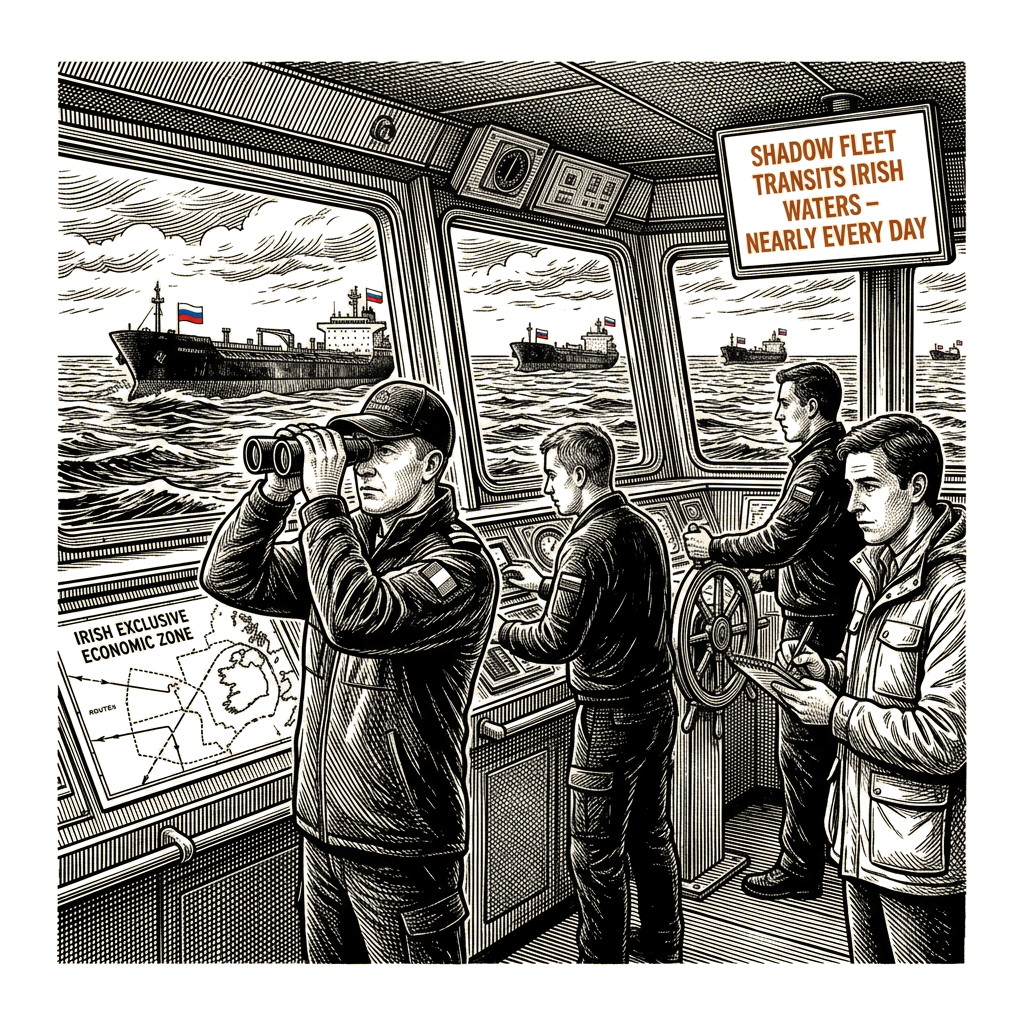
The Journal’s reporting came from aboard the Lé George Bernard Shaw, an Irish navy patrol vessel, where Lt. Cmdr. Maria O’Callaghan walked a reporter through the purple lines on her console that mark the locations of undersea cables carrying internet traffic and banking transfers. About 75% of all trans-Atlantic subsea cables pass through or near Irish waters, according to Telegeography data cited by the newspaper. After an 18-month rise in shadow fleet activity, O’Callaghan said, suspected Russian vessels are now in the waters “nearly every day.”
Ireland’s defenses to protect the stretch are scant. The country has eight patrol ships for an expanse the size of California, no long-range military radar, no combat aircraft, no air defenses, and no ability to detect hostile submarines. The Irish Naval Service said some 388 suspected shadow fleet vessels passed through the Irish Sea from January to September 2026, up from 132 over the same period in 2025.
Recent incidents have put those limits in view. The Irish navy found a Russian spy ship, the Yantar, loitering over critical internet submarine cables and energy infrastructure in 2024 and escorted it away. In late 2025, unidentified drones were seen flying over Dublin airport during a visit by Ukrainian President Volodymyr Zelensky, and Irish Prime Minister Micheál Martin suggested the incident was part of a Russian hybrid campaign. The Kremlin denies involvement. U.S. and British forces have spotted Russian attack submarines in Irish waters at least twice since 2022. The United Kingdom has scrambled jets to deter Russian fighters spotted over Ireland’s west coast.
On the patrol, O’Callaghan monitored ships for suspicious behavior, looking for what she called “pattern of life.” Similar data cables have been damaged in the past by fishing vessels dragging their anchors. “As a mariner, we are aware of what is normal and what is not normal,” she said. “If they happen to loiter in an area of interest, we go to investigate that and ask the questions.”
Ireland allocates 0.2% of its GDP for defense, the lowest proportion of any EU member state even after raising military spending by more than 40% in recent years. The country is not a NATO member, so its territory does not come under the alliance’s mutual-defense pact. A 2022 review of Ireland’s military capabilities recommended expanding the armed forces and acquiring radars and jet fighters; the government has since increased spending to roughly $1.7 billion in 2026 and released its first-ever maritime security strategy. The shortfall persists: Ireland’s armed forces number around 7,750 personnel, below a stated goal of about 9,700, and recommended materiel purchases have not happened, the Journal reported.
“Nothing in Ireland’s neutrality prevented Ireland from buying primary radars, and that was identified as a gap in February 2022,” said Tobias Billström, who served as Sweden’s foreign minister during that country’s NATO accession and is now director of strategy and government affairs at Nordic Air Defence, a tech startup. “Ireland has diagnosed itself accurately but it has so far declined the treatment.”
Ireland’s reluctance has historical roots. Opposition to World War I and British attempts to draft Irishmen fueled the Irish revolution that led to independence; anti-militarism has since been central to avoiding internal division, and attitudes against rearmament persist. “Neutrality and opposition to war and empire are absolutely integral to what this country is,” said Richard Boyd Barrett, a lawmaker from the left-wing People Before Profit party. Barrett argued the threat is overstated. “Russia can barely win a war against Ukraine,” he said. “It’s preposterous, to be honest with you, that Russia represents any serious military threat.” Irish governments have historically used neutrality to justify low defense budgets, while nonaligned peers such as Sweden and Finland for years maintained strong armed forces, Billström said.
Outside Ireland, the gap is drawing sharper concern. Speaking ahead of a recent EU defense ministers’ meeting outside Dublin, the bloc’s top foreign and security official, Kaja Kallas, said maritime security in Ireland “is a great concern for all of us because there are cables that are underneath the sea and that are really affecting the everyday lives of people.” Asked about Ireland’s spending, she said, “member states are making different contributions to defense. It very much depends on whether they feel that the threat is real or not.” At Ireland’s request, a British warship and submarine-hunting helicopter provided security at the meeting — a sensitive deployment given the legacy of 800 years of British rule in Ireland.
Elisabeth Braw, a senior fellow at the Atlantic Council, framed the gap as a mismatch between Ireland’s chosen economic model and its security posture. “Ireland made a bet on globalization and a world without conflict, essentially, and set itself up as a European hub for primarily American companies,” Braw said. “But you also need to make sure that you’re able to provide the environment for them when things are not perfect in the world, and Ireland is not set up for that.” Former U.S. national security adviser Robert O’Brien has called Ireland’s defense investments “pitiful,” arguing that the absence of radar and intelligence networks exposes American tech firms to Chinese and Russian espionage and cyberattacks.
David Murphy, an expert on Irish military history at Maynooth University, was more blunt. “We have sleepwalked into this position where we are in the most difficult security horizon that I can remember,” Murphy told the Journal. “We are essentially defenseless. We don’t have the people, we don’t have the equipment. We’re 25 years behind the rest of the world right now.”