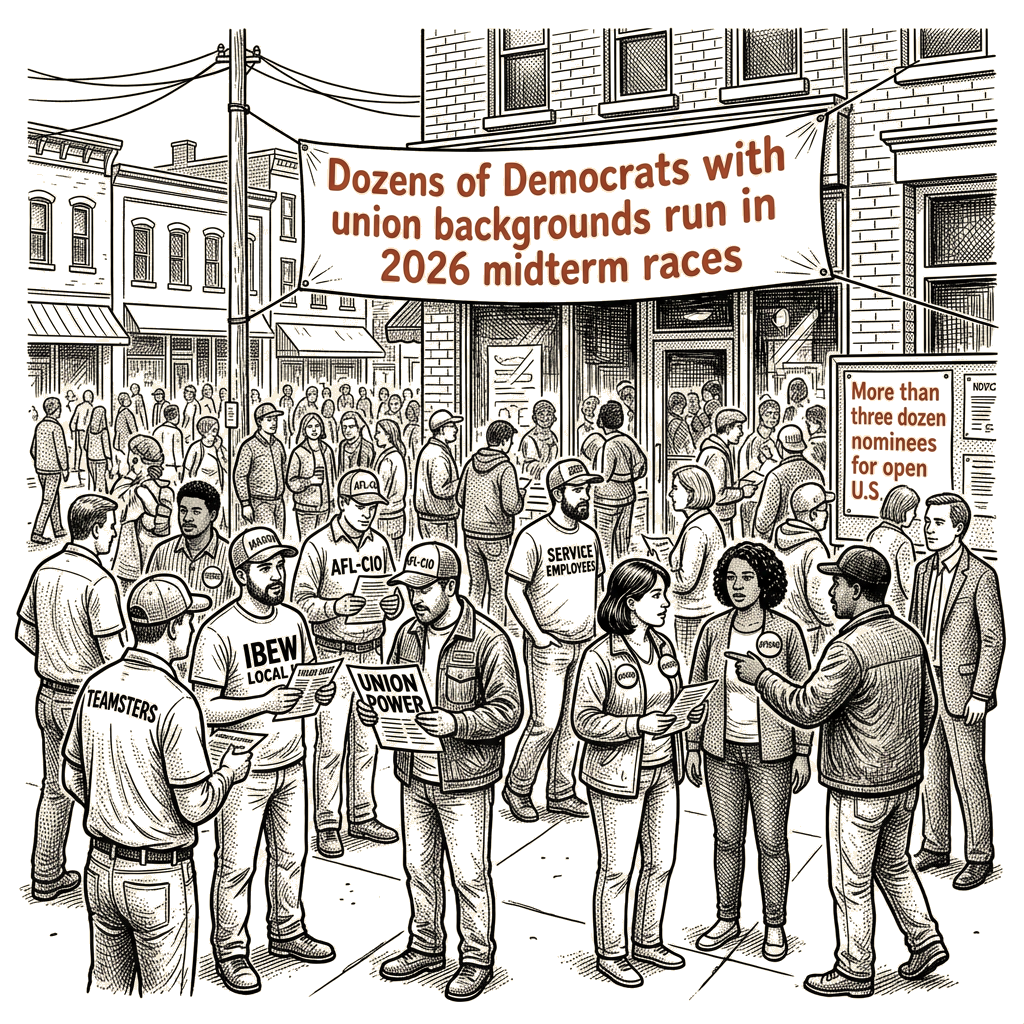
Union candidates invoked pro-worker themes 159% more than non-union rivals
More than three dozen nominees for open U.S. House and Senate seats in the 2026 midterm elections have backgrounds as labor union representatives or members, according to a Guardian analysis published Saturday. Several candidates are running in heavily Democratic districts where they are nearly certain to win in November, while others are competing in highly contested races that could determine control of the House and possibly the Senate. Most are Democrats, though some are running as independents.
The wave of union-background candidates comes as Democrats work to rebuild support among working-class voters, centering their campaign messaging around affordability. The nominees include teachers, federal employees, construction workers, ironworkers and union organizers.
“In a political environment that’s been dominated by wealthy elites for decades, union candidates provide a level of trust and credibility that’s simply unmatched,” Steve Smith, a spokesperson for the AFL-CIO, the largest federation of labor unions in the U.S., told the Guardian. “These candidates are at long last returning the levers of power to the people.”
A 2024 study by researchers at California State University and the University of California, Los Angeles found working-class voters are 6.4 percentage points more likely to prefer a political candidate with a working-class occupation over one with an upper-class occupation. Yet a 2026 report by the Center for Working-Class Politics found that working-class candidates make up just 8% to 14% of Democratic and 5% to 8% of Republican congressional candidates.
The same report found that union candidates invoked pro-worker themes 159% more often than non-union candidates, and argued that running more union members could increase the representation ordinary Americans have in Congress by elevating people who can speak to and deliver on issues that affect the working class.
“Voters want elected leaders who understand the struggles working people face in an economy rigged against us,” Smith said. “In every area of the country, at every level, union members are running for office and winning because they bring lived experience in leveling the playing field for workers and creating a brighter future for our families.”
In 2024, Donald Trump sought to woo labor leaders and blue-collar voters with populist trade promises, but exit polls and surveys conducted after the presidential election found little evidence that union members had shifted toward him. According to the VoteCast survey conducted for the Associated Press and Fox News, union members preferred Kamala Harris over Trump by 16 percentage points — 57% to 41% — matching Joe Biden’s 16-point lead over Trump with union households in 2020.
Trump was formerly a member of the Screen Actors Guild, but he resigned from the union in February 2021 rather than face disciplinary charges for violating its constitution regarding his actions and role in inciting the attack on the U.S. Capitol on Jan. 6, 2021. In his resignation letter, Trump wrote “Who cares!” and accused the union of never doing anything for him. In response, the union issued a two-word statement: “Thank you.”
Americans overwhelmingly favor labor unions, according to recent annual Gallup polls, with 68% approving labor unions in 2025. Union density has declined over recent decades, from more than 30% in the 1950s to 10% in 2025, correlating with what the Guardian described as a drastic increase in wealth and income inequality in the U.S.
The Guardian identified six Senate candidates and 32 House candidates with labor union backgrounds, running to join the roughly 25 current members of Congress who have previously worked in the labor movement or in a job represented by a union.
Senate candidates
Todd Achilles, independent, Idaho. A former American Federation of Teachers member from his work as a public policy professor and lecturer, Achilles is running in a race where the Democratic nominee withdrew in July.
Abdul El-Sayed, Democrat, Michigan. El-Sayed is a former American Association of University Professors member from his time as a professor and scholar at Columbia University, Harvard University, the University of Michigan, Wayne State University and American University. The AAUP made its first-ever national political endorsement in backing his Senate campaign. “If the markets actually worked the way they’re supposed to, you might have some efficient movement of money,” El-Sayed told the Guardian in July. “The problem is, we don’t live in capitalism, we live in oligopoly.”
Troy Jackson, Democrat, Maine. Jackson has worked union jobs as a member of the Painters and Allied Trades (IUPAT), the Machinists (IAM), Operating Engineers (IUOE), United Auto Workers (UAW) and Laborers’ International Union of North America (Liuna). “Everything Troy fights for comes from his working-class roots as a logger from Allagash and the 1998 blockade, when he stood up to powerful landowners undercutting Maine workers,” his campaign manager, Dan Gottlieb, said in a statement. “Mainers know whose side Troy is on: theirs. For him, solidarity isn’t a slogan — it’s how he’s lived his life.”
Angie Nixon, Democrat, Florida. Nixon is a state legislator and the Democratic nominee in a special election to fill Marco Rubio’s vacated Senate seat. She previously directed the Florida Public Services Union’s higher education campaign.
Dan Osborn, independent, Nebraska. Osborn, a former president of Bakery, Confectionery, Tobacco Workers and Grain Millers International Union Local 50G, which represents Kellogg’s workers, faces Republican Pete Ricketts, the heir to billionaire Joe Ricketts, co-founder of TD Ameritrade.
James Talarico, Democrat, Texas. A public school teacher, Talarico is a member of the San Antonio Alliance of Teachers and Support Personnel and a longtime member of the Texas State Employees Union (TSEU — CWA Local 6186).
House candidates
Colin Allred, Democrat, Texas 33rd. Allred, a former member of the NFL Players Association, is running in a newly redrawn Democratic-dominant district.
Chris Backemeyer, Democrat, Nebraska 1st. Backemeyer, a former U.S. State Department employee, is a member of American Federation of Government Employees Local 1534.
Mitchell Berman, Democrat, Wisconsin 1st. Berman worked a union job in college at UPS as a member of Teamsters Local 344. As a nurse, he has worked union jobs as a member of the Wisconsin Federation of Nurses & Health Professionals and National Nurses United. “Coming from a working-class background, understanding what folks are going through [and] having walked a mile in my neighbor’s shoes gives me the ability to look at legislation from the perspective of having some empathy and understanding for what people are dealing with,” Berman said in August.
Bob Brooks, Democrat, Pennsylvania 7th. Brooks, a former president of the Pennsylvania Professional Fire Fighters Association, is running to flip one of the state’s swing districts. “We need to change who’s representing us and who’s making the rules and the laws,” Brooks said in June. “That’s what inspired me to do this. I think we need more everyday people down there, because everyday people are the ones that are struggling.”
Connie Chan, Democrat, California 11th. Chan, a former member of the International Federation of Professional and Technical Engineers Local 21, is in a general election runoff to replace Nancy Pelosi’s vacated seat.
Darializa Avila Chevalier, Democrat, New York 13th. In one of the biggest primary upsets of 2026, Chevalier, a United Auto Workers Local 2325 member, defeated incumbent Rep. Adriano Espaillat, chair of the Congressional Hispanic Caucus. She is expected to easily win the general election in the heavily Democratic district. “That really changed the course of my education and my PhD program, to be able to be part of a union that fought for me, my work conditions, my wage, and made it possible for me to continue my program,” she said in June. “I was able to teach at a pace that was manageable, right, with a workload that was manageable, but also be paid enough to actually lead a dignified life.”
Carmela Conroy, Democrat, Washington 5th. Conroy was a union member represented by the American Foreign Service Association.
Sam Forstag, Democrat, Montana at-large. Forstag served as vice-president of the Forest Service Council Local 60, an arm of the National Federation of Federal Employees. “There is genuinely a fundamental lack of representation for working people in federal office right now, and that has serious, substantive effects on what kind of policies they actually prioritize and what they pass,” Forstag said in February. “The primary function of government is to step in when the market is not meeting a need and to make people’s lives materially better. And it seems like some people at the national level forgot about that.”
Chris Gallant, Democrat, New York 1st. Gallant served as president of his local union with the National Air Traffic Controllers Association.
Vince George, Democrat, West Virginia 1st. George was a member of the West Virginia Education Association and is a retired American Federation of State, County and Municipal Employees member.
Bob Harvie, Democrat, Pennsylvania 1st. A teacher for more than 20 years, Harvie is a former member of the Bucks County Technical High School Education Association.
Missi Hesketh, Democrat, Missouri 7th. Hesketh is a teacher and member of the National Education Association and a former member of the Missouri State Teachers Association.
Bill Hill, independent, Alaska at-large. Hill is a former union construction worker. The leading Democrat in the race dropped out and endorsed his campaign.
Amanda Hollowell, Democrat, Georgia 1st. Hollowell was the state director for 9to5 in Georgia, a worker-led organization that arose from women-led worker organizing in the 1970s.
Jake Johnson, Democrat, Minnesota 1st. A high school math teacher, Johnson served as an official with his local teachers’ union. “To me, a lot of the great things that happen in public schools happen because of unions,” Johnson said in July. “We’re the ones fighting for smaller class sizes. We’re the ones fighting for reasonable wages. That’s happening because of teachers’ unions. We’re the ones that are raising the bar as far as teacher quality.”
Tanya Lloyd, Democrat, Texas 27th. Lloyd is a former Texas American Federation of Teachers member.
Donavan McKinney, Democrat, Michigan 13th. McKinney, a former Service Employees International Union organizer, defeated incumbent Rep. Shri Thanedar in the Democratic primary. He is expected to easily win the general election in a district that favors Democrats by 22 percentage points, according to Cook Political Report’s Partisan Voting Index.
Analilia Mejia, Democrat, New Jersey 11th. Mejia, a former union organizer with the Service Employees International Union, Unite Here and United Food and Commercial Workers, won a special election in April.
Jena Nelson, Democrat, Oklahoma 5th. The former Oklahoma teacher of the year in 2020, Nelson is a teachers’ union member. The district last flipped blue during Trump’s first term in 2018; Republicans retook it in 2020.
Richard Pan, Democrat, California 6th. Pan, a pediatrician, is a member of the Union of American Physicians and Dentists — AFSCME Local 206.
Brian Poindexter, Democrat, Ohio 7th. Poindexter, an ironworker, apprenticeship instructor and former organizer, is running to unseat Rep. Max Miller, who faces calls to resign over domestic assault allegations from his ex-wife, the daughter of Republican Sen. Bernie Moreno, and from Stephanie Grisham, a former White House press secretary under Trump’s first administration. “People are working harder and harder. We’re getting less and less and we’re getting more and more of the burden,” Poindexter said. “I’d like to see an economy that works for all of us, not just the wealthy. We need to build an economy that rewards work, not just wealth.”
Chris Rabb, Democrat, Pennsylvania 3rd. Rabb helped organize adjuncts at Temple University with the United Academics of Philadelphia while working as an adjunct professor.
Kyle Rable, Democrat, Texas 19th. Rable is a member of the Texas State Employees Union, CWA Local 6186.
Lauren Reinhold, Democrat, Kansas 1st. Reinhold, a former federal employee, served as a union steward and officer while working at the Social Security Administration and National Labor Relations Board.
Ceretta Smith, Democrat, Georgia 12th. Smith is a past president and current member of AFGE Local 2017 and serves as the fair practices coordinator and women’s coordinator for AFGE Council 172, which represents Defense Commissary Agency workers. The U.S. Army veteran has worked as a federal employee for more than 20 years.
Katy Padilla Stout, Democrat, Texas 23rd. Stout, a former American Federation of Teachers member, has been endorsed by the AFT.
Trina Swanson, Democrat, Minnesota 8th. Swanson was a member of the American Federation of Government Employees while working at U.S. Citizenship and Immigration Services. She is running against Republican incumbent Rep. Pete Stauber. “Northern Minnesota taught her that unions strengthen our middle class,” Swanson’s campaign website states.
Claire Valdez, Democrat, New York 7th. Valdez won the Democratic primary after the retirement of Rep. Nydia Velázquez. Valdez served as an organizer with United Auto Workers Local 2110 at Columbia University.
Mai Vang, Democrat, California 7th. Vang, a California Faculty Association member, edged past 82-year-old Democratic incumbent Doris Matsui in the primary. The two will face each other again in the November general election.
Randy Villegas, Democrat, California 22nd. Villegas is a former United Auto Workers Local 4811 member, which represents higher-education workers.
Brandon Wade, Democrat, Oklahoma 2nd. Wade is an official with International Union of Operating Engineers Local 351, where he has held several roles while working more than 20 years in the oil and gas industry.
Marni von Wilpert, Democrat, California 48th. Von Wilpert, a former NLRB attorney who helped write the Protecting the Right to Organize (PRO) Act, is a member of the Nonprofit Professional Employees Union. “One of my biggest priorities for running for Congress myself is to finish this work, to come back as a member of Congress and finally get labor law reform across the finish line,” von Wilpert said. Her Republican opponent, Jim Desmond, worked as a pilot for Delta Air Lines, where he was a member of the Air Line Pilots Association, but has opposed unions on project labor agreements.