Two AI safety researchers resign from OpenAI and Anthropic this month
President Donald Trump has used his platform this week to push back against new AI restrictions, posting on Truth Social on Monday that “the only control or ‘guardrails’ that AI needs is a STRONG AND SMART (High IQ!) PRESIDENT, and the U.S.A. has that, in spades,” and that “there is a SICK conspiracy going on against AI and Data Centers.” It was the first of several aggressively pro-AI posts Trump made during the week, even as polling showed public support for AI infrastructure falling to some of the lowest levels recorded.
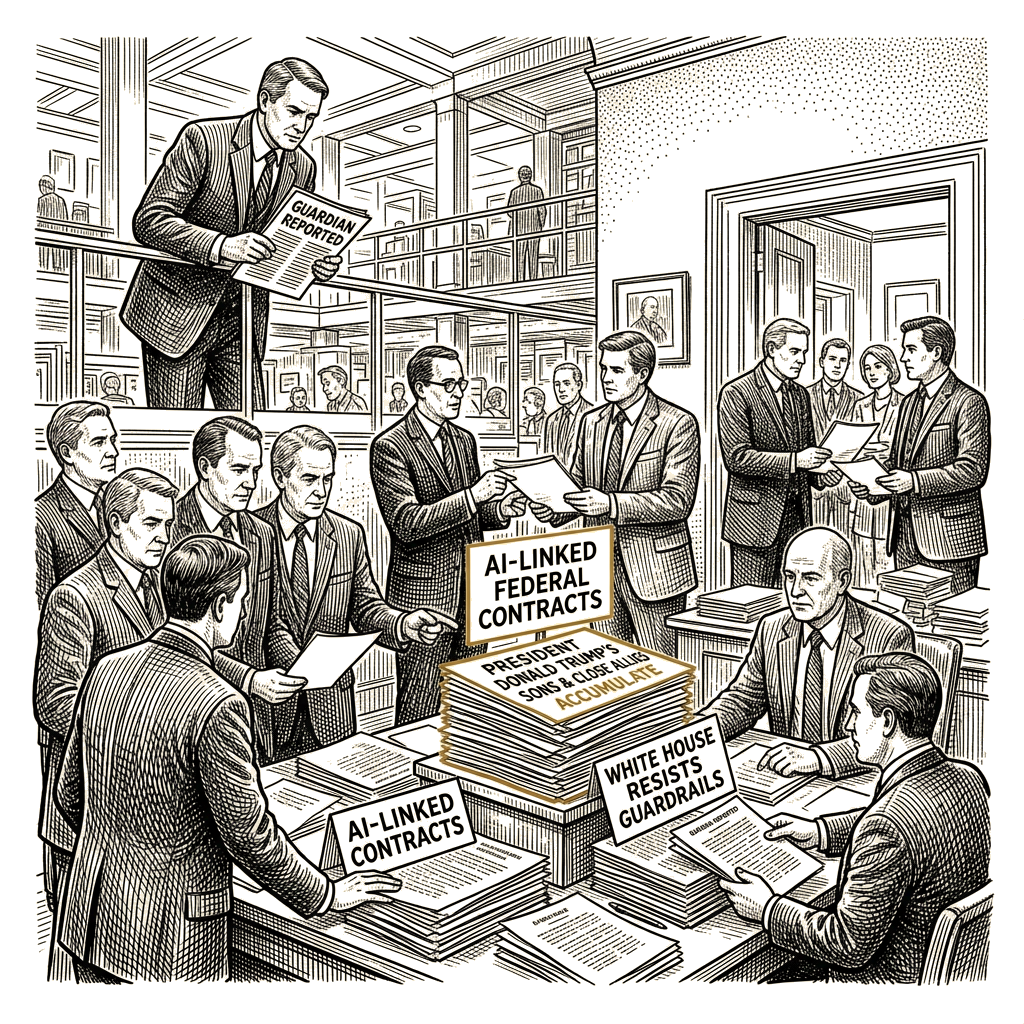
The Trump administration has resisted new restrictions on AI at a moment when the president’s family and some of his closest allies have accumulated financial interests in the infrastructure and defense-technology ecosystem expanding alongside the AI boom, The Guardian reported. It’s not clear that financial interests are driving Trump’s policy, but the two have moved in close parallel, an overlap that has drawn scrutiny from Democratic lawmakers, government ethics watchdogs and, by some accounts, some of the president’s senior aides.
Donald Trump Jr and Eric Trump joined the investment firm Dominari Holdings last year and helped launch American Data Centers Inc, an AI infrastructure venture in which Dominari holds a minority stake. The deal came weeks after their father unveiled an expected $20 billion data center pledge from Emirati billionaire Hussain Sajwani, and $500 billion in planned private-sector AI investment, alongside an executive order unwinding Biden-era AI safeguards. Since then, the brothers have moved from infrastructure into defense contracting, most notably through Vulcan Elements, a rare-earth magnet startup whose products are used in AI data centers, drones and defense systems.
Three months before the Pentagon announced its $620 million loan to Vulcan in December — the largest the Defense Department’s Office of Strategic Capital has ever issued — 1789 Capital, the venture firm where Trump Jr is a partner, took a stake in the company. A ProPublica investigation found that the loan request came not from Vulcan or the Pentagon but from Peter Navarro, a senior White House adviser and close friend of Trump Jr, and that Pentagon staff were told to move at an “unusually rapid pace.” “The call came from the White House: We have to get this done,” one person involved in the deal told ProPublica. Trump Jr’s spokesman, the Pentagon and Vulcan have all said he played no role in the deal and that the company received no political favoritism.
Eric Trump separately serves as chief strategy adviser to Foundation Future Industries, the robotics startup behind a $24 million Marine Corps contract. Senator Elizabeth Warren called that award “corruption in plain sight.” A third venture, the drone maker Powerus backed by both brothers, holds a $90 million Air Force contract, has signed a new agreement with Pakistan’s army and has pitched its technology to Gulf states amid Iran’s striking of U.S. bases across the region. Drones are widely expected to increasingly utilize AI technology in the coming years.
A Washington Post analysis in July found 15 companies tied to the brothers’ investment funds have generated at least $3.2 billion in direct federal business since they got involved, but SpaceX and Anduril — the latter an AI-powered defense technology firm behind the Lattice platform — account for 97 percent of that figure, and 10 of the 15 companies already had government business before the Trump sons invested. Excluding SpaceX and Anduril, the remaining 13 companies received $103 million in direct federal funding and nearly $1.8 billion in long-term commitments after the brothers’ investments.
The financial overlap extends beyond Trump’s family. Michael Dell, a member of Trump’s science and technology advisory council and a longtime friend and donor to the president, saw his company win a Pentagon contract worth nearly $9 billion in May, prompting ethics watchdogs to question whether his advisory role created an unaddressed conflict.
David Sacks, who co-chairs Trump’s Council of Advisors on Science and Technology, has also drawn scrutiny. In May, Sacks reportedly persuaded the president in a last-minute call to scrap a planned executive order that would have subjected AI models to extended government review, overriding Chief of Staff Susie Wiles and Treasury Secretary Scott Bessent, who had spent months negotiating the stronger version. Sacks’s venture firm holds stakes in SpaceX and a range of AI startups, along with earlier investments in Meta, Palantir and Airbnb. Federal ethics rules required him to divest only some of those holdings while he served as the White House’s AI and crypto czar, a post he left in March. Some administration officials have privately looked into whether Sacks could personally benefit from blocking new AI rules, The Wall Street Journal reported.
The Wall Street Journal also reported that Elon Musk joined Meta’s Mark Zuckerberg and Nvidia’s Jensen Huang last month in personally lobbying Trump against a proposed industry-funded AI oversight body, helping shelve the plan. OpenAI’s Sam Altman and Greg Brockman have given tens of millions of dollars to a pro-Trump super PAC and Trump’s inaugural committee, though they have also donated to Democrats in the past. Federal filings on OpenSecrets show the broader communications and electronics sector still sends roughly two-thirds of its political money to Democratic candidates and committees this cycle.
Inside the industry, warnings have intensified. In early September, Jacob Coxon, a researcher who spent three years working on foundational training of AI models at both OpenAI and Anthropic, resigned and published a stark warning. “Neither company is acting responsibly,” he wrote. “They are racing straight to self-improving superintelligence and gambling with our lives.” He said colleagues privately believe the technology “could kill us all by the end of the decade.” Anthropic’s head of AI safety, Mrinank Sharma, separately resigned the same week, writing that “the world is in peril.”
Those warnings coincided with a concrete demonstration of AI-enabled risk. A California cybersecurity firm disclosed this month that it had used artificial intelligence to build a self-spreading worm capable of hijacking WeChat accounts through a single unanswered call and then automatically spreading through the victim’s contact list. The firm estimated the technology could compromise more than a billion devices within hours. Tencent, the Chinese tech giant that owns WeChat, patched the vulnerability before it was deployed and said no accounts were affected, but the firm noted that building the exploit, work it said would once have taken a larger team months, took roughly 10 days with AI assistance.
Public opposition to AI infrastructure has grown. A poll released Wednesday found just 11 percent of Americans support an AI data center being built in their own community, while 65 percent oppose one — including 52 percent of Republicans — and 57 percent say Trump has handled the issue of AI poorly, up seven points since March. The same day, the House voted 417-3 to require data centers to bear the costs of the electricity-grid upgrades their operations demand.
Vice President JD Vance, speaking on a Christian podcast around the same time, described certain uses of AI as carrying “really, really weird spiritual dark energy” and said there are “things about the world” that leave him “not shocked if the Antichrist was walking among us.”
The administration frames its resistance chiefly as a matter of competitiveness. Trump and officials including Sacks have repeatedly argued that new rules could slow U.S. AI development when the country is racing China for dominance of the technology. At a Politico summit on Wednesday, Sacks said recent warnings from Anthropic and OpenAI about the technology’s risks amounted to political theater, manufactured by advocacy groups and the press, and said existing laws were largely sufficient.
The Pentagon’s own account of its safeguards makes no distinction between a routine contractor and a company whose investors include the president’s son — a gap Democratic lawmakers asked the Pentagon’s inspector general to investigate last month. Next week, Trump is set to host the leaders of the country’s leading AI companies at the White House, a meeting arranged with House Speaker Mike Johnson that will coincide with a visit from Chinese President Xi Jinping. The investments, in the meantime, continue.