Canadian visits to Detroit region down 30% since early 2025
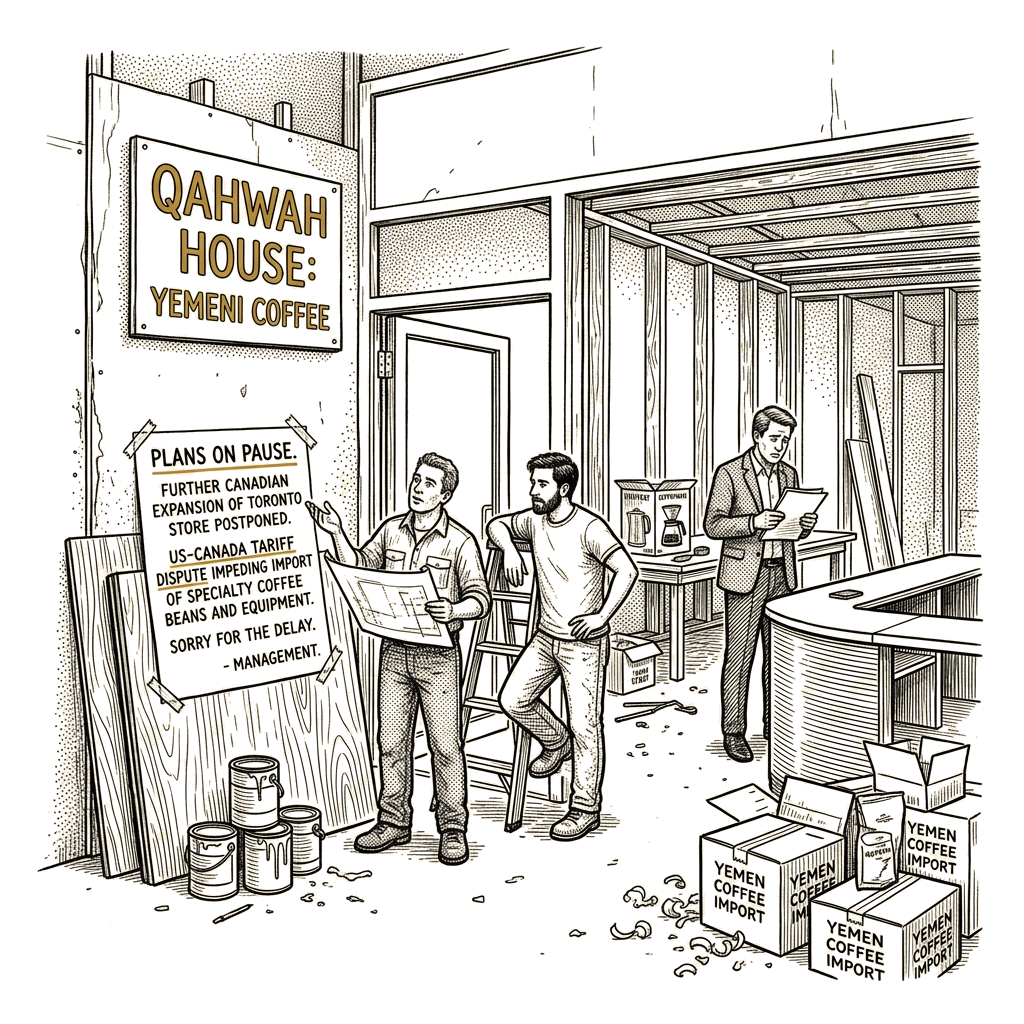
The Trump administration’s July announcement of 50% tariffs on Canadian imports has reached Dearborn, Michigan, home to the largest community of Arab Americans in the United States and situated roughly a five-minute drive from the nearest border crossing. Qahwah House, a Yemeni coffee chain with 32 branches across the country and three locations in Dearborn, has paused a planned expansion into Toronto even though its Canadian licenses and registrations were already in place. Trump has repeatedly suggested that Canada become a U.S. state.
Qahwah House imports and serves coffee exclusively from Yemen. Marketing director Mohamed Ahmed said the company estimated that about 10% of its Dearborn business comes from Canadian customers. The chain had been preparing to open a branch in Toronto — Canada’s largest city and home to thousands of residents of Arab descent — before the tariffs were announced. “Where it does affect us is that we are trying to expand into Canada,” Ahmed said. “We have our registrations, license, everything in place to open up in Canada. For now, we’re holding off just to make sure it’s a feasible move to expand.” He added: “There are a lot of super recent changes, so we’ll see how that plays out.”
Broader tourism data track the pullback. Brett McWethy of Visit Detroit said Canadian visitation to the Detroit region has been down about 30% since early 2025 and remains at that level. Ottawa announced reciprocal sanctions on U.S. imports that took effect on 8 September, and trade talks held last month failed to resolve differences between the two countries. Last year, during the initial round of tariff disputes with Canada, Detroit businesses reported a steep fall in income from Canadian visitors.
Canada is Michigan’s largest trading partner. Dearborn’s Arab restaurants were so popular north of the border that a decade ago the Toronto Star dedicated an article to highlighting the suburb’s best eating spots, even though it is a four-hour drive from the Canadian city.
Windsor, Ontario, home to about 25,000 people of Arab descent, sits on the eastern shore of the Detroit River across from Detroit. For decades Windsor families made regular weekend trips to Dearborn’s Lebanese and Yemeni cafes. Robert Nelson, a professor of history at the University of Windsor who has written extensively on food and its cross-border dynamics, said his informal surveys show a split among Arab Canadians in Windsor: those with family or work ties to Dearborn are continuing to cross the border, while others are staying home in what he described as symbolic opposition to the Trump administration.
“Those who go to Arabic restaurants in Dearborn are overwhelmingly Arab Canadians,” Nelson said. “Dearborn is where it’s at; there’s so much Arabic being spoken around you. Before [the trade problems] Arab Canadians would go to Dearborn restaurants.” He added: “Now, if you have family or work [in Dearborn] you’re not stopping crossing the border because of politics. But there are members of the Arab community in Windsor who are traveling less, who speak about supporting local.”
The broader Michigan auto industry has been drawn into the dispute. Ford Motor Company employs thousands of workers at its Rouge plant in Dearborn, and the automaker is among the manufacturers affected by the tariff dispute with Canada.
Not every business has felt the chill. Khader Masri, who has run Masri Sweets on Dearborn’s Schaefer Road for more than 35 years, said the Canadian customers he knows have for the most part remained loyal. “There are five or six families who come over here that I know of – one came from London, Ontario, last weekend,” Masri said. “They are still coming. They are not thinking of any of that [political] commotion.”
Nelson echoed the sentiment from Windsor. “Our lives are so intertwined with greater Detroit that it is no simple political act to say: ‘I’m not going to cross the border any more,’” Nelson said. “To punish the small business owners who rely so heavily on Canadian customers because of the current administration also strikes me as a very difficult argument to make,” he added.
Communities on both sides of the border are demonstrating renewed resiliency amid the politics, according to The Guardian.
In a separate sign of the cross-border tensions, an NFL game held in Buffalo, New York, on 17 September drew attention when the Canadian national anthem was sung on the field by the Canadian group the Barenaked Ladies, a moment that drew criticism from some conservative media outlets, according to The Guardian. “I think the Canadians are smart enough to disassociate whatever president [Trump] says versus not coming here to visit the states for work or leisure,” Ahmed said. “I think Canadians do a good job of understanding that.”
The Dearborn chamber of commerce said it had not received any reports from businesses struggling specifically because of fewer Canadian visitors. Several restaurant owners declined to comment because of the political aspect of the trade dispute and what they described as the Trump administration’s wider targeting of immigrant communities, according to The Guardian. Others interviewed said they did not track which customers travel from Canada.
The broader Michigan food industry has been under more visible strain. An April report from the Michigan Restaurant and Lodging Association found that more than half of Michigan restaurant and lodging businesses reported declining sales, far above the national level, which was reported to be 39%.
For Qahwah House, the uncertainty has reached operational details beyond the Toronto expansion. Ahmed said the company has held off on buying furniture from a Canadian supplier. “There’s just been too much uncertainty,” Ahmed said.