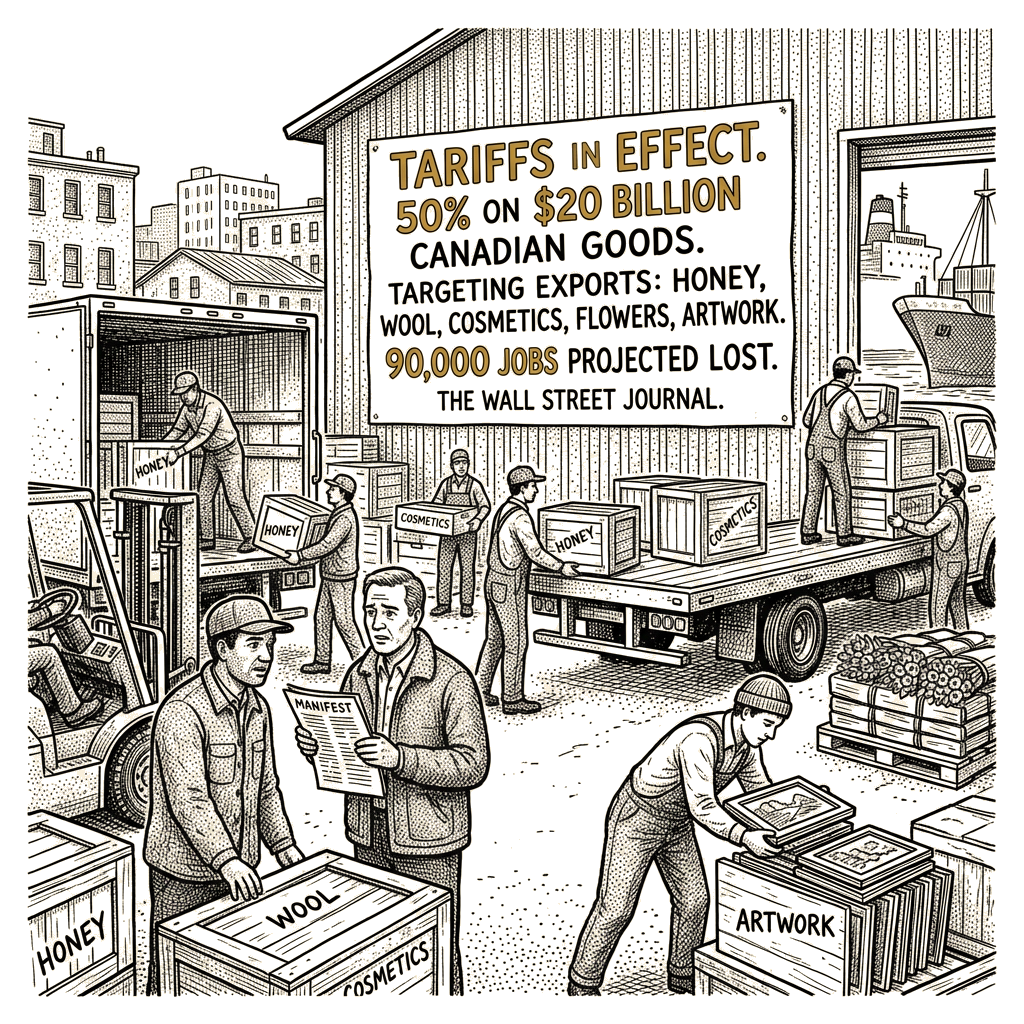
Flowers Canada Growers projects $151 million in annual floriculture losses
A Canadian Federation of Independent Business survey released this month found that 40% of its member exporters reported selling products targeted by the new tariffs. Of those, nearly 80% said they expected revenue losses if the tariffs were imposed, and more than one-third estimated losses of at least 50%. CFIB head Dan Kelly called the impact “very grave.”
Trevor Tombe, a University of Calgary economist, projected the tariffs could cost 90,000 jobs, the Journal reported. Economists at Desjardins Group estimate the unemployment rate could climb to 7% by year-end from 6.4% in July if tariffs remain on both sides of the border. Canada had logged five consecutive quarters of declining business investment before the new levies, with executives telling the Journal they had been uncertain about moving forward with hiring and investment plans.
The Canadian economy had shown signs of turning a corner before the new tariffs took effect. Statistics Canada reported Friday that gross domestic product expanded at an annualized rate of 3.3% in the second quarter, the fastest pace in more than three years. In July, Bank of Canada Governor Tiff Macklem said companies were adapting to trade uncertainty. “We were starting to believe that this was going to be a kickoff for investment to start to increase,” Dawn Desjardins, chief economist at Deloitte Canada, told the Journal. “But now, we are under this pall of uncertainty with how our trading relationship is really going to evolve with our still-largest trading partner.”
The new tariffs most heavily hit industries in Canada’s three largest provinces — Ontario, Quebec and British Columbia — and target goods including plastics, machinery, chemicals and forest products, the Journal reported. Some sectors face particular exposure: Canada’s agriculture department estimated that 56% of Canadian honey exports by volume went to the U.S. in 2025, and the Flowers Canada Growers industry group has estimated the new tariffs could cost the Canadian floriculture sector $151 million in annual losses.
In the prairie province of Alberta, Lorne Prins, who co-founded Gull Lake Honey Company in 2018, told the Journal he feared the tariffs could send honey prices “into a free fall.” Honey producers rushed exports to the U.S. after Trump first threatened the tariffs in July and before they went into effect, buying themselves some time, Prins said, but producers are now in wait-and-see mode. “We might weather this season because a lot of honey has already moved,” he said. “But if this drags out, it’s going to be a disaster.”
In Niagara-on-the-Lake, Ontario, U.S. sales make up almost half the business at Orchid Greens, and owner Guann Chen said raising prices would likely lead to losing customers. Some clients have already told him they might look elsewhere because of the tariffs. A store-bought orchid can take around two years to grow, leaving producers to guess years ahead about market access, Chen said. “We bring happiness to people’s homes and lives, and the fact the U.S. has targeted us is very odd,” he told the Journal.
Erin Pretty, who manages Real Wool Shop in Carleton, Ontario, has raised prices to reflect new U.S. tariffs on some wool she imports; she told the Journal some American customers have complained about the higher prices and online sales to the U.S. have dried up. Warren Levine, president of Toronto-area lip balm producer Lips Inc., said he had been dismayed by the trade battle given the traditionally close ties between the U.S. and Canada. Levine told the Journal he had already stockpiled U.S.-made tubes in case they ended up on Canada’s list of retaliatory levies and was considering sending lip balms to the U.S. under a tariff code for body and skin products that isn’t targeted. “But [Trump] seems to be lying awake at night, just trying to figure out where the loopholes are that people are getting stuff through, so I think that’s all going to be affected, too, eventually,” Levine said. Vojtech Vyhnak has put on hold plans to hire workers for his Calgary custom canvas printmaking business, Canvas Prints Ltd., which has traditionally relied on the U.S. for half the company’s sales and which he would normally be preparing to expand for the busy Christmas season.
The Canadian government has announced more than $20 billion since last year to help firms and workers hit by tariffs. Canada has also pledged retaliatory levies on U.S. goods to take effect Sept. 8. The Journal reported U.S. officials have suggested they will respond to any Canadian retaliation, potentially setting the two sides on what the paper described as “the path of a full-blown trade war with more widespread costs for consumers and businesses on both sides of the border.”
Previous rounds of U.S. tariffs on Canadian goods had exempted goods compliant with the U.S.-Mexico-Canada Agreement, but the new ones do not, the Journal reported. Since returning to the Oval Office, Trump has imposed several sets of tariffs on Canadian goods, including duties tied to claims about fentanyl crossing the northern border — duties the Journal reported have been struck down by the Supreme Court — as well as levies of up to 50% on steel, aluminum, lumber and autos.