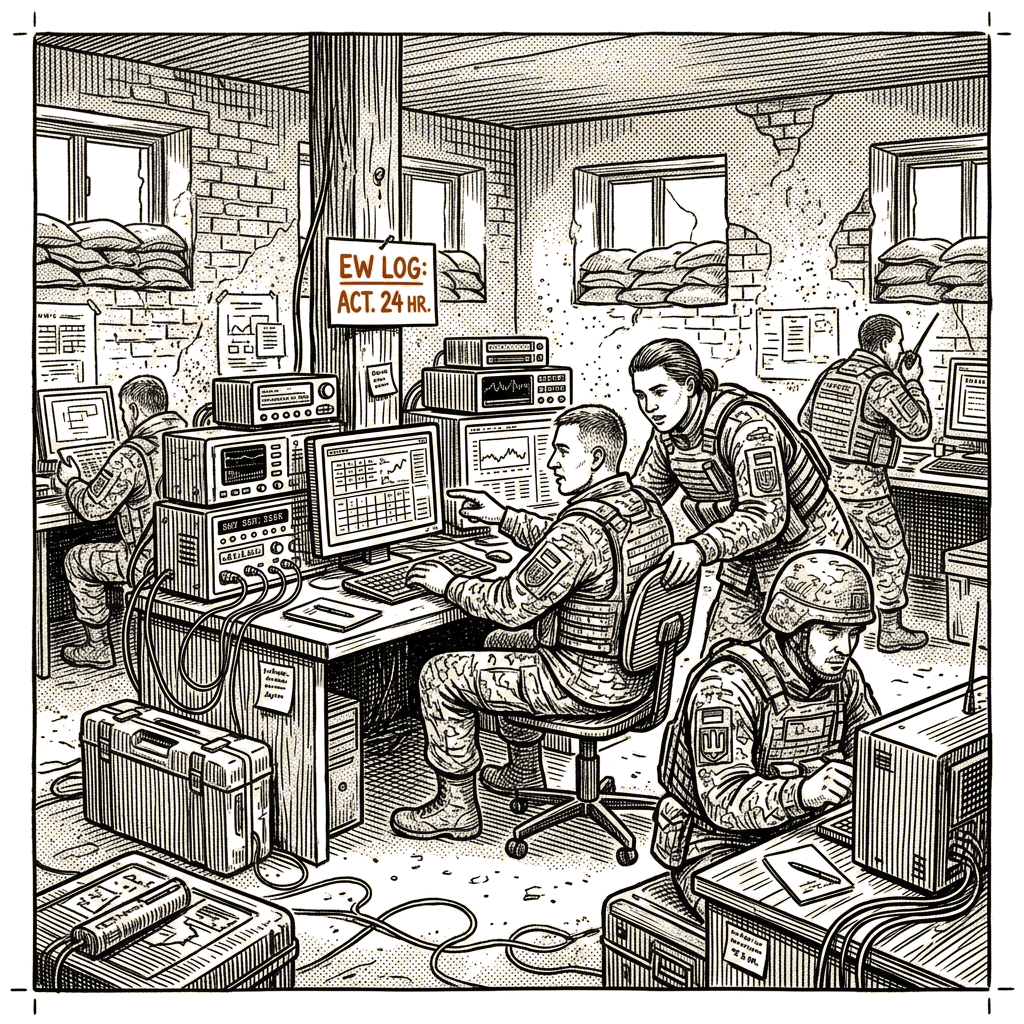
Night Watch’s Lima system jams drones, missiles, and guided bombs
KYIV, Ukraine — A silent electronic warfare battle is raging in the Russia-Ukraine war as both sides attack and defend communication signals on a massive scale, The Wall Street Journal reported.
“This is a new era of spectrum warfare,” Lt. Col. Matt Sherburne, the U.S. Army’s chief for electronic warfare capabilities development, told the Journal. Both sides are attacking and defending communication signals on an unprecedented scale, innovating at pace, while the U.S. and other Western countries are working to catch up, the Journal reported. The Pentagon is investing heavily in new capabilities.
Both sides are now engaged in a constant game of cat and mouse, jumping around the frequency spectrum to jam and avoid each other, and they are increasingly using AI to do that, the Journal reported.
Night Watch, an elite Ukrainian jamming unit, uses a system called Lima to blast signals over a 120-mile range that disrupt, spoof, and down Russian drones, missiles, and guided bombs, a major in the unit identified by the call sign Alchemist told the Journal. The unit used Lima to confuse the ballistic missiles that crashed into the Dnipro, filling the air with false signals — a technique known as spoofing.
Earlier this year, two Russian ballistic missiles hurtling at hypersonic speeds toward a key government site in Ukraine’s capital were intercepted by a radio signal and crashed into the Dnipro River, according to Night Watch. Around that time, the navigation apps on many phones in Kyiv showed users as located in Peru — what the Journal described as the electronic calling card of Night Watch.
Last November, Night Watch claimed one of its biggest scalps when it intercepted a hypersonic Kinzhal missile, once dubbed invincible by Russian President Vladimir Putin. Lima beamed a false navigation signal at the missile, prompting it to alter direction and break up under the pressure of its own extreme speed, according to Night Watch officers.
Ukraine won’t say how often electronic warfare, rather than in-flight failure, is responsible for downing missiles and drones. It can be hard to tell the difference, the Journal reported. Electronic interference can unintentionally divert a target to civilian areas. Ukrainian officers say Lima can sometimes interfere with their own drones during operations.
Electronic warfare fell out of focus in the West after the end of the Cold War. Since the start of the 20th century, when the British Royal Navy experimented with radio jamming and intercepting enemy communications, the vulnerability of radio signals has been exploited in combat, and the technology truly took off during World War II, when the U.K. and Germany jammed and spoofed aerial navigation signals in what Winston Churchill called “the battle of the beams.” As military communications and radar became more sophisticated during the Cold War, so did the technology to interfere with them. In post-Cold War conflicts in Afghanistan and Iraq, the U.S. faced lower-tech adversaries, and further advances in electronic warfare were less of a Pentagon priority. U.S. officials say Russia’s invasion of Ukraine has been a wake-up call.
By 2022, electronic warfare had become one of the Pentagon’s top three procurement priorities, alongside long-range munitions and affordable technology for countering drones and missiles, according to Bill LaPlante, who served as the Biden administration’s top procurement official.
The scale of disruption at the front is substantial. One officer for Ukraine’s Unmanned Systems Forces said electronic warfare suppresses 70% to 95% of radio-controlled drones detected in the sector where his team operates. Phantom Defense, a Ukrainian manufacturer, said it has detected more than 11,500 Russian drones over the past year of operation and successfully neutralized around 7,500, with results confirmed via the video feeds from the drones, which the company also intercepts. Ukrainian firm December1 said it now sells thousands of its front-line and long-distance jamming units per month, up from dozens in 2024.
Joshua Ransford, a former U.S. Marine who served in Iraq before joining Ukraine’s international legion in 2022, told the Journal that in his first days of fighting, Russian forces jammed his GPS signals and radio frequencies, rendering much of his equipment useless. The enemy flew drones that could find Ukrainian positions by sniffing out their electronic emissions. “It really sucked,” Ransford said.
China is also expanding its capabilities, with military analysts telling the Journal that Beijing has established electronic warfare units on an archipelago of man-made islands in the South China Sea.
Both sides are building around the jammers. Naval vessels sometimes communicate with other ships via lasers that cannot be jammed. Russia and Ukraine are using fiber-optic cables to connect drones directly to their operators. Both sides have artificial intelligence-enabled drones that can lock onto and destroy targets without needing a feed to a pilot. Each workaround has shortcomings: lasers work only over small distances and in good weather; fiber-optic drones are slower and less maneuverable; and AI has some way to go before drones can reliably navigate terrain over long distances, Vito Tomasi, a managing director at German drone maker Quantum Systems, told the Journal.
On a balmy August day, six Lima antennas shaped like megaphones pointed skyward from poles on the edge of a field in rural Ukraine. The antennas blast out electromagnetic signals generated by computers connected to the poles and housed in protective cases. A soldier received an air-raid alert for ballistic missiles and entered a camouflaged, net-covered hut, where he turned four keys on switch boxes to trigger Lima’s barrage of electronic noise. Similar setups are dotted around the country, creating a network of invisible signals to stop missiles, guided bombs, and drones. When Night Watch teams are able to retrieve a downed target, they often scour the wreckage to figure out new ways to jam them.
At one research lab, an officer spread out circuit boards and antennas on a table, noting that the latest models were from China. At the end of 2024, Night Watch discovered that Russian drones and missiles were using Chinese-made components known as Controlled Reception Pattern Antennas, which can detect where jamming signals are beamed from and, in fractions of a second, use complex algorithms to dodge them.
“It was a big problem for us,” said an officer known by the call sign Frenchy.
Night Watch and Cascade, the company that makes Lima, worked around the clock for three months to find a solution. The result was Lima Quant, whose own mathematical algorithms work out ways to overcome such an antenna. But then the Russians doubled the number of antennas from four to eight, then to 16, and now to 32, each time reacting to new Lima updates, the Journal reported.
The U.S. has begun using some of its renewed capacity. The U.S. operation to seize former President Nicolás Maduro began with electronic warfare to knock out the ability of the Venezuelans to see and communicate. The Iran war saw the first deployment of the U.S. military’s new signal-jamming jet, the EA-37B Compass Call. As the U.S. and Europe boost spending, spectrum warfare has become one of the most lucrative fields for Western defense companies, the Journal reported. Hot items include pods tethered to ships and planes that replicate the electronic signature of the vehicles they trail and act as decoys for missiles and torpedoes, drones that sniff out adversary electronic emissions, and equipment that alters radar pulses to confuse the enemy.
At a workshop near Ukraine’s eastern front, an electronic warfare unit of the Azov Brigade finished work on circuit boards inside a black plastic case, much like those used to store tools. The circuits transmit signals via four antennas on the box for several hundred yards, on frequencies the unit believes Russia is currently using. A sergeant at the workshop summarized the approach: “We make sure that their drone cannot hear its operators.” An Azov soldier identified only by the call sign Dobri said jamming signals downed a Russian drone speeding toward him — gear he credited with saving his life.
Several Ukrainian and Western air-defense experts who spoke to the Journal said a system such as Lima is capable of foiling ballistic missile attacks. Russia’s success in piercing Kyiv’s air defenses with ballistic missiles this year demonstrates that electronic warfare isn’t a perfect stand-in for Patriot interceptors, though it comes at a fraction of the price and is readily available. Ukraine uses high-end equipment such as Lima to protect cities and vital infrastructure, while soldiers on the front line face a constant threat of drones that need a cheaper, more abundant antidote.
The U.S. is taking notes, Col. Josh Koslov, the U.S. Air Force’s director of non-kinetic operations, told the Journal. “If you are not winning in the spectrum,” Koslov said, “you are going to lose the war.”