Latvian president says Russia’s military has grown more dangerous since 2022
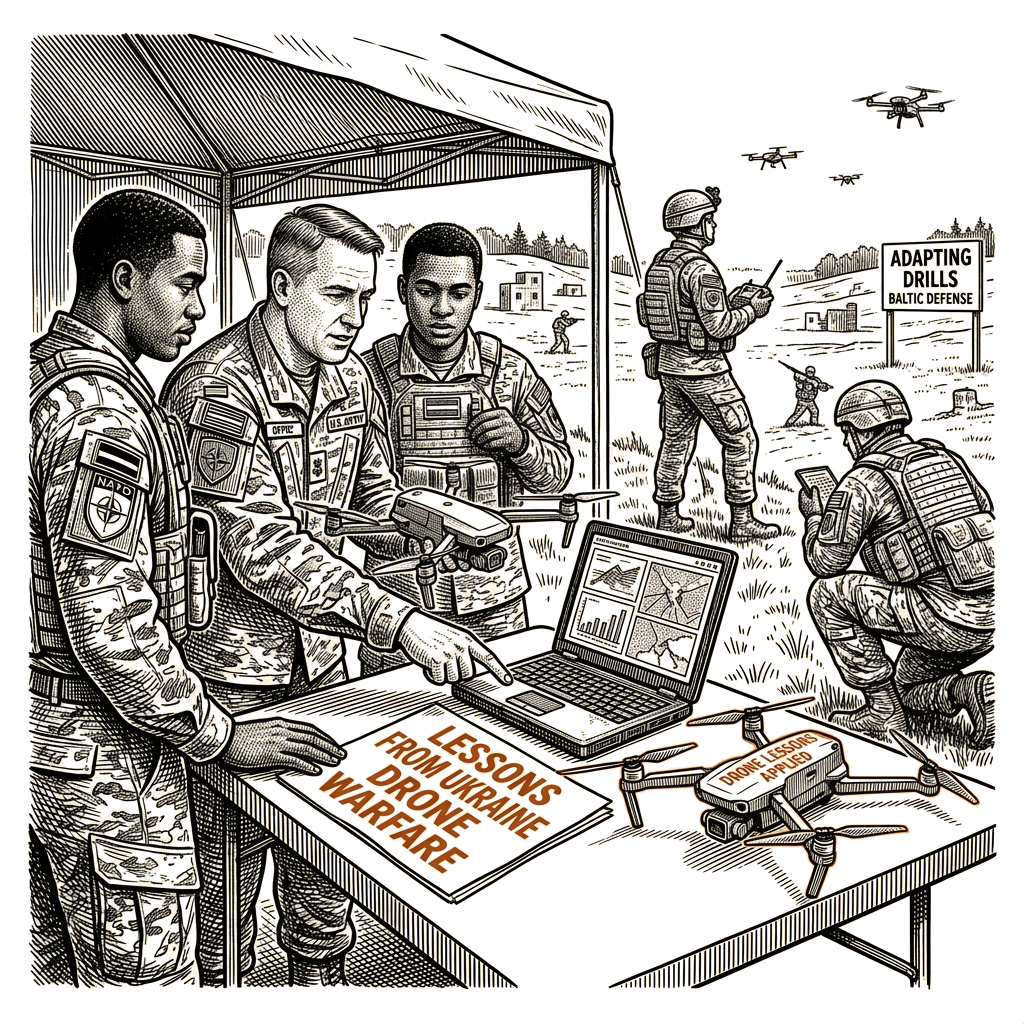
NATO forces in the Baltic states are racing to absorb the drone-driven lessons of the war in Ukraine, but commanders on the ground acknowledge the alliance is not yet where it needs to be.
In a pine forest near Daudzeva, Latvia, Danish soldiers wearing strips of red tape on their helmets stealthily moved through the trees and, unleashing a firestorm, overran a position held by Spanish troops. “Todos muertos”—“everyone is dead”—quipped one Spanish soldier, relaxing under an armored vehicle whose cannon had been raised to signal its destruction.
The Danish mechanized infantry company role-played the enemy in a September exercise by the Canadian-led NATO brigade deployed to protect Latvia from nearby Russia. The previous night, Danish drones launched simulated attacks on the brigade’s assembly areas, sowing chaos that awakened sleeping soldiers and left some of them designated as dead, the Danish commander said with evident satisfaction.
The exercise, one of several held across the Baltic states this year, sought to prepare the brigade should the growing Russian threat against European countries spill into outright war. It involved implementing the lessons of how the nature of warfare has been transformed by the drone revolution in the battlefields of Ukraine—with mixed results.
“We don’t just train anymore. We do mission rehearsal,” said the NATO brigade commander, Canadian Col. David Brassard. “This is a fundamental change in mindset.”
Some 35% of Canada’s entire land forces are committed to Latvia, Brassard said. Similar NATO units are led by Germany, which is permanently positioning a brigade in Lithuania, and the U.K., which is leading a battle group in Estonia.
Latvian President Edgars Rinkēvičs said in an interview that he was receiving intelligence assessments of looming Russian escalation, though for now below the threshold of outright military invasion that would trigger NATO’s Article 5 commitments to mutual defense. The war against Ukraine that began in 2022 has made Russia’s military stronger rather than weaker, a threat sometimes obscured by Russian failures to significantly advance on the ground in Ukraine, he warned.
“The Russian economy is probably not as good as it used to be, but the Russian military is more dangerous than it used to be four and a half years ago, and we need to take this into account,” Rinkēvičs said. “Like it or not, this is a military that now has battle experience, and has also been very flexible and agile to adapt to new warfare.”
Unknown drones, perhaps Russian and perhaps operated by local civilians, have been observed flying over the area during the exercise, Brassard said. The Baltic states have already been subjected to hybrid attacks.
The Danes, from the Royal Life Guards Regiment, have invested considerable time watching drone footage from Russian and Ukrainian social-media channels. Almost all of the company’s roughly 150 troops have gained at least rudimentary piloting skills, and the company’s commander, a veteran of the Afghan war, said he has visited several units inside wartime Ukraine.
Yet even his unit was far from proficient in emulating the Russian and Ukrainian way of war, in which some 90% of kills come from drones and much of traditional military doctrine has become obsolete, the commander said. Some 90% of the drones used by the Danish “red force” in the exercise were for observation and intelligence gathering, with a few used as weapons.
Even the Danes, with all their emphasis on learning the lessons of Ukraine, have only a small amount of drones, though more would come in case of conflict, the commander said.
Down the road in the forest, two Canadian Leopard tanks sat parked at an intersection, bare of the netting and drone defenses that have become indispensable in the war between Russia and Ukraine. The crews said they are just starting to learn about drone warfare. Asked about drone defenses, one soldier said he should soon be issued a shotgun; there was no drone detection technology in the tank.
At a nearby Canadian artillery battery, the commander said troops have been spacing their M777 towed howitzers 12 kilometers apart (a bit more than 7 miles)—much farther than usual—to minimize the chances of drone detection. They were also digging them into the ground as deep as 3 meters to make them more survivable once discovered. The Canadian major, who served in Ukraine as an adviser before 2022, said his soldiers constantly watched videos of the war and proposed new solutions and techniques.
To Juris Jurašs, a former Latvian lawmaker who joined the Ukrainian military as a reconnaissance company commander in 2022, such measures miss the point. Towed howitzers like the M777 are rarely used in Ukraine nowadays because they get targeted by drones immediately after firing, and no amount of digging would help, he said. Tanks have all but disappeared from the front line, and those that attempt to operate are usually covered in multiple layers of hedgehog-like drone defenses.
“A tank in the battlefield now is like a dessert cake—the drone boys will be fighting each other over the right to strike it first,” Jurašs said. “NATO armies are not ready for this kind of modern war. They’ve only heard about the war in Ukraine from TV or social media, and they don’t understand just how much everything has changed.”
More drones and other modern technologies are coming, and the NATO brigade in Latvia is adapting by practicing how to cover roads with antidrone netting and how to create hardened headquarters, Brassard said. While Ukrainian troops aren’t training with his forces, they do work with the Latvian army and national-guard brigades.
“Are we where we are supposed to be? Not 100%,” Brassard said. “But the threat across the border right now gives us some time to reach our cruising speed.”
Rinkēvičs said he has urged fellow NATO leaders to speed up changes in plans and doctrine. “NATO needs to be much more flexible and more adaptive, both national forces and the entire defense planning in the alliance,” he said.
At a conference in Riga, Kyrylo Budanov, chief of staff of the Ukrainian presidency and a former military-intelligence commander, complained that on those occasions when Ukrainian forces are asked to participate in NATO exercises, it is usually as the “red team” playing the adversary rather than as part of the main force.
“By not involving these units as your own, you don’t understand the algorithms that we have developed, and all you get to see is how the opposing force is destroying your units, which has been happening all the time,” Budanov said. Drones by themselves, without an integrated military system behind them, are useless, he added.
Latvia’s defense minister, Raivis Melnis, a former military officer who served in Ukraine during the war, agreed. “Russia is aggressive. It is important for us to understand that Russia doesn’t seek peace,” he said. “There is only one country in the world that knows how to fight Russia in reality, and that is Ukraine. We need those lessons, we need to get ready.”