US matchmakers encourage Taiwan drone partnerships
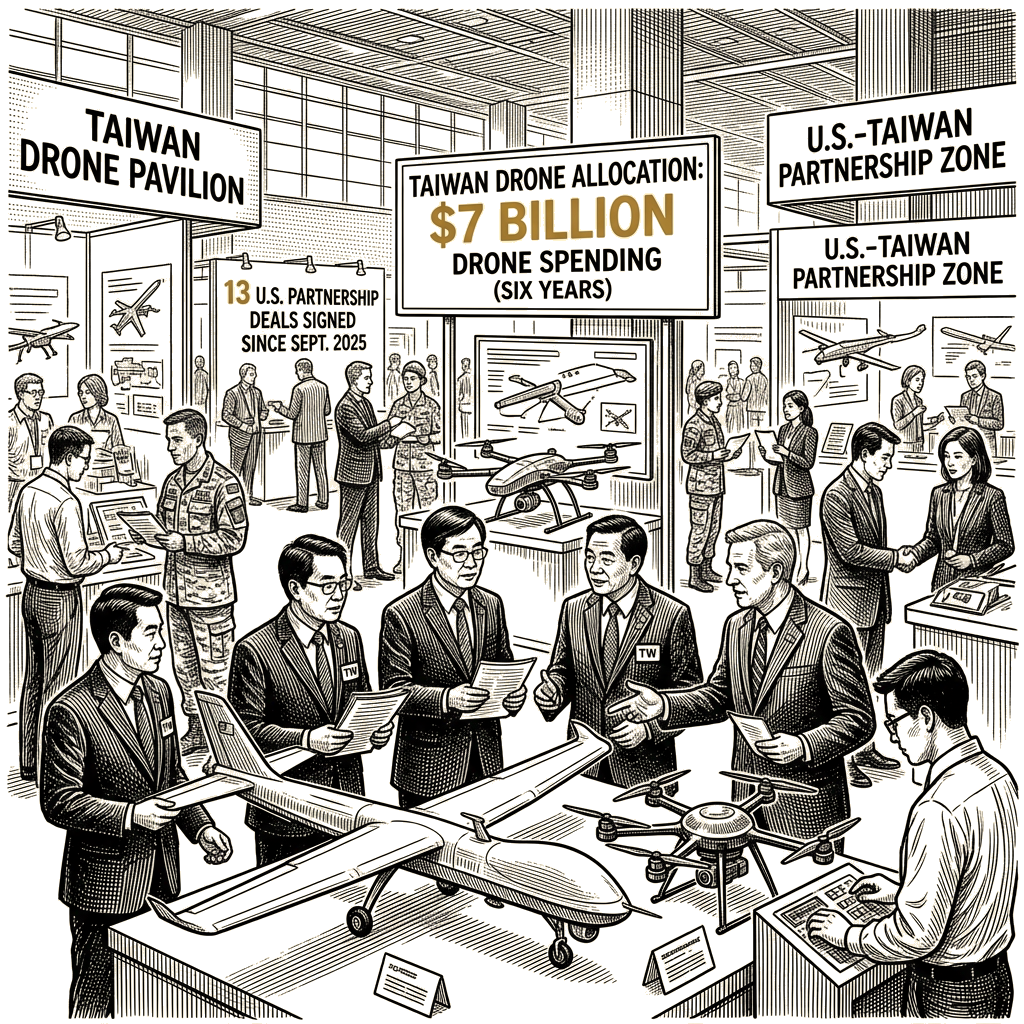
U.S. drone-tech startups like HavocAI are swarming into Taiwan and — with the encouragement of U.S. government matchmakers — pairing with Taiwanese manufacturers to build a drone supply chain that avoids China, with at least 13 collaboration agreements signed since September 2025, The Wall Street Journal reported.
The emerging industry could serve the U.S. military’s demand for a secure drone supply chain that steers clear of China while giving Taiwan what its officials describe as an arsenal essential to its survival as a self-ruled democracy. The partnerships range from small defense-tech firms to Anduril Industries, an arms supplier to both the Pentagon and the Taiwan military whose drone contracts with Taipei have already passed the $1 billion mark.
Taiwan’s government allocated over $7 billion for drone spending over the next six years in August, a decision that drove new deals and revived partnerships formed while the budget was still only a plan. Officials in Taipei see a full-fledged domestic drone industry as vital to deterring China from using force to try to seize the island, which Beijing considers its territory.
The urgency has grown as President Trump withholds approval for the sale of $14 billion in arms to Taiwan. Supporters of defense-industry collaboration see the partnerships as a way to strengthen ties between Washington and Taipei amid worries that the U.S. is no longer willing or able to help the island defend itself.
The strategy emulates the “you design it, we’ll build it” model championed by Taiwan Semiconductor Manufacturing, drawing on Taiwan’s decades-long reputation as a nimble contract manufacturer supported by a network of local industries. “American companies are already coming to Taiwan to find R&D partners and build out their drone supply chains,” Raymond Greene, director of the American Institute in Taiwan, the de facto U.S. embassy, said in a speech this summer.
HavocAI, a Rhode Island startup founded in 2024 by former U.S. Navy flight officer Paul Lwin, designs software to manage autonomous maritime fleets. “If we can help Taiwan build thousands of these autonomous boats, it could protect Taiwan,” Lwin said. “It could prevent a war from breaking out.”
CSBC, which has built warships for Taiwan for more than five decades and is building the island’s first submarine, became a clearinghouse for the partnership rush after Taiwan’s Defense Ministry said in December that it needed 1,320 one-way surface drones — uncrewed attack boats that explode on reaching their target. The navy later requested $930 million over six years to buy them. Chen Jeng-horng, CSBC’s chairman, said the company has been inundated with potential collaborators offering drone technology and needing shipbuilding know-how. “American firms are all flocking to us,” Chen said at the company’s Taipei office. “If they want to expand their business, Taiwan is the next major client.”
Chen and other CSBC executives spent more than half a year vetting about a dozen U.S. and European firms, touring the U.S. and reviewing product demos at sea before selecting HavocAI. Chen flew to Rhode Island last month to sign the deal. Chen said Taiwan lacks the technology to remotely control a large number of uncrewed systems across land, sea and air, despite a strong industrial base and shipbuilding strength.
The partnerships represent progress toward a so-called “non-red” or “democratic” supply chain that could serve both Taiwan and the Pentagon. Most parts that Taiwanese vendors are making for Anduril are for products not made for use in Taiwan, said Anduril co-founder Palmer Luckey. “My business interest is maybe ‘designed in the U.S., made in Taiwan,’ or ‘designed collaboratively and made in Taiwan,’” Luckey said in a small group interview in Taipei. But Taiwan, he said, “needs to design its own weapons systems and manufacture its own weapons systems at scale” to face Chinese threats.
For the U.S., making drones on American soil remains a policy priority. “Our overt preference is to buy American,” Defense Secretary Pete Hegseth said last year as he introduced Drone Dominance, a $1.1 billion Pentagon program to purchase small, lethal drones. Trent Emeneker, who previously led the Blue UAS Project, the Pentagon program responsible for vetting secure drones and parts, said the shift cannot happen instantly. “Not everything can be made in the United States today. We can want it to be done, but that’s just not possible to make that happen overnight,” said Emeneker, who runs a drone-training startup, Kill Zone. “Anything that can be done to build the supply chain up outside of that mainland Chinese ecosystem, it’s a good thing.”
The National Chung-Shan Institute of Science and Technology, the R&D arm of the Taiwanese military, signed a co-production deal last year with Anduril to manufacture the U.S. company’s Barracuda 500 cruise missiles and underwater drones in Taiwan. It was one of six agreements NCSIST signed the same day with Western companies, including a plan with Northrop Grumman to explore collaboration on air and missile defense modernization for Taiwan’s Defense Ministry. At the end of last year, Congress directed the Pentagon to establish a joint drone program with Taiwan.
“The longer-term U.S.-Taiwan collaboration may have significant benefits to American defenses,” said Rupert Hammond-Chambers, president of the U.S.-Taiwan Business Council. Emeneker said Taiwanese production could also supply U.S. forces overseas, particularly U.S. Pacific Command, which operates thousands of miles from the American mainland, where “Taiwanese production can fill a need that does exist.”
Str8 Industries, a startup co-founded by tech entrepreneur Phil Ho and retired U.S. Navy officer Bilal Awad, is another potential contender for the navy’s proposed $930 million drone-boat budget. Str8 has an R&D operation in northern Taiwan, works with a shipyard in the southern port of Kaohsiung and maintains a home office in Virginia. Ho said the company can “build capabilities in situ—in Taiwan for the potential contingency scenarios.” If China blockades Taiwan, Ho said, “everything on the island is what you can rely on.”
The partnerships have begun producing hardware. In late September, California-based AEVEX and Taiwan’s CIRC conducted a live demonstration on Taiwan’s southeastern coast in which a small, white fixed-wing drone took off from an airstrip and descended quickly to strike a red balloon on the ground. AEVEX, already a Pentagon supplier, provided the design for the Taiwan-made, 3-D-printed airframe. CIRC designed the flight controller, computing board and payload systems, and sourced motors and batteries locally.