Carney calls projected Alberta result ‘a clear choice’
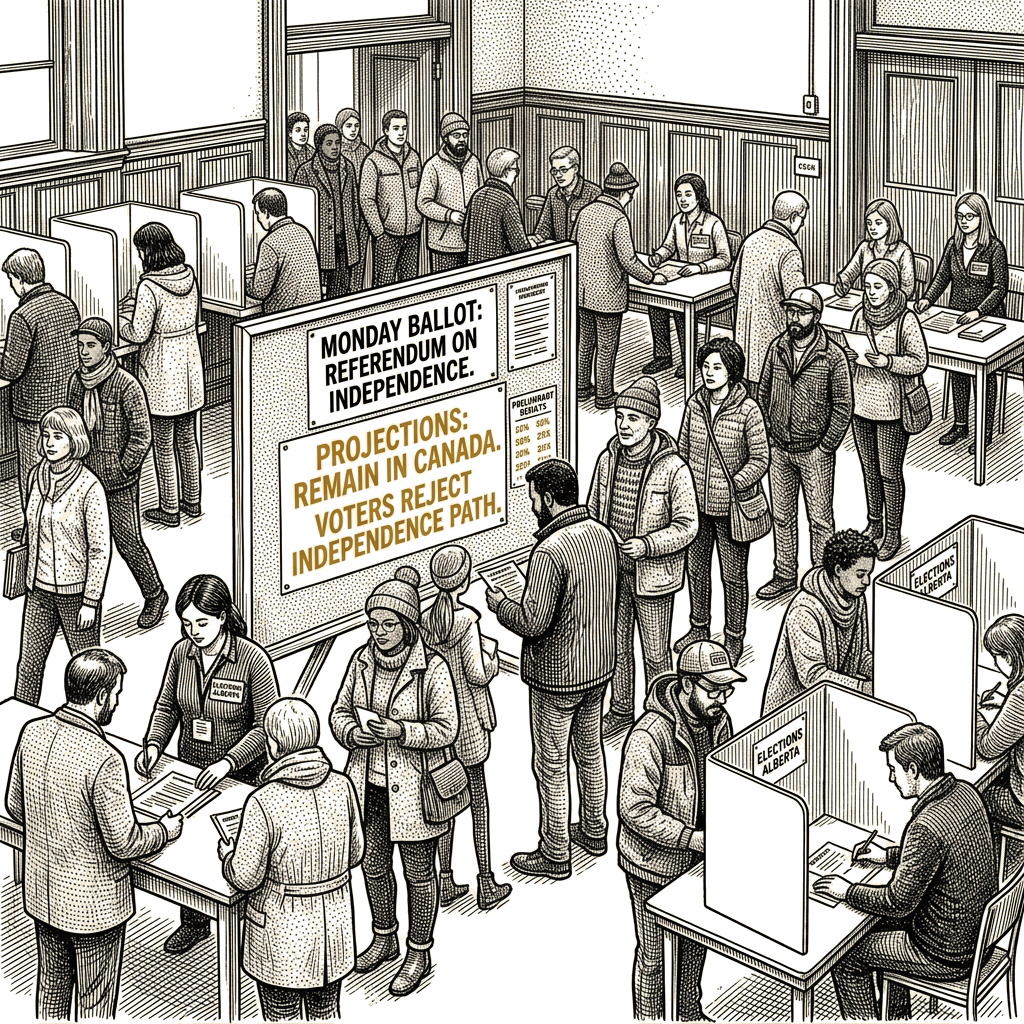
Albertans voted Monday to remain part of Canada, with projections from Elections Alberta showing more than two-thirds of ballots rejected pursuing a binding independence referendum. The ballot was a non-binding advisory question asking whether the province should commence the legal process required under the Canadian Constitution to hold a binding referendum on separation, not a direct vote on independence itself.
Prime Minister Mark Carney called the projected result “a clear choice” on the part of Albertans. At a pro-separatist watch party in Edmonton, the hum of upbeat chatter quickly quieted as those present saw the projected results, and one separatist leader insisted his campaign was not over. After overnight vote projections were published by Canadian broadcaster CBC and others, the mood soured among the separatist camp. A pro-independence watch party attended by the BBC packed up quickly, and people went home.
One of the separatist leaders, Jeffrey Rath, struck a defiant tone, vowing that the push for independence would continue. Speaking to the BBC World Service’s Newsday programme, Rath, a lawyer based in Calgary, said he saw Monday’s vote as a “first step” which had taught the movement some “valuable lessons.” Asked whether his movement would push to keep holding votes on independence until it got the result it wanted, he responded “why not?” and insisted that “the math and the economics” all added up on his side of the argument.
Alberta Premier Danielle Smith called the vote earlier this year in response to a public petition. Smith opposed the separatist push but said the public will for a vote was undeniable. She welcomed the initial results, commenting: “Albertans have voted for a stronger Alberta in a united Canada.” Smith said before the vote that if voters chose the option to remain, a referendum on separation would not be held, at least not while she was in power.
The vote followed a grassroots group that gathered about 300,000 signatures on a petition asking for a binding referendum on separation. A judge blocked that petition, saying it failed to consult indigenous First Nations people, but Smith opted to go ahead with the ballot. A separate group collected signatures on its own petition opposing separation, which was signed by more than 400,000 people.
The ballot question asked: “Should Alberta remain a province of Canada or should the Government of Alberta commence the legal process required under the Canadian Constitution to hold a binding provincial referendum on whether or not Alberta should separate from Canada?”
Separatists making the case for independence argued that the oil-rich province’s economic growth had been stifled by the environmental policies of Canada’s central government in Ottawa. Opponents of a breakup, including Carney, called for Canada to present a united front in the face of external pressures, including the ongoing trade war with the United States.
Despite the projected results, the conversation around Albertan sovereignty is not over. Separatist leaders have indicated that they plan to push Smith out of power within her United Conservative Party, hoping to install a leader more sympathetic to their cause. It is unclear if they have the numbers to do so, but debate around the issue could dominate politics in Alberta for years to come.
Another separatist leader, Mitch Sylvestre, told the BBC on polling day that “a lot of work will have to be done” to curb the appetite for independence if his side did lose.
Canada has grappled with challenges to its unity before. The province of Quebec held two unsuccessful referendums on independence, in 1980 and 1995. Alberta separatists believe Quebec used the threat of independence to gain significant political leverage over Canada’s central government.
Although responses to the referendum question are being tallied as a priority, there were nine other questions on Monday’s ballot paper. Five of these dealt with immigration, while the other four focused on the Canadian constitution.