Forecast showed slightly decreased chance of flash flooding before team’s departure
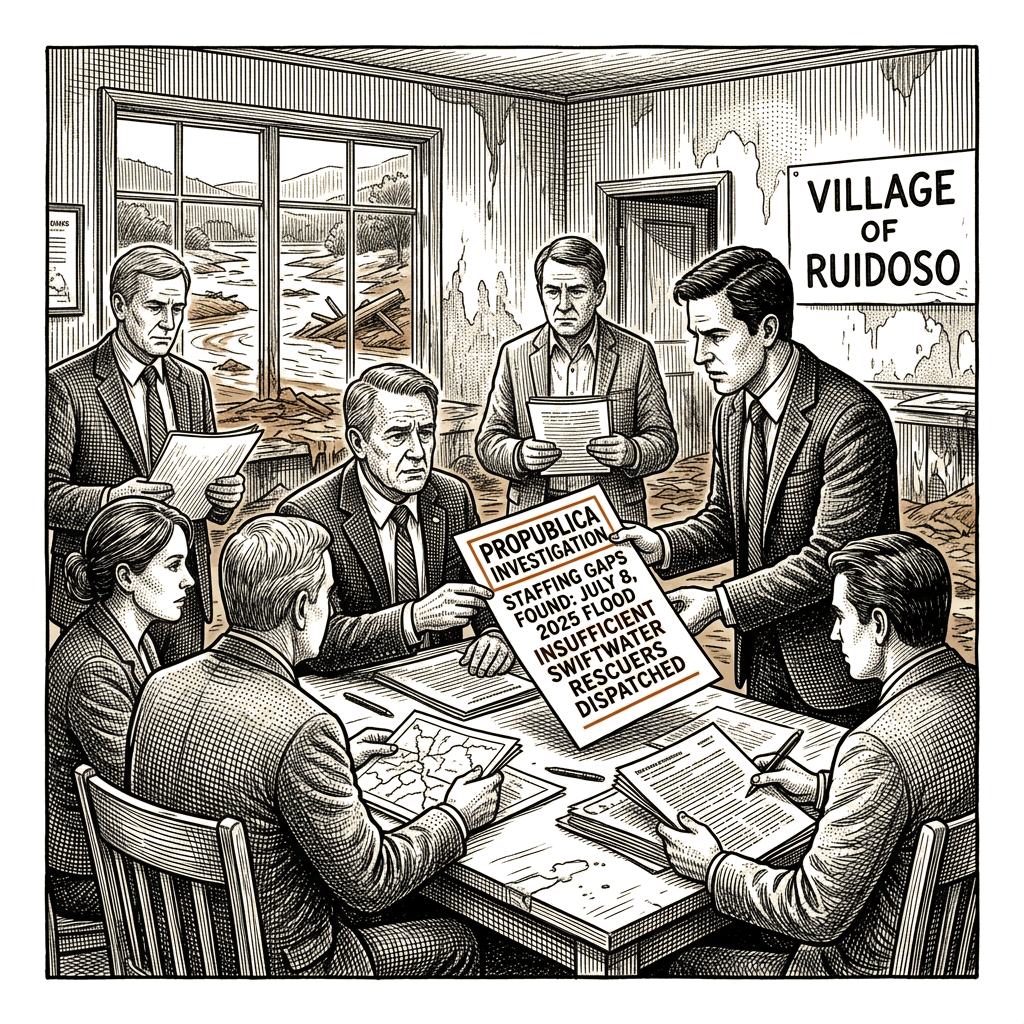
A ProPublica investigation published on October 21, 2026, reported that Village of Ruidoso leaders had not provided enough training or dispatched enough swiftwater personnel before the July 8, 2025 flood. Five rescuers involved in the response said those decisions left first responders with inadequate support as the water rose. The flood killed Stephanie Trotter’s 4-year-old daughter and 7-year-old son, along with an adult man; Trotter’s husband, Sebastian, survived.
Five rescuers said the flood’s strength made evacuation of the area where the Trotter family was camping the children’s best chance before the water arrived. ProPublica said village leaders knew dangerous floods were likely because two intense 2024 wildfires had scarred the hillsides above town, and that even moderate rain on severe burn scars can trigger post-fire floods and debris flows. The report said leaders seeking to encourage tourism scolded residents who warned of the danger on social media. ProPublica consulted seven experts outside Ruidoso with experience in floods and other emergency responses.
Forty-five minutes before the downpour began, Mayor Lynn Crawford told a council meeting that whenever the village was alerted to flooding, firefighters and public works employees would be ready: “Everybody is in position.” At 2:12 p.m., the National Weather Service issued a flash flood warning. About 20 minutes later, Hall summoned all off-duty swiftwater technicians. At 2:38 p.m., a weather service hydrologist wrote to emergency managers, “Water is Out of the Banks in the Rio Ruidoso at the County Line.” At 2:47 p.m., the warning was upgraded to a flash flood emergency.
Internal fire department records show that Hall did not call in the full department until 3:10 p.m., 45 minutes after Ruidoso dispatchers recorded the first call for rescue related to the flood. Before firefighters could access Riverview RV Park, Stephanie Trotter and her daughter were swept downstream.
Stephanie and Sebastian Trotter said they had no idea the town was in danger and did not receive the National Weather Service’s automated alerts. They also said they had not known about or signed up for text-message alerts created by the village. During the hour before the flood reached the family, first responders with loudspeakers drove through other parts of the community and told people to seek high ground. No officials with loudspeakers went to Riverview RV Park, even though the area was known to flood and sat just down the road from the primary fire station.
The village also did not use its sirens that day. During the 2024 fires, Ruidoso emergency manager Eric Queller had overseen the evacuation of thousands using the siren system. After the flood, the village said using the sirens could have put people in harm’s way by directing them onto roads covered with water.
Ruidoso had planned three additional sirens that could instruct people to seek high ground during flooding and permit a more orderly evacuation. The sirens were not operational by July 8. In an interview the previous year, Queller said the disasters the community had faced since 2024 had delayed the project. By that summer, the village had installed voice-activated sirens and reversed its position on the standard system, saying it would use the sirens during floods.
The Ruidoso Fire Department employed nine swiftwater technicians trained to conduct flood rescues. When forecasters issued the warning because of heavy rain, however, only a handful were working, along with four New Mexico National Guard technicians in vehicles capable of navigating floodwater. A Guard spokesperson said its members helped rescue nine people.
Five rescuers said Hall had for weeks resisted requests from off-duty swiftwater technicians who wanted to be stationed in flood-prone areas before storms arrived. Pre-positioning those firefighters would have required overtime. One of the flood-prone areas Hall had declined to staff was close to Riverview RV Park, where Trotter and Stark had been staying. One rescuer said, “We’ll have to pay for that, and what if nothing happens?”
Two additional swiftwater teams had recently been in Ruidoso. When the late-June forecast showed a slightly decreased chance of flash flooding, the state Department of Homeland Security and Emergency Management ordered the Las Cruces team home. One team member, who spoke on condition of anonymity to protect their employment, said, “We didn’t understand why we were being sent home.” The other swiftwater team, from Texas, left after deadly flooding struck Kerr County and surrounding regions in its home state.
A Department of Homeland Security and Emergency Management spokesperson said in an email, “New Mexico was experiencing multiple flooding threats,” adding that the Las Cruces team needed to remain available to respond elsewhere. The spokesperson said the state had only about eight swiftwater teams.
The Las Cruces team was not deployed to another flood; it went home. A swiftwater technician said, “I could understand if we were sent somewhere else.” A former incident commander for Cal Fire, California’s fire agency, said the state shared responsibility for the inadequate emergency response on July 8 because of its decision to send the team home. “This should be a clarion call as to reevaluating their resource availability.” The departure left Ruidoso’s firefighters leading rescue operations in the village.
Hall had planned to train every firefighter as a swiftwater technician. In February, the firefighters unionized, and many worked second jobs. The department changed course and sent them for a lower-level certification that limited their ability to conduct rescues in rushing water. Once monsoons arrived that year, multiple rescuers said Hall rarely stationed off-duty firefighters in vulnerable areas. Sometimes in the afternoons, when rain was most likely, multiple firefighters were out of town.
At around 3:30 p.m. on July 8, 2025, Jere Stark was nearly waist-deep in a flooded river at Paradise Canyon Drive, a couple hundred yards from the village fire department’s headquarters. The torrent had carried Stark a quarter mile, leaving him covered in mud and extremely cold. A firefighter and a police officer lacked enough rope or manpower to lift him over a temporary barrier separating them from the debris-filled water.
Only two firefighters and one police officer were the first responders at the barrier. One firefighter was not wearing a personal flotation device, which the report described as a basic safety measure for flood rescues. Stark was waiting for help behind the barrier when the first responders arrived.
Not far from Stark, Stephanie Trotter huddled on the ground behind the temporary barrier, shielded from the floodwaters. Trotter, a tourist from El Paso, Texas, had been washed away with her young daughter. A civilian remained with her while a second firefighter hauled in a rope he had used to rescue her. The civilian asked, “Is somebody coming for her?”
At least eight other firefighters were trying to save people upstream at Riverview RV Park, where Trotter and Stark had been staying. Civilians soon assisted at the barrier. A property owner wearing shorts and flip-flops and a second passerby each helped a firefighter haul Stark from the water with another rope.
Trotter and two civilians told Police Officer Jimmy Hernandez that her 4-year-old daughter, 7-year-old son and husband were missing. Hernandez radioed, “We need swiftwater rescue here.” No additional swiftwater teams arrived for at least 25 minutes. Both children died, along with an adult man. Trotter’s husband, Sebastian, survived.
Following Stark’s rescue, the first responders at Paradise Canyon Drive were overwhelmed, according to two civilians who were present and Hernandez’s body-camera footage. Trotter told Hernandez that her daughter was in the water and that the family had been in an RV. Property owner Corey Sexton said he saw a child float past and alerted first responders.
Hernandez told crews downstream to look for a child but also radioed that he thought the children were in an upstream trailer. The two firefighters at Paradise Canyon Drive moved to the upstream bridge, prepared rope and watched the water. Minutes later, a radio call reported that two children were trapped in a house at the upstream RV park. Swiftwater technicians there waded into the water and saved them.
During the crucial minutes immediately after the Trotters’ children were swept downstream, no one had clear information. Multiple firefighters said the department briefly thought it had found all the missing children. Experts told ProPublica that chaos and misinformation are common during disaster responses, but said they can be mitigated through good dispatch systems and adequate staffing.
Records show that Ruidoso firefighters fielded 34 emergency calls on July 8 after flooding started. The department said it made more than 60 rescues.
Firefighters said another limitation was the department’s dispatch system without computer-aided capability, a system fire departments typically use. Ruidoso did not have one. Firefighters said the shortfall predated Hall and that he had favored acquiring a computer-aided dispatch system. Experts said chiefs without such a system often rely on memory or notes, while radio channels can become clogged and add to confusion. Ruidoso firefighters said the effect was acutely felt during chaotic situations.
In April, senior Ruidoso Fire Department officers held a meeting about Hall’s leadership while he was absent. ProPublica reviewed a recording of the gathering. An officer said Hall still would not pre-position additional firefighters and asked, “How many people are going to die?” Hall declined to answer questions about the meeting or the allegation that he had not pre-positioned enough firefighters to avoid paying overtime.
To promote tourism, Ruidoso had signed a contract with Contour Airlines to provide flights between Denver and the village. Emergency medical workers had to be present at the airport during takeoffs and landings, 17 miles from where Trotter and Stark were rescued.
The Village of Ruidoso did not answer detailed written questions about its emergency response and had not publicly released a report on the rescue effort. Hall disputed ProPublica’s reporting but declined to provide specifics. Crawford said protecting the village included balancing public safety with tourism, which she described as the lifeblood of the local economy. Hernandez and the police department did not answer emailed questions, and the department’s deputy chief did not answer questions by phone.
Despite the deaths, first responders said village leadership had not adopted changes they considered necessary and continued to give tourism priority.