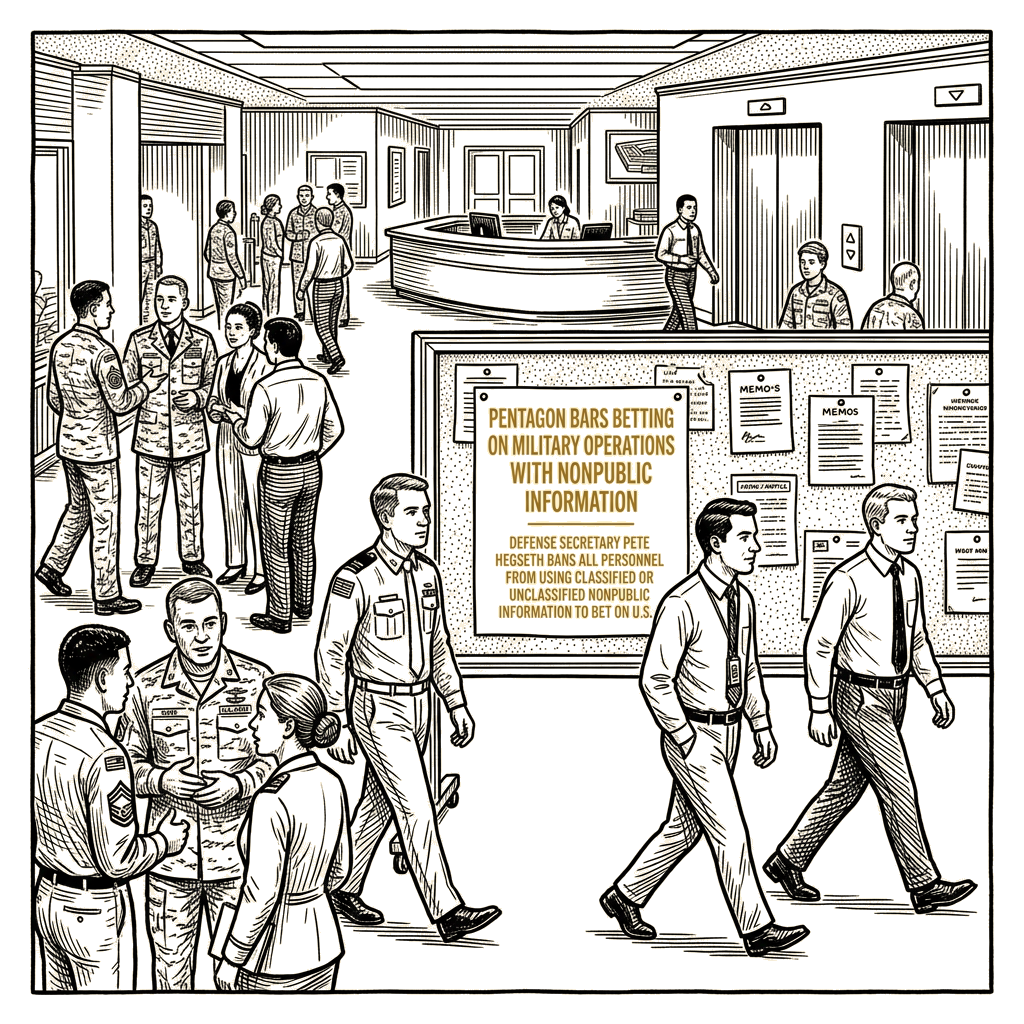
The memo sets a broad personnel and platform prohibition
Defense Secretary Pete Hegseth’s three-paragraph directive bars all Pentagon personnel from using classified or unclassified nonpublic information to bet on U.S. military operations. Dated Tuesday and obtained by CBS News, the memo applies the restriction to all financial platforms, including Polymarket and Kalshi, both prediction-market platforms. The ban carries the threat of administrative, disciplinary and possibly criminal action.
The memo covers the information whether it is classified or unclassified and extends the restriction to all financial platforms, not only the two prediction markets it names. The policy therefore reaches the use of nonpublic information rather than prohibiting every wager involving a military subject.
The Van Dyke indictment supplies the concrete context
In April, the Justice Department charged Gannon Ken Van Dyke with using classified information about the operation to make Polymarket bets. The report identifies Van Dyke as a U.S. Army Special Forces soldier who participated in the capture of Venezuelan leader Nicolas Maduro in January.
The indictment alleges that Van Dyke was involved in planning and executing the operation from about Dec. 8. It also alleges that he placed 13 bets valued at a combined $33,034 concerning U.S. military involvement in Venezuela in late December.
Federal prosecutors allege that Van Dyke profited $409,881 from his bets concerning the Jan. 3 military operation. The Justice Department’s case concerns the use of classified information for bets on a U.S. military operation, while Hegseth’s directive applies to all Pentagon personnel and all financial platforms.
Hegseth cites security, judgment and mission concerns
In the memo, Hegseth wrote: “Make no mistake why this matters. Our enemies watch movements in these markets. When an American service member, intelligence professional or other department civilian engages in a financial transaction on a military outcome, they create a signal. That signal can be aggregated, correlated and exploited by hostile foreign intelligence services to anticipate our movements, targets and timing.”
He tied that warning to the protection of service members: “The lives of our service members often depend on the enemy not knowing what is coming. The men and women who carry our flag into harm’s way deserve a force that protects them — not one that exposes them to the enemy for personal gain.”
Hegseth also said financial stakes in military operations could warp judgement. He illustrated the conflict with a logistician who bets on the date of a strike and would have an interest in that date. He said: “That is precisely the kind of dilution of the warrior ethos this department has strived to eradicate under this administration.”
The memo also presented betting as a distraction from the department’s mission. Hegseth wrote: “We are restoring lethality, discipline and singular focus on fighting and winning our nation’s wars, and nothing should distract us from that sacred mission. Not entertainment. Not a payout. Every member of this department will conduct themselves accordingly.”
Prediction markets have grown into broad wagering venues
United Press International reported that prediction markets such as Polymarket and Kalshi have surged in popularity in recent years. The report said users could make wagers on seemingly anything, from who will win the Super Bowl to when the war between Russia and Ukraine would end.