State election officials ready for worst-case scenarios including arrest
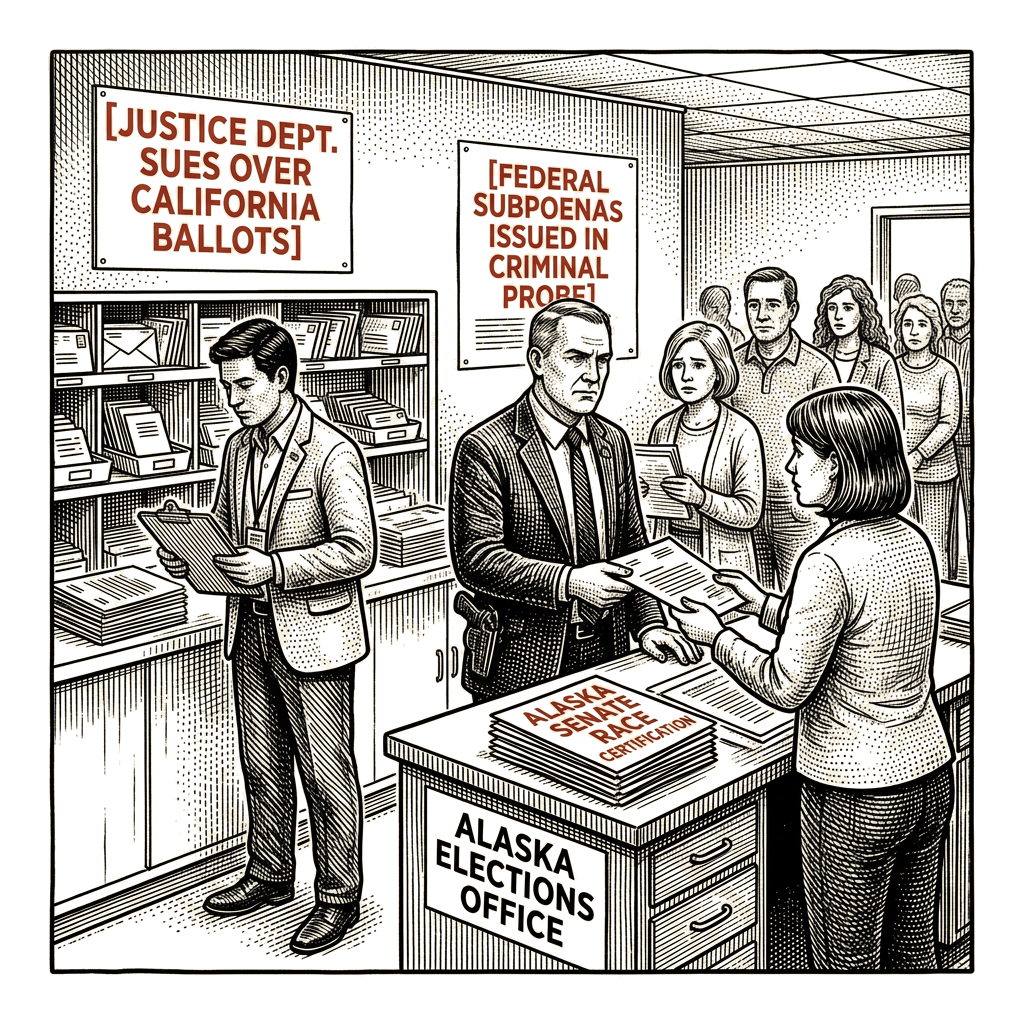
The Justice Department is suing over ballots in California and the certification of a key Alaska Senate race and has issued subpoenas in criminal probes in both states, before most votes in Tuesday’s midterms have been counted. State officials of both parties have been bracing for their electoral processes to come under scrutiny, after months of hostile interactions between the Trump administration and state officials over the procedures for how Americans vote.
In California, the Justice Department is pressing forward with its third attempt in recent days to force the state to set aside up to 20,000 ballots returned by people the administration says are “likely noncitizens.” On Thursday, top federal prosecutors sent subpoenas to state and local officials as part of a criminal probe into allegations of illegal voting, according to people familiar with the matter.
In Alaska, the department wants the courts to block the certification of a key Senate race if the Republican loses. It stepped up that effort Thursday, issuing new subpoenas as part of a criminal investigation and expanding its civil lawsuit seeking to delay certification of the results. The dispute centers on a state ballot that includes an independent Senate challenger with the same first and last name as Republican incumbent Sen. Dan S. Sullivan. The department has also pledged to sue Washington state if officials there don’t agree to take steps to prevent ballots from voters the administration says aren’t citizens.
The administration argues in court that while the Constitution empowers states to run elections, it does so subject to federal laws passed by Congress, which the executive branch is responsible for enforcing. “Some elections are decided by a handful of votes,” Bill Essayli, the top federal prosecutor in Los Angeles, said during the California ballot litigation Tuesday. “There’s an interest in the American public, your honor, having trust and confidence in their elections, and that when we get our election results, that the public will accept those results.”
Rejecting the administration’s request to put a hold on the state ballots, Judge David Carter said the federal government had never made such a demand of a state or local government on the eve of an election. “If the Executive can discount votes and threaten an ongoing election due to unproven allegations, then our democracy is in danger,” said Carter, an appointee of President Bill Clinton.
Across the country, state officials of both parties have vastly expanded the range of worst-case scenarios they plan for, going beyond traditional drills for events such as power outages, fires or armed militia near polling places. Election officials have repeatedly told the public that voting will run smoothly, fairly and transparently. Michigan Attorney General Dana Nessel, a Democrat, said lawyers from her department have drafted briefs “for virtually every set of circumstances we could think of, except the zombie apocalypse.” “If I was a betting woman, I would bet with my entire 401(k) that he’s going to try to interfere in Michigan,” Nessel said last month of President Trump.
Maryland’s state elections administrator said he ran a simulation earlier this year preparing for his own arrest. Jared DeMarinis met with 70 officials from around the state for contingency planning, and he asked them to consider what would happen if he is detained on Election Day. “Who would represent me in my official capacity for being arrested?…How do I get bail? This is not like your normal daily occurrence about your job,” DeMarinis said. “This one here, there is a possibility.”
Trump has said he would respect the midterm results if state elections are run fairly, a significant caveat for a president who in a prime-time address in July declared the U.S. election system “so broken and vulnerable that no one can possibly defend it.” If recent elections are any guide, there will likely be a flood of lawsuits filed by the Democratic and Republican parties, which have each readied legions of lawyers to go to court as needed.
Democratic National Committee Chair Ken Martin has reached out to donors in recent weeks asking them to help fund midterms-related litigation that may have to take place after Election Day, according to people familiar with the discussions. “The DNC is preparing to fight back against any attempts from Trump and Republicans to undermine free and fair elections,” a committee spokesperson said.
The Republican National Committee says it has recruited a record number of poll workers and mobilized volunteer lawyers, citing election integrity as a crucial issue for getting GOP supporters to turn out. “Confidence drives participation,” said Ally Triolo, the RNC’s election integrity communications director.
Acting Deputy Attorney General Trent McCotter said Thursday that the Justice Department this week intends to send letters to the chief election officials in every state telling them to retain all election-related records and papers for 22 months, as required by federal law. That can include voter registration forms, sign-in sheets, poll books, copies of identifying documents that are submitted and ballots themselves, he said. State officials have also received other letters from the department, including some threatening them with criminal prosecution if they “knowingly” allow noncitizens to vote.
The friction extends to election monitoring. Some states have weighed deploying their own observers to observe the observers, and voting groups have rushed to field volunteers. On Thursday, Colorado Secretary of State Jena Griswold, a Democrat, said she would only authorize Justice Department monitors to enter voting centers in Adams County if they were accompanied at all times by observers she had appointed. The department declined the offer, Griswold said, and pledged instead that monitors would remain outside polling places and not come within 100 feet of centers, in accordance with Colorado state law.