Panel cited Purcell precedent and disenfranchisement risk
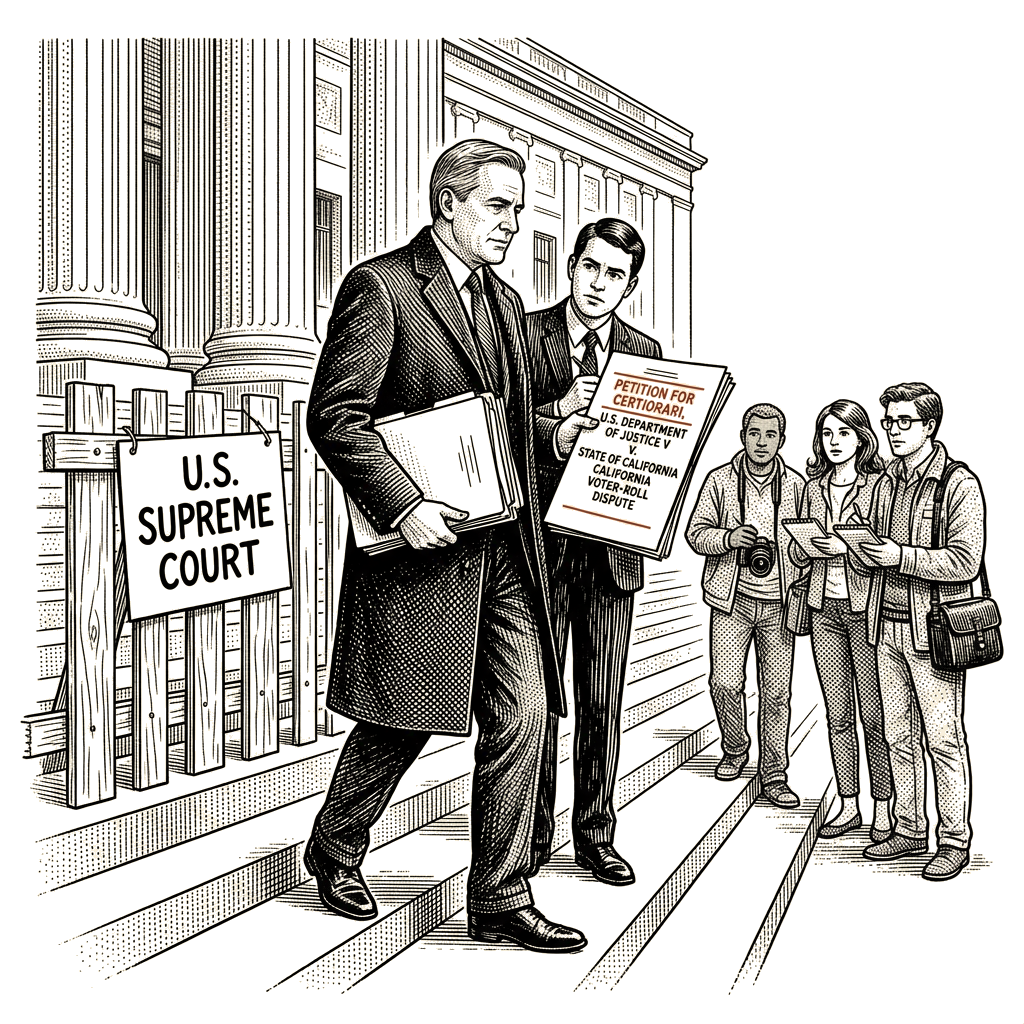
The Justice Department filed notice Monday that it plans to appeal to the U.S. Supreme Court in its dispute with California over voter rolls, with Election Day one day away. Its filing followed rulings by a federal district judge and a divided 9th Circuit Court of Appeals panel rejecting the department’s request for an order that would set aside and stop processing ballots tied to thousands of people. It remained unclear whether the Supreme Court would agree to intervene or act before Nov. 3.
The Justice Department’s request is to halt processing of ballots tied to the 20,000 people it says are “likely” noncitizens on California’s voter roll. The department says their ballots should not be counted until their citizenship can be verified.
The lower courts sided with arguments from California and Los Angeles County that the federal government’s list was unreliable and that creating a novel system to segregate ballots while voting was already underway was infeasible. The 9th Circuit ruling was divided: Judges Mark J. Bennett, a Trump appointee, and Gabriel P. Sanchez, a Biden appointee, rejected the emergency request, while the panel’s third judge, Patrick J. Bumatay, also a Trump appointee, dissented. In Friday’s decision, Bennett and Sanchez wrote: “[T]here is a material risk that granting the United States its requested relief would result in disenfranchisement and could jeopardize the County’s entire election.” The two judges cited the Purcell principle, longstanding precedent that election rules should not be altered on the eve of an election, and the Constitution’s allocation of authority to states to run elections. Their opinion also cited the National Voter Registration Act, which bars states from systematically removing ineligible voters within 90 days of a federal election. County election officials found that many people on the Justice Department’s list did not have active voter registrations and did not receive ballots by mail, making the actual number of ballots in dispute likely much smaller than 20,000.
Before the Supreme Court filing, the Justice Department took additional steps in its dispute with California election officials. In recent weeks, department officials warned local election officials they could be criminally prosecuted if they did not cooperate with federal demands to segregate ballots. Last week, the Justice Department sent grand jury subpoenas to employees at the Los Angeles County Registrar-Recorder’s office.
The Supreme Court’s decision on intervention, and any action before Nov. 3, remains unresolved. The Justice Department continues to seek an order halting the processing of ballots tied to people whose citizenship has not been verified, while the lower courts have rejected that request.