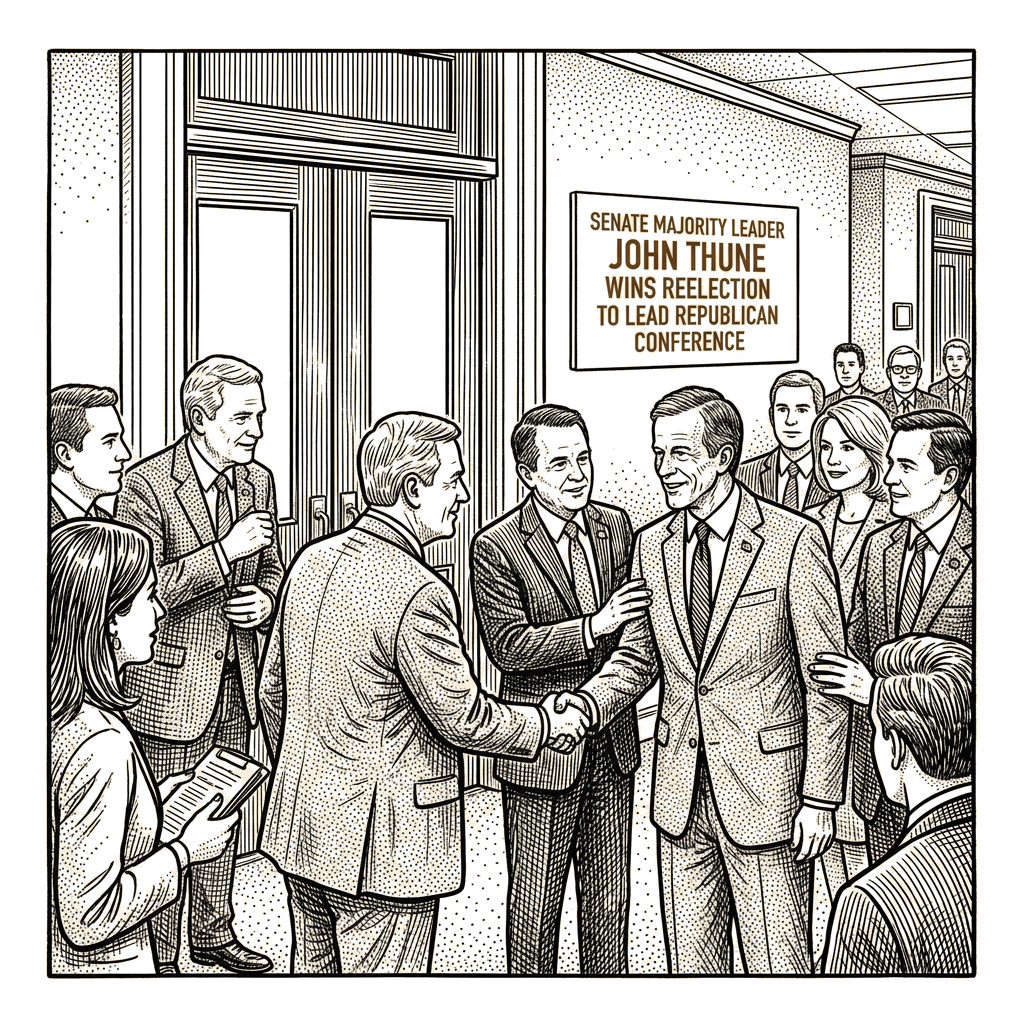
Thune begins planning for a Senate minority role
Senate Majority Leader John Thune, 65, won reelection Tuesday to lead the Senate Republican conference next year, according to The Wall Street Journal. Thune ran unopposed and was elected by acclamation after a pair of hourslong, closed-door meetings, despite calls from colleagues to delay the vote and reassess the party’s leadership after midterm losses.
Republicans entered the midterms with a 53-47 majority, but losses in the Midwest and South left them on track to lose as many as nine seats in the next Congress. The projected losses prompted some Republicans to call for an evaluation of the leadership team before the vote.
Sen. Ron Johnson of Wisconsin and a half-dozen other Republicans had argued that the party needed to conduct a self-evaluation before retaining the same leadership team, while acknowledging there was no alternative candidate. Johnson said, “That kind of defeat demands change,” referring to the midterms. But, he added, “That’s part of our problem: who would want the job?”
Sen. John Cornyn of Texas, who is leaving Congress after losing his Republican primary, questioned the value of waiting for another candidate. Cornyn said, “It’s hard to beat somebody with nobody,” as some Republicans continued to debate whether the leadership election should have been delayed.
Thune had also drawn criticism from President Trump for months because the Senate had not passed the sweeping SAVE America Act, a bill designed to tighten voting rules nationwide. The impasse created frustration among the GOP base, The Wall Street Journal reported. On Monday, Trump called Thune a “very fine man” but reiterated his disappointment that the Senate had not passed some Republican bills.
Ahead of the vote, Thune’s allies were working to turn the page and unify around him instead of reopening the political wounds from the party’s losses. Sen. John Boozman of Arkansas praised Thune’s performance, saying, “I think he’s done an excellent job.” Boozman said he did not blame Thune for the losses, even though they were bigger than expected, and added, “In fact, if anything, he raised a tremendous amount of money. Lots of it.”
The Senate Leadership Fund, a super PAC allied with Thune, and its affiliated group One Nation marked the largest independent expenditure effort in Republican history, with a budget of more than $800 million, according to Alex Latcham, the group’s executive director.
Thune has already begun turning to how to make the most of the remaining weeks before the new Congress. He has called Senate Minority Leader Chuck Schumer of New York to discuss working together, has made clear that he wants to make a priority of confirming Trump’s judicial nominees before the window closes on the Republican majority, and has begun thinking about how to approach his new role as Senate minority leader.
Thune told reporters late Monday night, “I think we have an opportunity in the next two years.” He continued, “It’s going to be different for sure than the last two years, but it’s time for us to pivot and to make it clear to the American people that we heard them and we intend to do a better job.”
The Senate Democratic leadership election will not take place until early December. Several newly elected Democrats said they would not vote for Schumer for majority leader, while people close to him said he already had the commitments he needed to win.
Thune’s reelection settled the Republican leadership choice but not the chamber’s eventual partisan balance. Republicans still face the prospect of losing as many as nine seats, while Democrats have not selected their own leaders and several newly elected Democrats have said they will not vote for Schumer as majority leader.
The Wall Street Journal report was written by Lindsay Wise and Siobhan Hughes. Wise, a reporter covering Congress at the Journal, previously worked as a Washington correspondent for the Kansas City Star and an investigative reporter for the Star and McClatchy newspapers. Before McClatchy, she reported for the Houston Chronicle’s metro desk on the night cops beat. She also covered Texas veterans and the military, traveling to Iraq for the Chronicle, and documented the stories of Houston’s Arab and Muslim refugee communities. She has a bachelor’s degree from the University of Virginia and a master’s degree in Modern Middle Eastern Studies from St. Antony’s College, Oxford. Between 2003 and 2006, she worked as a freelance journalist in Egypt.
Hughes, a reporter covering Congress in the Journal’s Washington bureau, joined the congressional team after the 2010 elections and has spent more than a decade tracking the growth of partisanship and political fragmentation in the United States. She has covered government shutdowns, two presidential impeachment trials, several Supreme Court nomination fights and the enactment of major tax, trade, stimulus and climate laws, and her coverage explores the intersection of policy, process and personality. Before joining the congressional team, she had an energy beat for Dow Jones Newswires and has also worked at Congressional Quarterly and Bloomberg News, beginning her career covering securities policy for Institutional Investor’s newsletter division.