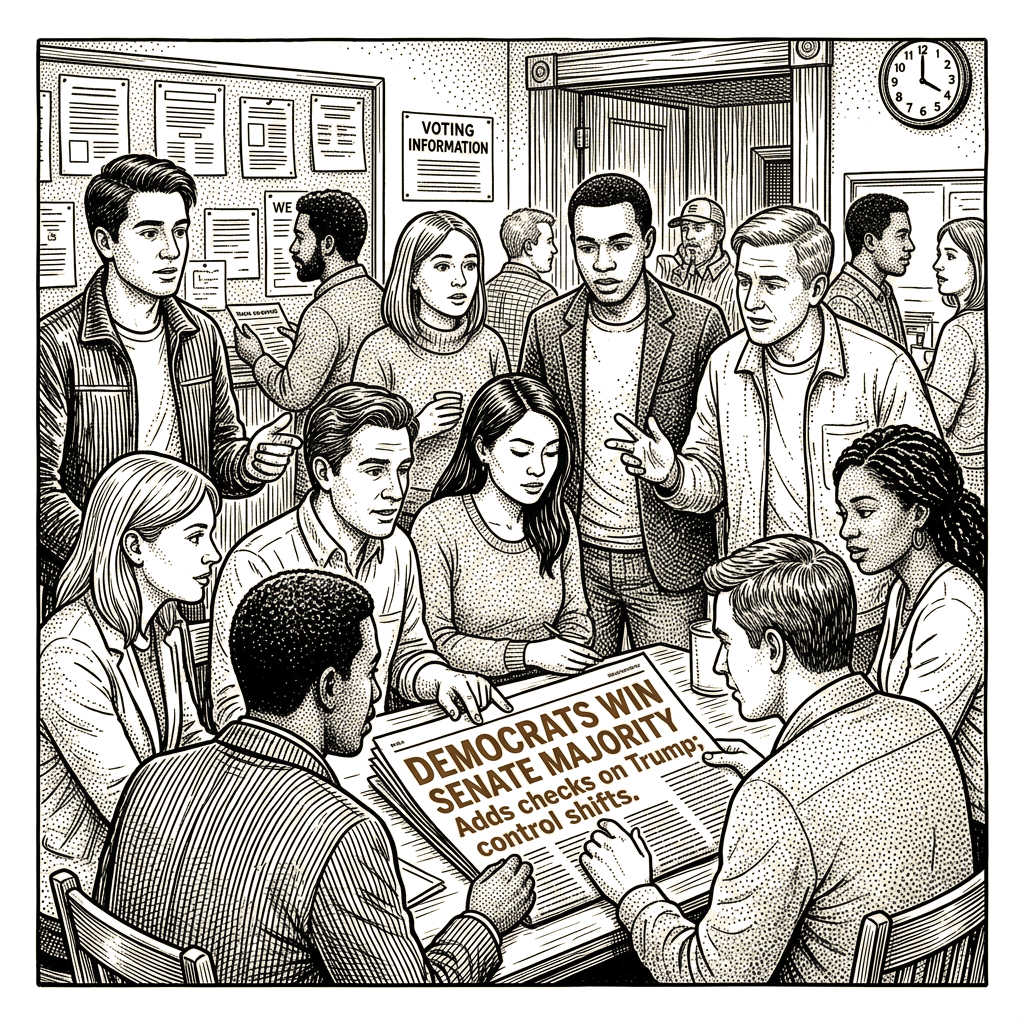
Control of the House remains too early to call
Democrats won a majority in the U.S. Senate on Nov. 3, 2026, according to an Associated Press tally of race calls, ending two years of unified Republican control in Washington. The result sets up a new period of divided government, while control of the House remains too early to call.
Democrats secured control after Josh Turek defeated Republican Rep. Ashley Hinson in Iowa, according to an Associated Press race call. The party needed to flip four Republican seats, and victories in North Carolina, South Carolina, Ohio, Texas, Kansas and Iowa gave Democrats control of the chamber.
The outcome reversed a Senate that Republicans entered the year controlling by 53-47, despite having little expectation that the majority was at risk. NPR reported that frustration over the cost of living forced Republicans to compete in several states President Trump won by double digits in 2024. Polls cited by NPR also found many voters upset about the war in Iran, Trump’s immigration agenda, his tariff policies and perceived corruption in government.
In the closing weeks, President Trump took to the campaign trail and urged Republican voters to pretend he was on the ballot. NPR said his approval ratings were hovering near historic lows and that the argument was not enough to preserve the GOP majority.
The Senate shift gives Democrats a new check on President Trump through Senate oversight and sets the stage for investigations that could dominate the remainder of Trump’s second term, NPR reported. Democrats have signaled an ambitious agenda that could include inquiries into the independence of agencies such as the Justice Department and Homeland Security and into the business interests of President Trump and his family.
The Senate majority does not remove the need for bipartisan votes on must-pass legislation. Democrats still have to work with Republicans on legislation including the 12 annual appropriations bills needed to fund the government. Democrats rode to victory promising that affordability would be a key focus, but NPR reported that many of their priorities were unlikely to become law while Trump remained in the White House.
President Trump said in a Pod Force One podcast interview published Monday that he would block Democratic legislation if Democrats took control of Congress. “I’ll become Mr. Veto,” Trump said, adding, “and then at some point we’ll probably make deals.”
The change also affects nominations. Senate Republicans have been key to securing votes for Trump’s Cabinet and judicial nominees, and more nominations were expected in the final two years of his presidency. A Democratic majority now gives the party control over which nominees will receive floor votes.
The loss of the majority is a setback for Senate Majority Leader John Thune, R-S.D., who said in a September floor speech that “hard-working Americans would undoubtedly take a back seat” under a Democratic-led Congress. Thune is largely expected to remain the top Senate Republican when the new Congress convenes in January.
NPR reported that the Democrats’ victory represents a vindication for Minority Leader Chuck Schumer, D-N.Y., who faced criticism from some progressives early in Trump’s second term because they thought he was not doing enough to stand up to the president. In an October floor speech, Schumer said Democrats were ready to challenge President Trump and Republicans’ agenda: “We are ready to hit the ground running to lower costs, rein in chaos and stop the corruption.” He added, “Republicans broke faith with the American people. We know we need to build that trust with the Americans back up, and we will.”
The Senate result settles the chamber’s party control but leaves the full congressional balance after the midterms unsettled. Democrats gain leverage over oversight and nominations, while must-pass legislation still requires Republican votes.