Club for Growth’s McIntosh says keeping the Senate will determine Thune’s future
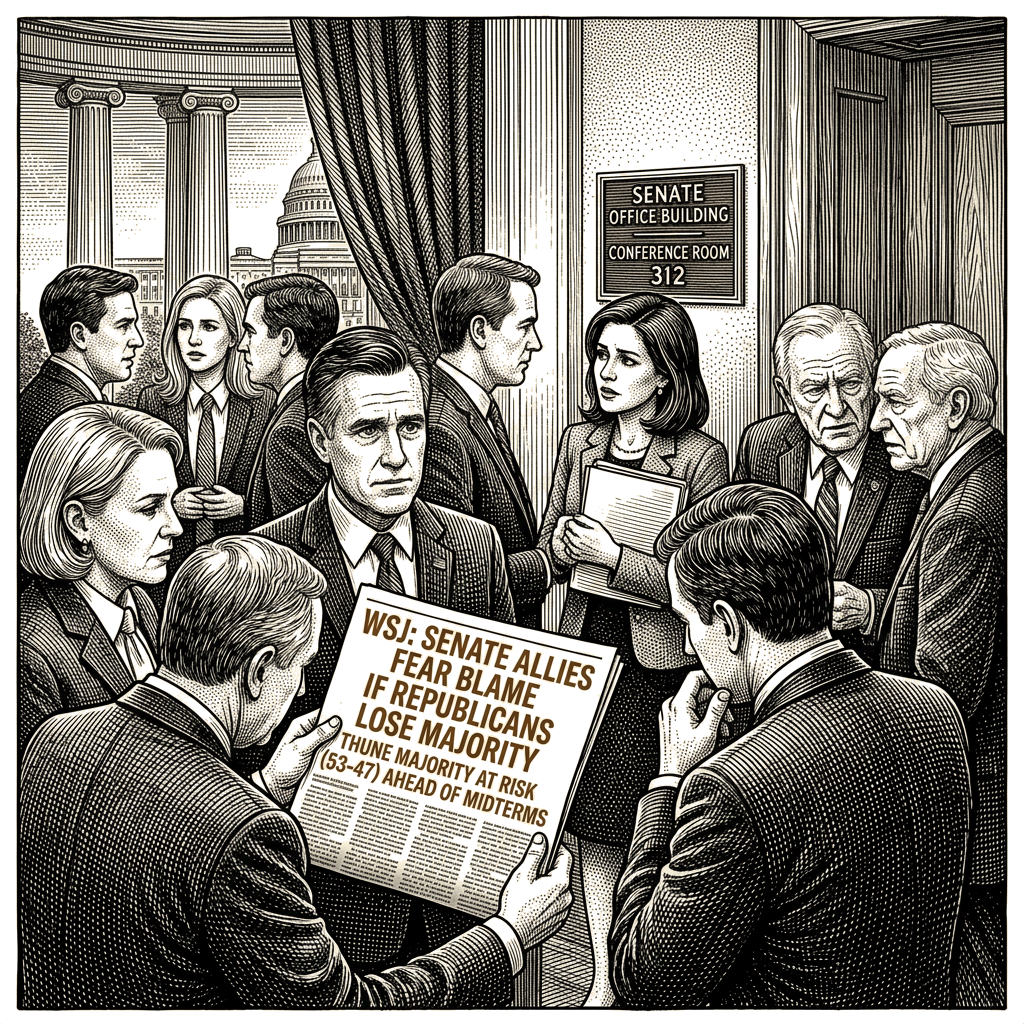
Some allies of Senate Majority Leader John Thune fear he could take blame from President Trump and others if Republicans lose their 53-47 Senate majority in the midterms, The Wall Street Journal reported. Republicans currently hold a 53-47 edge, but Democrats are seen as having a good shot to flip the chamber. Club for Growth president David McIntosh said, “I think his future will be determined by whether or not we keep the Senate,” citing frustration among GOP activists, particularly over the stalling of the SAVE America Act.
Thune has indicated he will run for Senate Republican leader in the next Congress whether Republicans keep or lose the Senate. Spokesman Ryan Wrasse said Thune “is running to be Senate Republican leader in the 120th Congress, and there’s no ambiguity about it.” Less than two years after taking over as the top Senate Republican from Sen. Mitch McConnell (R., Ky.), Thune is expected to have broad support when GOP colleagues choose a leader after the midterms, and no candidate has announced a challenge. But some Republicans aligned with Thune are stopping short of saying he has a lock on the top spot, and some suggest the job could prove hard or unappealing if the party loses its majority.
Rep. Andy Barr (R., Ky.), set to win an open Senate seat this fall, said, “He’s doing a great job,” and added, “I have confidence that he will continue to be majority leader.” Barr also said, “there’s a lot of ambition in the Senate—I’m not going to predict that there’s not going to be a competition” if Republicans lose the majority.
President Trump’s pressure on Thune to pass the SAVE America Act had reached such intensity in prairie towns back home that South Dakota GOP chairman Jim Eschenbaum said he told Thune, “You’ve got to advocate harder.” Eschenbaum described how he pushed the leader to get colleagues to approve the measure to force stricter checks on voting eligibility. Thune replied, “I’m only one vote—I can’t force them to vote for it,” Eschenbaum recalled. Thune, 65, took heat for months from Trump for not passing the sweeping voting bill, stirring frustration among the GOP base.
Trump has called the SAVE America Act, which would require proof of citizenship to register to vote, among other measures, critical for winning the midterms and future elections. He publicly pressed Thune to find a way to pass it, stirring grassroots agitation, but eased his public pressure as the midterms drew near. When Republicans booed Thune’s name at the midterm convention in Dallas in September, Trump defended him as “working hard” amid Democratic opposition. The president also gave Thune and his family a tour of his new helipad in a meeting described by people familiar with it as warm.
Thune’s allies say decisions by Trump lie at the center of the GOP’s challenges. They cite high gasoline and diesel prices because of the U.S. war with Iran, along with tariffs, as factors putting many red-leaning states in play. The report also said Trump endorsed some GOP candidates seen as flawed, including Texas Attorney General Ken Paxton and Georgia Rep. Mike Collins. Sen. John Cornyn (R., Texas), who lost his primary after Trump backed Paxton, said of the White House, “I can guarantee you that they won’t accept responsibility themselves,” when asked whether it would blame Thune or whether Trump would acknowledge his own role in Senate losses.
Asked earlier this year whether he worried the president might try to oust him, Thune said, “that could happen.” Asked whether Trump might shift blame toward him, Thune said in August, “You never assume anything with the president.” Asked last month if he expected a leadership challenge after the election, he laughed and said, “I don’t know.”
Thune appeared alongside candidates in Nebraska and Iowa last week and helped raise hundreds of millions of dollars for the Thune-aligned super PAC, Senate Leadership Fund, to deploy in advertisements nationwide. Sen. Mike Rounds (R., S.D.), who said he had talked with Thune many times during the recess, said Thune “still got the fire in his belly. He still wants to make things happen.”
Ahead of the election, some Republicans said Thune had not given them enough chances to show they were fighting to bring down costs. Inside the Republican conference, some senators complained when Thune sidelined votes on affordability measures ahead of the election. In the final weeks of the session, he prioritized floor time for cryptocurrency and college-sports bills. He did hold a vote related to electricity costs and data centers, but other bills were left out. Sen. Susan Collins (R., Maine), described as one of the most vulnerable Republicans, did not get a vote on her proposal to cap insulin costs for people with private insurance.
Sen. John Kennedy (R., La.) said Thune brought up the data-center legislation only because “a lot of us raised fresh hell.” Sen. Rick Scott (R., Fla.) said the chamber “ought to be voting on things. One—people care about election security. Number two—they care about how do you get the cost of living down.” Scott ran against Thune for leader in 2024 but said he does not plan to do so again this year. Thune said he could not meet everyone’s needs and suggested some ideas were not practical. Recently, Trump unsuccessfully pushed Thune to bring the Senate back into session to pass a year-round daylight-saving-time bill, according to people familiar with the matter.
Thune’s allies say he was able to deliver on Republican priorities such as spending reductions and tax cuts. They also say he tried to pass the SAVE America Act, but the math did not work: Thune lacked the 60 votes needed to advance the bill and the 51 votes needed to change Senate rules. White House spokesman Davis Ingle said the White House and president “have enjoyed working closely” with Thune to deliver on promises to the American people. Ingle added, “We look forward to continuing this close relationship.”
Thune has maintained a tight circle back home, where he goes almost every weekend. Over the summer recess, he detailed provisions he had put into the farm bill to help ranchers and soybean growers and interacted on a first-name basis with the jeans-clad visitors who came to Dakotafest, the annual farm conference. Paul TenHaken, the former mayor of Sioux Falls, said Thune can be seen at a local gun store buying shells for pheasant hunting or meeting friends for cheeseballs or burgers at a local sports bar. “He is doing this job because he feels called to do this job at this time in our country,” TenHaken said.
Pressures could build, Eschenbaum said, predicting that there would be a primary challenge when Thune was up for reelection in 2028 and that it could succeed. “If enough people start working to oust someone, they’ll get him ousted. It’s just a matter of how hard people are willing to work,” he said. Eschenbaum said activist Scott Presler, a prominent proponent of the SAVE America Act, told him he could get the money to fund a primary challenge. Presler did not respond to requests for comment. Elon Musk is a major donor to Presler’s super PAC, which focuses on GOP voter turnout, and Musk’s America PAC gave $1 million last month. Musk could not be reached to comment. Alex Latcham, executive director of the Thune-aligned Senate Leadership Fund, called Presler “not a serious factor in Republican politics.”
Thune has wrestled with his political future in the past. He lost his first run for Senate in 2002 and again in 2022 after Trump urged then-South Dakota Gov. Kristi Noem to run against him. Noem declined, and Thune won reelection easily. Dick Wadhams, who managed Thune’s 2004 win over then-Senate Minority Leader Tom Daschle (D., S.D.), said, “I think he could walk away from the Senate if he just decided it wasn’t fun anymore.” He added: “But I also know that he has got that competitive side to him. I think that’s something he is going to have to work through.”