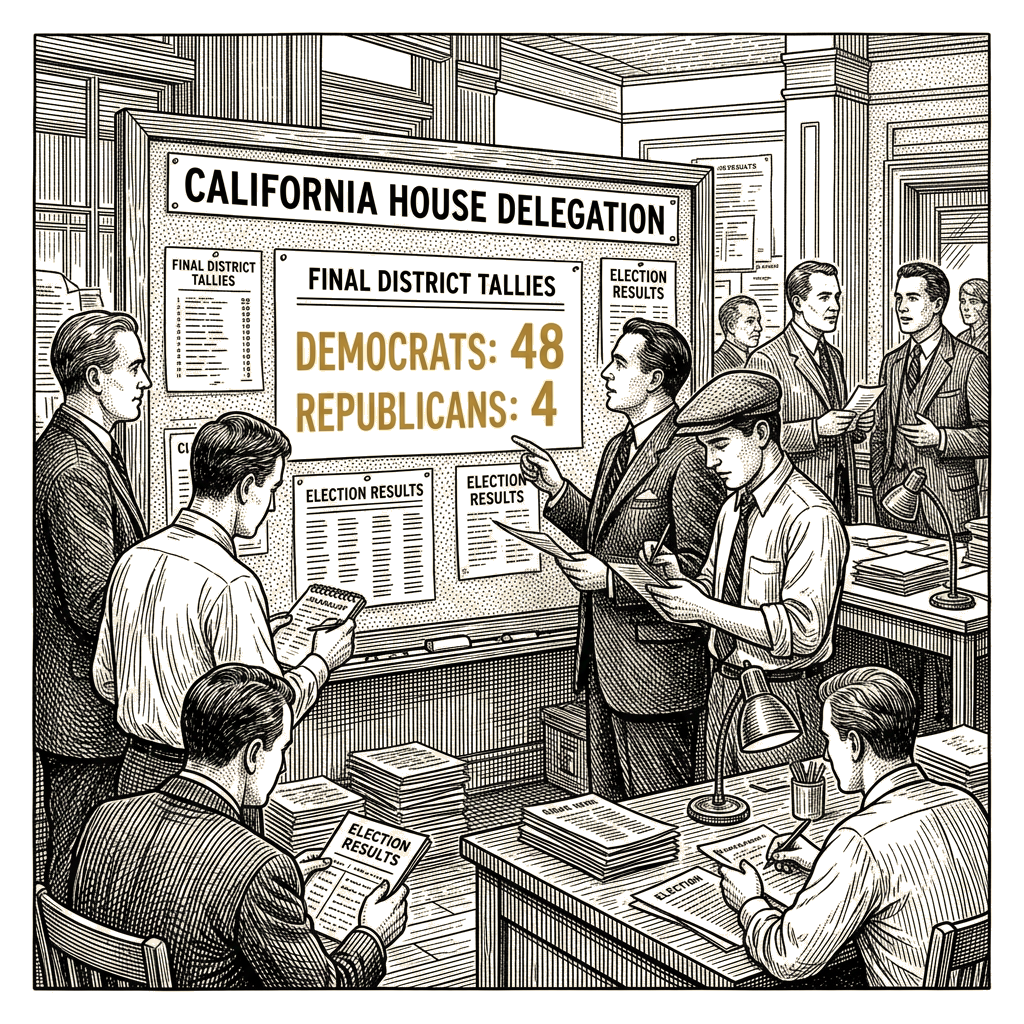
Five key races reshaped the delegation; Democrats’ internal contest produced mixed results
California’s congressional lineup is set at 48 Democrats and four Republicans after the state’s remaining 2026 House races were settled. Republicans lost five incumbent seats and now appear to have their smallest California delegation since 1937, when the party also held four U.S. House seats.
News From The States described the national midterms as a Democratic blue wave and said five California Republicans were among those defeated. The outlet attributed much of the Republican setback to Proposition 50, Democratic Gov. Gavin Newsom’s plan to fight the ultimately unsuccessful GOP moves to gerrymander red states.
The Associated Press on Monday evening called the state’s final congressional race, an unexpectedly close contest for Republican incumbent Rep. Jay Obernolte of Big Bear Lake, one of the state’s few remaining Republicans. Obernolte will return to Washington, D.C. next year with fellow GOP survivors Rep. Tom McClintock of Elk Grove, Rep. Ken Calvert of Corona and Rep. Vince Fong of Bakersfield.
California Democrats also faced an internal midterm power struggle between progressives and moderates, and News From The States described the results as mixed. Some progressive challengers outperformed expectations and toppled establishment incumbents by large margins, while moderates prevailed in other districts. Five key races illustrated the changes.
In Bakersfield, Democratic newcomer Randy Villegas decisively routed Republican incumbent Rep. David Valadao, a farmer from Hanford, by more than 35 percentage points. A progressive endorsed by Sen. Bernie Sanders and Rep. Alexandria Ocasio Cortez, Villegas won in the heavily Latino district stretching down the San Joaquin Valley from Fresno to Bakersfield.
Valadao had consistently evaded attempts to unseat him, apart from a 2018 midterm loss following President Donald Trump’s first two years in office, by pitching himself as a “moderate and independent thinker,” News From The States said.
News From The States also reported that Democratic Socialists of America member Angela Gonzalez-Torres unseated Democratic incumbent Rep. Jimmy Gomez by a margin of more than 24%. Her Los Angeles district stretches from Koreatown through Boyle Heights to East L.A.
The Sacramento-area race was a Democratic “battle of the ages” between Sacramento City Councilmember Mai Vang, 41, and Rep. Doris Matsui, 82. News From The States called it the most disappointing loss for progressives. Matsui faced her first-ever challenge from a sitting public official who had the resources to run a well-funded campaign, loaned her campaign $7 million and defeated Vang with help from Republican and unaffiliated voters.
In another Democrat-on-Democrat battle in Northern California, political neophyte Eric Jones largely self-funded a multimillion-dollar campaign to unseat incumbent Rep. Mike Thompson, a nearly 30-year veteran of Congress. Jones made his fortune with the venture capital firm Dragoneer Investment Group, which he co-founded, and advanced from the primary by running to Thompson’s left as a progressive challenger. Justice Democrats, the liberal, Sanders-aligned group, endorsed him.
Jones won the general election by pivoting to the center and, with support from a super PAC mostly funded by Dragoneer investors and partners, persuaded some Republicans and nonaffiliated voters to take a chance on him. News From The States said several advertisements funded by the super PAC, known as New Leadership Now, employed inflammatory anti-immigrant rhetoric to portray Thompson as “soft on illegal criminals” and “a liberal Democrat” who “supports sanctuary cities.”
In San Francisco, state Sen. Scott Wiener will succeed former House Speaker Nancy Pelosi after defeating Pelosi’s chosen candidate, San Francisco Supervisor Connie Chan. News From The States described Wiener as one of the Legislature’s most progressive members and said he was portrayed as a moderate by San Francisco’s ultra-liberal progressives, especially after artificial intelligence giant Anthropic channeled money toward pro-Wiener ads. The outlet said Wiener had led in polls consistently since the June primary, despite Pelosi’s campaign for Chan.
Wiener defeated progressive tech millionaire Saikat Chakrabarti in the primary. Chakrabarti failed to advance after running a self-funded campaign that News From The States described as carrying the same insurgent energy promoted by national progressives.
California’s four Republicans will return to Washington next year in what appears to be the state’s smallest GOP delegation since 1937, when the party also held four U.S. House seats. The outlet noted that 90 years ago California had only 20 U.S. House seats.